
WinningHunter Review 2026: Pricing, Features, Pros, Cons, and Is It Worth It?

If you are trying to find winning dropshipping products faster, validate product demand with more confidence, and reduce wasted testing budget, WinningHunter is one of the more ambitious tools in this space. Instead of acting like a simple ad spy database, it positions itself as an all-in-one ecommerce research platform that combines Facebook ad spying, TikTok ad spying, store tracking, revenue insights, AI-powered reverse search, trend discovery, and supporting tools for product validation.

That broader positioning is exactly why WinningHunter keeps showing up in conversations about product research, dropshipping research tools, and ecommerce competitor tracking. Many sellers do not just want more ads to look at. They want a tool that helps them answer a more practical set of business questions: Is this product already scaling? Are multiple stores selling it? Does it still look early enough to test? Can I study the winning angle before I build my own offer? Does the margin still make sense after ad costs?

This review looks at WinningHunter from that real-world perspective. Instead of judging it like a flashy dashboard demo, this article breaks down what the tool actually helps you do, where it genuinely saves time, where you still need to be careful, which plan makes the most sense, and whether it is worth paying for if your goal is to find and validate products more efficiently.
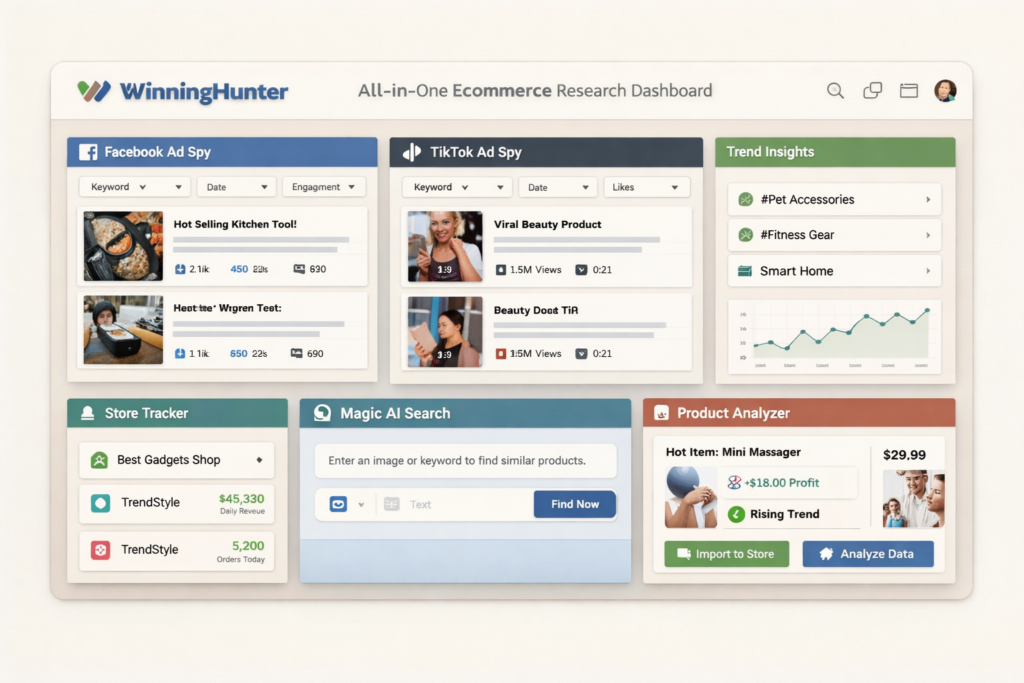
WinningHunter-inspired all-in-one ecommerce research dashboard showing Facebook ad spy, TikTok ad spy, store tracking, Magic AI search, and product validation workflow in a clean interface

Quick Answer: Is WinningHunter Worth It?

Yes, WinningHunter can be worth it if you actively test products, study competitor ads, and want a faster workflow from product discovery to product validation. Its biggest advantage is not just that it shows ads. Its real strength is that it combines ad research, store tracking, AI reverse search, and trend analysis in one place. That can make your research process faster, more structured, and more useful than manually piecing together insights from separate free tools.

However, WinningHunter is not magic. It can help you narrow the field, spot promising angles, and reduce random guessing, but it still does not replace judgment. You still need to think about offer quality, creative strategy, landing page strength, market timing, and profit margin. It is best used as a decision-support tool, not as an automatic “winner finder.”

CategoryVerdict
Best forDropshippers, ecommerce marketers, and product researchers who want ad spying and store validation in one workflow
Biggest strengthCombines ad discovery, store tracking, AI reverse search, and trend research
Main weaknessLower plans are more limited, and store/revenue data should be used directionally rather than blindly
Best plan for most usersStandard
Good for beginners?Yes, but only if they are willing to learn a real research process
Overall takeawayA strong research tool if you are serious about validating products before spending on ads

What Is WinningHunter?

WinningHunter is a product research and competitor intelligence platform built for ecommerce sellers, especially dropshippers who rely on paid ads and fast-moving product testing. At its core, the platform is designed to help users identify promising products, analyze competitor ads, track Shopify stores, estimate product demand, and discover trends earlier than they could by using only native ad libraries.

The reason WinningHunter gets more attention than many basic spy tools is that it tries to solve several problems inside one environment. A traditional ad spy tool might help you discover creatives, but it often stops there. WinningHunter goes further by trying to connect ads, store behavior, revenue signals, reverse search, and research workflow tools into one research stack. That is a much stronger pitch for sellers who do not want to jump between multiple subscriptions just to evaluate one product idea properly.

Put simply, WinningHunter is not really trying to be “just another Facebook ad spy tool.” It is trying to be the central research hub for finding, validating, and planning product tests. Whether it fully lives up to that promise depends on your workflow, your expectations, and how intelligently you use the data, but that is clearly the direction of the product.

Why WinningHunter Stands Out in a Crowded Market

There are many tools that promise to help you find winning products. The problem is that a lot of them only improve one narrow part of the process. You might get a list of ads, but no good way to validate whether the product is still scaling. You might get a store tracker, but no convenient way to trace winning creatives back to the stores behind them. You might get a trends tool, but no practical path from trend spotting to creative research and competitor analysis.

WinningHunter is more compelling because it compresses those steps. It is built around a tighter research loop:

  • Find ads that look commercially promising
  • Study how long they have been running and how they are scaling
  • Trace the product or creative back to actual stores
  • Check store-level activity and revenue signals
  • Use AI reverse search to uncover similar competitors
  • Monitor trend momentum
  • Estimate acquisition targets and margin feasibility

That type of workflow is useful because product research is not really about finding more products. It is about filtering bad ideas earlier and moving stronger ideas toward testing faster. The more wasted tests you avoid, the more valuable a research tool becomes.

Another reason WinningHunter stands out is that it presents itself as beginner friendly without only targeting beginners. In practice, that is important. Many research tools are either too stripped down to be useful for serious operators or too complex for newer sellers to use effectively. WinningHunter seems to be aiming for a middle ground: broad enough to support more advanced workflows, but still structured around recognizable tasks like ad discovery, store tracking, and product validation.

According to the company, its database is also large and frequently refreshed, with 500k+ Facebook ads, 100k+ TikTok ads, and 20k+ Pinterest ads added to the library daily, plus 5k+ new stores being tracked daily. If those numbers reflect the platform’s real operating scale, that gives WinningHunter a strong freshness advantage for people researching fast-moving product trends rather than evergreen categories only.

WinningHunter-style workflow interface showing ad discovery, competitor store research, trend analysis, and product validation in a structured ecommerce research process

Core WinningHunter Features Explained

FeatureWhat it doesWhy it matters
Facebook AdSpySearches and filters Facebook ads by spend, media type, creation date, performance, and moreHelps you find ads with stronger commercial signals instead of random inspiration
TikTok Spy ToolAnalyzes trending TikTok ads and supports filters for targeted researchUseful for catching short-form creative trends earlier
Sales TrackerShows sales-related store insights and daily revenue/ad spend referencesHelps validate whether a store or product appears to be moving
Shopify Store Revenue TrackerProvides revenue-oriented competitor insightsUseful for product validation, spotting growth, and refining strategy
Magic AI Reverse SearchLets you reverse search creatives or product images to find competitorsConnects ad discovery with store-level competitor intelligence
Exploding TrendsHighlights emerging product or niche trendsHelps you avoid entering too late
Product ImportingSupports direct product importing to your storeSaves time once you move from research to execution
Target CPA CalculatorCalculates acquisition targets based on price, COGS, and desired profitAdds a profitability filter to product research

1. Facebook AdSpy

WinningHunter’s Facebook AdSpy is one of the platform’s strongest foundations. Instead of forcing you to manually browse a massive ad library without much structure, it is designed to help you narrow the field using filters such as ad spend, ad set amount, media type, creation date, product creation date, and performance. That matters because serious product research depends on signal quality, not just ad volume.

In practical terms, this means you can spend less time scrolling through weak or irrelevant creatives and more time focusing on ads that show signs of traction. For product researchers, the difference between a tool that merely displays ads and a tool that helps prioritize ads is enormous. Better filtering makes the research process more actionable.

2. TikTok Spy Tool

TikTok is now one of the most important places to spot product momentum early, especially for visually demonstrable or impulse-friendly products. WinningHunter’s TikTok Spy Tool is built around this reality. It is positioned to help users analyze trending ads globally, discover high-converting products faster, and filter ads by spend, engagement, and performance.

For many dropshippers, this is not a side feature. It is a critical research layer. Some products show their strongest early signals on short-form platforms before they appear saturated elsewhere. If your workflow depends on catching products during that earlier part of the curve, the TikTok research side of WinningHunter may be one of the platform’s most valuable elements.

3. Sales Tracker

The Sales Tracker is one of the reasons WinningHunter feels more useful than a simple inspiration tool. Ads alone can tell you what is being promoted. They do not automatically tell you whether the underlying store or product is performing well enough to deserve attention. A sales tracker helps bridge that gap by adding validation signals beyond the creative itself.

This is especially helpful when a product looks exciting on the surface but may only be getting attention without producing consistent demand. A strong research workflow should reduce emotional decision-making and replace it with layered validation. The Sales Tracker helps move WinningHunter in that direction.

4. Shopify Store Revenue Tracker

The Shopify Store Revenue Tracker adds another important layer by shifting the focus from individual creatives to broader competitor performance. Instead of only asking whether a creative is interesting, you can ask whether the surrounding store behavior suggests a healthier business case. This matters because a product can look flashy in ads while still being weak at the store level.

WinningHunter presents this feature as a way to validate product demand, identify revenue spikes, spot emerging trends, and refine pricing or marketing strategy. For users who care about making fewer low-quality tests, that kind of broader view is useful because it reduces overreliance on single-ad impressions.

5. Magic AI Reverse Search

Magic AI Reverse Search is arguably one of WinningHunter’s most differentiated features. Instead of only searching by keyword or browsing catalog-style results, this feature is designed to let you reverse search competitor ads and product images to find similar stores and better understand what is already working in the market.

This is valuable because it shortens one of the most time-consuming parts of research: connecting a piece of creative inspiration to the competitor ecosystem around it. If you can take an ad or product image and quickly map it to relevant stores, you get more context, faster. That usually leads to better testing decisions.

6. Exploding Trends

WinningHunter’s Exploding Trends feature is aimed at one of the most important questions in ecommerce: am I early, on time, or already too late? Trend research is rarely useful when it only tells you what is already obvious. It becomes useful when it helps you identify rising interest before the market feels overcrowded.

That is the promise here. The trends feature is framed around real-time data, growth analysis, and competitor context. If used well, it can help you stop treating product research like random treasure hunting and start thinking more in terms of timing, momentum, and decision quality.

7. Product Importing and Supporting Tools

WinningHunter also includes smaller but still useful workflow features. The platform highlights product importing, which can help move a product from research to store setup more quickly. It also mentions the ability to remove TikTok watermarks and download videos for ads directly from the platform. These features are not the main reason to subscribe, but they make the system more complete.

That matters because good tools do not only help you research. They also reduce friction between research and execution. Even small workflow improvements can add up if you test often.

WinningHunter-inspired feature overview dashboard combining Facebook AdSpy, TikTok Spy, store revenue tracking, Magic AI reverse search, trends, and product importing tools

How WinningHunter Fits Into a Real Product Research Workflow

A lot of reviews stop at listing features. That is not enough. The more useful question is how WinningHunter actually fits into the day-to-day process of finding, filtering, and validating products.

StepHow WinningHunter helpsWhat you should look for
1. DiscoveryUse Facebook and TikTok ad spy toolsAds that are scaling, running longer, or repeatedly show strong signals
2. ValidationCheck store tracking and revenue toolsWhether the product appears to be moving beyond one flashy creative
3. Competitor mappingUse Magic AI reverse searchSimilar stores, overlapping offers, creative angles, and niche crowding
4. Timing checkUse trends toolsWhether the niche still looks early enough to test
5. Profitability checkUse Target CPA calculatorWhether your pricing and ad economics can still work
6. ExecutionUse importing and workflow toolsMove faster without rebuilding everything manually

This type of workflow is where WinningHunter makes the strongest case for itself. If you only use one feature and ignore the rest, you may feel like the tool is expensive. If you use it as a structured research stack, the value proposition becomes much stronger because you are not paying only for visibility. You are paying for better filtering and faster decision-making.

WinningHunter Pricing

WinningHunter currently offers three main plans: Basic, Standard, and Premium. The platform also offers monthly, quarterly, and annual billing options, with lower effective monthly costs on longer commitments. For most users, the Standard plan looks like the real sweet spot because it is where the tool starts feeling like a true all-in-one research environment rather than a restricted starter version.

PlanMonthlyQuarterly (effective monthly)Annually (effective monthly)Best for
Basic$49/mo$42/mo$30/moBeginners who mainly want core access and lighter research
Standard$79/mo$68/mo$49/moMost active dropshippers and product researchers
Premium$249/mo$212/mo$150/moHeavy users, teams, or advanced operators who want deeper tracking

The main reason Standard stands out is feature depth. It includes broader dashboard filters, TikTok ads, Pinterest ads, trends, Magic AI search, and tracking for 50 stores. Basic is workable for entry-level usage, but it looks more like a limited research starter tier. Premium is clearly designed for users who need much more tracking depth and are willing to pay for scale and higher-touch support.

PlanIncluded highlights
BasicFull dashboard access, Facebook Ads, Meta Advertisers, limited filters, track 25 stores, Magic AI search, 5 Premium Shops Explorer credits, 24/7 customer service
StandardEverything most serious users need: Facebook Ads, Meta Advertisers, Pinterest Ads, TikTok Ads, all dashboard filters, track 50 stores, Magic AI search, Trends, 10 Premium Shops Explorer credits, 24/7 customer service
PremiumTrack 500 stores, unlimited Premium Shops Explorer credits, weekly private 1-on-1 call, 24/7 live chat customer service, plus broader high-end access

Which WinningHunter Plan Should You Choose?

If this sounds like you…Best planWhy
I am brand new and want to explore the platform carefullyBasicLowest full paid entry point and enough for initial research habits
I test products regularly and want a serious research workflowStandardBest balance of price, filters, tracking depth, and feature completeness
I run a more advanced operation or want deeper tracking across many storesPremiumMuch larger tracking allowance and extra support for heavy usage

For most readers searching for a WinningHunter review, Standard is the most rational choice. It is the plan where the platform’s broader value proposition becomes fully visible. If you are only using Basic, you may not experience the product the way it is really meant to be used.

WinningHunter Pros and Cons

ProsCons
Combines ad spying, store tracking, reverse search, and trends in one platformCan feel expensive if you only use one feature occasionally
More complete validation workflow than many single-purpose spy toolsBasic plan is noticeably more limited
Useful for both Meta and TikTok product researchRevenue data should not be treated like accounting-grade truth
Magic AI reverse search adds a practical research advantageYou still need judgment; the tool does not choose winners for you
Includes margin-oriented support through the Target CPA calculatorSome users may overestimate what the sales tracker can reliably prove

Who Should Use WinningHunter?

WinningHunter is a better fit for some ecommerce users than others. The platform is most compelling when it saves you money by reducing bad tests or speeding up good research. If your business model does not depend on that, the value becomes less obvious.

Best fitWhy it fits
Dropshippers testing products weeklyYou benefit most from faster validation and more structured research
Ecommerce marketers studying competitorsYou get ad-level and store-level context in one place
Product researchers who want a repeatable systemThe tool helps connect discovery, validation, and timing
Small teams or agenciesHigher plans can support broader store tracking and more research depth
Probably not ideal forWhy
People who only want a free ad library replacementWinningHunter’s value is in the full stack, not in mimicking one free tool
Casual beginners who are not ready to test products seriouslyYou may underuse the platform and not justify the subscription
Sellers who do not rely on competitor researchMany of the strongest features may not matter enough to you
WinningHunter-style ecommerce research workspace focused on product validation, competitor ad analysis, store tracking, and market trend discovery for dropshippers

The Most Important Warning: How Accurate Is WinningHunter’s Sales Tracker?

This is one of the most important sections in the entire review because it separates realistic expectations from blind hype.

WinningHunter’s own sales tracker explanation makes it clear that users should not interpret the tracking data as flawless truth. The company says stores doing under $30k per month are not accurate and recommends ignoring them for serious analysis. It also frames the sales tracker as a tool for learning about bigger stores, especially those doing around $100k per month and up. Elsewhere, the company explains that sales data is more than 70% accurate for certain store ranges, while revenue can be less accurate because AOV can vary significantly due to discounts, bundles, and promotions.

That honesty actually improves the product’s credibility. It tells you how the tool should be used: as a directional validation layer rather than as a perfect measurement system. If you treat the tracker as a way to confirm broader patterns, compare stores, and spot stronger signals, it can be highly useful. If you treat every number like audited truth, you will probably misuse it.

So the right mindset is this: WinningHunter helps reduce guesswork, but it does not eliminate uncertainty. Use the numbers to guide research, not to replace thinking.

How to Get Better Results From WinningHunter

Buying a research tool does not automatically improve product selection. The people who get the best return from WinningHunter are the ones who use it methodically. Here are the habits that make the platform more effective:

  • Do not chase every interesting creative. Look for repeatable patterns, not random novelty.
  • Use ads as your first filter, not your last conclusion. Always validate with store and competitor context.
  • Check timing. A good-looking product may still be too late if the market is already saturated.
  • Use the Target CPA calculator before you get emotionally attached. A product can look exciting and still be financially weak.
  • Treat the tracker directionally. Use it to confirm patterns, not to pretend uncertainty does not exist.
  • Study angles, not only products. Sometimes the winning insight is the positioning, not the item itself.

If you approach WinningHunter this way, it becomes much more than a browsing tool. It becomes part of a disciplined research process.

Ready to research products with more structure instead of guessing from random ads? Try WinningHunter and use its filters, store tracking, and AI search together so you can narrow your next test before you spend on creatives and ad budget.

👉 Start Researching Winning Products with WinningHunter

WinningHunter vs Using Only Free Tools

This is another practical question that matters more than flashy marketing. A lot of sellers already have access to free research methods, so why pay for WinningHunter?

ApproachAdvantagesLimitations
Free/native tools onlyNo subscription cost, useful for casual browsing, good for very basic inspirationMore manual work, weaker workflow integration, harder to validate ideas quickly
WinningHunterFaster filtering, ad + store research in one place, AI reverse search, trends, profit-support toolsPaid subscription and still requires judgment

The real value of WinningHunter is not that it gives you access to information that is conceptually impossible to find elsewhere. The value is that it organizes research better, shortens the time between idea and validation, and reduces friction across multiple parts of the process. That is why it makes the most sense for active operators, not occasional browsers.

Is WinningHunter Good for Beginners?

Yes, but with an important caveat.

WinningHunter appears to lower the barrier to entry with free-start messaging and beginner-friendly positioning. That makes it more approachable than some heavy research tools. But beginners still need to avoid one major mistake: assuming the tool itself will automatically find winners for them.

A beginner can absolutely benefit from WinningHunter, especially because it can save time and make product research feel less chaotic. But the beginners who get the best results are the ones who use it to learn good habits: filtering carefully, validating with context, checking margins, and researching competitors properly.

If you are a complete beginner with no testing budget and no plan for how to evaluate offers, even a good research tool may feel underwhelming. If you are a beginner who is serious about building a process, WinningHunter can be genuinely helpful.

Final Verdict: Should You Buy WinningHunter?

WinningHunter is one of the more compelling product research tools for dropshippers who want more than a basic ad spy database. Its strongest advantage is not any single feature by itself. The real appeal is the way it combines ad discovery, store tracking, revenue-oriented validation, AI reverse search, and trend monitoring into one workflow.

That makes it especially useful for sellers who are trying to reduce wasted testing, speed up product evaluation, and make their research decisions less random. In that role, WinningHunter looks strong. It can help you move from “this ad looks interesting” to “this product is worth deeper consideration” much faster than a fragmented research stack.

Still, this is not a tool you should buy with unrealistic expectations. The official accuracy caveats around lower-volume stores are important, and they should be taken seriously. WinningHunter is most powerful when used as a structured research assistant, not as a guarantee machine.

If you actively test products and you want a more integrated way to research ads, competitors, stores, and trends, WinningHunter is worth serious consideration. For most users, the Standard plan looks like the best overall value because it unlocks the wider workflow without jumping all the way to Premium pricing.

WinningHunter-inspired final decision dashboard showing ad analysis, product validation signals, competitor tracking, and a smart ecommerce testing workflow

If WinningHunter’s workflow matches how you actually research products, the next step is simple: start with the plan that gives you enough filters and tracking depth to evaluate products properly, then use it for a full week of structured research instead of judging it after one quick search.

👉 Check WinningHunter Pricing and Choose the Best Plan

WinningHunter FAQ

What does WinningHunter do?

WinningHunter is an ecommerce research platform designed to help users discover promising products, study competitor ads, track stores, analyze revenue signals, reverse search product creatives, and monitor trends for dropshipping and ecommerce research.

Does WinningHunter have a free trial?

The platform repeatedly promotes a free starting option and “no credit card required” messaging across multiple feature pages. However, because trial structure can change, it is still smart to verify the exact current onboarding offer before publishing a fixed trial claim.

How much does WinningHunter cost?

WinningHunter currently offers Basic, Standard, and Premium plans. At the time of writing, the monthly pricing shown on the official pricing page is $49, $79, and $249 respectively, with lower effective monthly pricing on quarterly and annual billing.

Is WinningHunter accurate?

WinningHunter’s own documentation says lower-volume stores under $30k/month are not accurate and should generally be ignored for serious analysis. The company also says sales data can be 70%+ accurate in certain ranges, while revenue figures may be less accurate because AOV varies.

Is WinningHunter good for beginners?

Yes, especially for beginners who want a more structured product research process. But it works best when beginners use it to build better research habits rather than expecting automatic winners.

Which WinningHunter plan is best?

For most people, the Standard plan is the best overall choice because it unlocks the broader feature set that makes WinningHunter feel like a real all-in-one research platform.

Can WinningHunter replace the Facebook Ad Library?

Not in the sense of being the exact same thing, but for many dropshippers it can be more useful because it layers ad discovery with filtering, store tracking, reverse search, and broader validation tools.

Who should avoid WinningHunter?

If you only want to casually browse ads once in a while or you are not actively researching products, you may not use enough of the platform to justify the subscription cost.

Leave a Reply