
If you are researching outbound software and typing Smartlead review into Google, you are probably past the stage of looking for a basic email sequencer. You want to know whether Smartlead is actually worth paying for, whether it can help you scale safely, and whether it is the right fit for your workflow. That is exactly how this review approaches the platform. Instead of treating Smartlead like just another cold email sender, this article looks at it as a full outbound operating layer built around deliverability, reply management, automation, mailbox scaling, and agency operations.
Smartlead has become popular because it addresses one of the hardest parts of outbound: scaling without destroying deliverability or creating operational chaos. In real outbound work, the challenge is rarely just writing a sequence. The real challenge is connecting multiple mailboxes, warming them safely, keeping campaigns organized, managing replies across accounts, maintaining list quality, and giving your team a workflow that still feels manageable when volume goes up. Smartlead is clearly designed around that problem set.
In this detailed Smartlead review, I will cover what the platform does well, where it feels strongest, how its pricing works, who should use it, who should skip it, and whether it deserves a place in a serious outbound stack in 2026. I will also show where Smartlead goes beyond cold email by adding deliverability tooling, pipeline management, verification, white-labeling, and even calling features. If your goal is to publish a ranking-focused article that helps readers make a buying decision, this is the angle that gives the page the best chance to perform in both traditional search and AI search results.
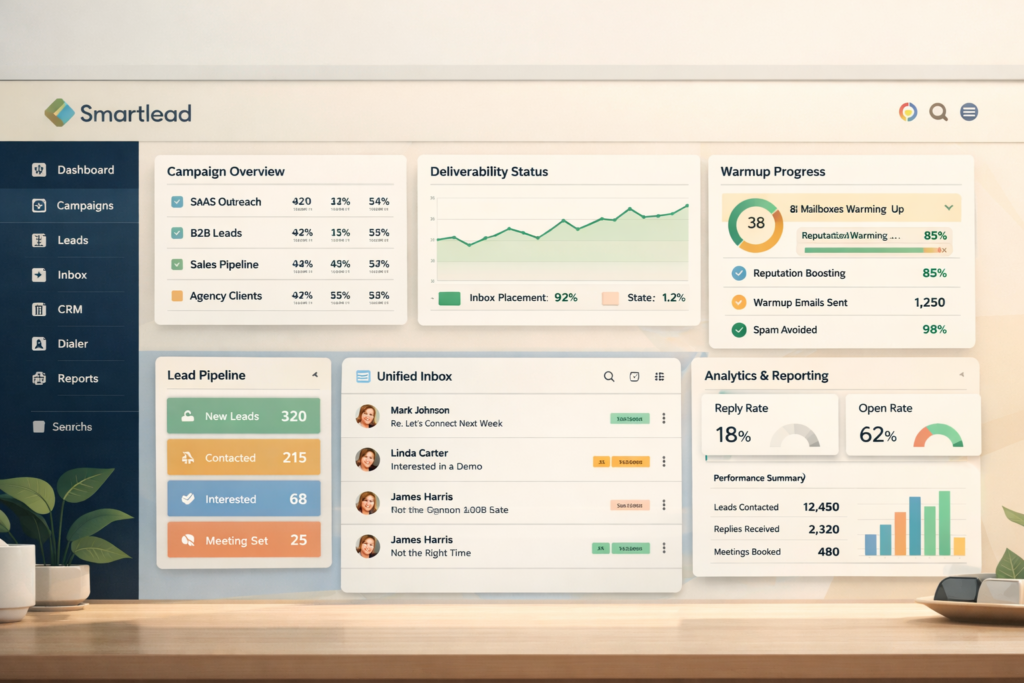
Quick Answer: Is Smartlead Worth It?
Yes, Smartlead is worth considering if you care about outbound scale, deliverability, centralized reply management, and flexible automation. It is especially attractive for lead generation agencies, outbound sales teams, recruiters, and operators who manage multiple mailboxes or client accounts. If your needs are simple and you only want a lightweight sequencer for low-volume outreach, Smartlead may feel broader than necessary. But if you are trying to build a system rather than run a few one-off campaigns, Smartlead becomes much more compelling.
| Category | Verdict |
|---|---|
| Best for | Agencies, SDR teams, recruiters, and outbound operators who need scale and control |
| Strongest advantage | Unlimited mailbox model, warmup, unified inbox, automation, and agency-friendly workflows |
| Potential downside | Small users may not need the broader platform depth |
| Value angle | More attractive when you compare total workflow value instead of entry price alone |
| Overall takeaway | One of the stronger choices for serious cold email and outbound execution |
What Is Smartlead?
Smartlead is an outbound sales platform built around cold email infrastructure, automation, and deliverability. On the surface, that sounds similar to many sales engagement tools. But Smartlead’s appeal comes from how it packages the parts that usually become painful as outreach grows: mailbox scaling, warmup, inbox management, verification, CRM syncing, and workflow automation.
That distinction matters. Many tools are easy to like during a free trial because they make it simple to launch a campaign. The real test comes later, when you start dealing with multiple sending accounts, reply sorting, deliverability dips, lead verification, team handoffs, and campaign data scattered across different systems. Smartlead is positioned to reduce those bottlenecks rather than just help you send emails.
Another important reason Smartlead stands out is that it is no longer positioned as only a cold email sender. The product ecosystem now extends into email verification, deliverability testing, integrated CRM-style pipeline management, white-label agency access, and SmartDialer for call workflows. That gives Smartlead a broader “outbound execution platform” feel, which is exactly how many serious buyers will evaluate it.
Who Should Use Smartlead?
Smartlead is not equally useful for every type of buyer. It is strongest when your outbound process already has enough complexity that basic tools start feeling restrictive.
| User type | Why Smartlead fits |
|---|---|
| Lead generation agencies | Multi-client workflows, white-label options, and scalable mailbox management make it much easier to package outreach as a service |
| Outbound sales teams | Centralized inbox handling, campaign control, and automation support help teams manage more volume with less confusion |
| Recruiters and niche outreach operators | Multiple mailboxes, follow-up control, and deliverability features are useful when reply handling matters as much as sends |
| Technical operators | API and workflow support make Smartlead a better fit for custom outbound systems |
| Founders doing serious outbound | It can replace a patchwork of separate tools once volume and complexity increase |
On the other hand, Smartlead may be more platform than product for a user who only wants to send a few hundred cold emails a month from one or two inboxes. In that situation, the tool can still work, but the value proposition is weaker because you are not really taking advantage of the infrastructure that makes Smartlead special.
What Makes Smartlead Different?
The best way to understand Smartlead is not to ask whether it can send cold emails. Of course it can. The better question is this: what happens after your cold email operation becomes serious? That is where Smartlead separates itself from simpler tools.
- It emphasizes scaling with multiple mailboxes instead of treating extra accounts like a premium luxury.
- It builds deliverability into the product experience through warmup, verification, and testing tools.
- It gives teams a unified place to manage replies and move conversations forward.
- It connects better to automation-driven outbound systems than basic email-only platforms.
- It gives agencies and service providers a much stronger operating model through white-label and client-facing workflows.
This is why many Smartlead reviews undersell the platform when they frame it only as a sender. The real value is that Smartlead tries to turn outbound into a repeatable operating system. That is a bigger promise than sequence sending, and it is also the reason the tool feels more relevant to advanced users.
Smartlead Review: Core Features Explained
1. Unlimited mailboxes and safer scaling
One of the strongest reasons people look at Smartlead is its mailbox philosophy. Instead of building pricing around charging you for every additional email account, Smartlead leans into a scale-friendly model. That matters because serious cold email is usually not about blasting more from one inbox. It is about spreading sending activity across a healthier infrastructure. If your tool punishes you financially every time you add mailboxes, your costs can rise long before results do.
Smartlead’s positioning is much more attractive for teams that need to manage multiple accounts across domains, campaigns, or clients. This is especially useful for agencies that operate many parallel outreach workflows. The more your system depends on mailbox distribution, the more Smartlead’s structure makes sense.
2. Automated warmup and deliverability protection
Deliverability is where many cold email tools start to feel incomplete. They give you sequence features, but the most important part of the job is left to guesswork. Smartlead is more opinionated here. Warmup is treated as a core part of safe sending, not as a minor add-on you are expected to ignore.
That matters because deliverability problems usually do not show up all at once. They appear gradually: lower open rates, quieter inboxes, more spam placement, and inconsistent campaign performance. By the time the problem becomes obvious, the damage may already be done. Smartlead’s warmup-centered positioning is therefore a real advantage for users who want a platform that acknowledges the operational reality of cold email instead of pretending every inbox behaves the same.
For new domains and new mailboxes, this is especially important. A platform that encourages warmer ramp-up, healthier sending patterns, and better sender reputation management is much easier to trust than a tool that focuses only on speed.
3. Unified Master Inbox for reply management
The Unified Master Inbox is one of the most practical reasons to choose Smartlead. Most outreach tools spend a lot of time marketing campaign creation, but reply management is where the actual revenue work happens. If replies are difficult to find, context is fragmented, or multiple inboxes create confusion, your workflow becomes slow and error-prone no matter how good your sequence was.
Smartlead’s inbox model is appealing because it gives teams one place to manage conversations instead of forcing users to jump across accounts. This becomes more valuable as soon as you operate multiple mailboxes or multiple campaigns. Even a modest-sized outbound team can lose opportunities when replies are spread across disconnected inboxes. Centralized reply handling reduces that friction.
From a buying perspective, this is one of Smartlead’s most underrated features. Plenty of tools help you send follow-ups. Fewer tools give you a better day-to-day environment for dealing with all the replies those follow-ups generate. For teams that care about pipeline movement rather than vanity activity, that difference is meaningful.
4. Automation, APIs, and integrations
Smartlead is a stronger choice when your outbound process extends beyond email sending. If you want campaign events to trigger CRM updates, internal notifications, workflow changes, or lead-routing logic, Smartlead’s automation angle becomes important. Basic senders can feel isolated because they work as their own silo. Smartlead is better suited to being part of a larger system.
This matters for agencies, revenue operations teams, and technical operators who want to coordinate outreach with sales workflows rather than keep everything manual. If you are already using tools like HubSpot, Salesforce, Pipedrive, Slack, Zapier, Make, N8N, or Google Sheets in your sales process, Smartlead is far easier to justify because it can sit inside that wider stack without feeling disconnected.
Another advantage is that automation helps you reduce repetitive work around campaign management. Once your outbound motion grows, small manual tasks multiply fast. A tool that offers better API and integration flexibility can save more time than a slightly cheaper sender ever will.
5. Integrated CRM and pipeline visibility
Smartlead’s integrated CRM direction makes the platform more interesting than older reviews might suggest. When a platform combines outreach activity with pipeline visibility, it becomes easier to track where conversations are actually going. That reduces the classic problem of outreach data living in one tool while deal movement happens somewhere else.
A synced, drag-and-drop pipeline view is useful because it lets teams move from “we sent emails” to “we are progressing deals.” That sounds simple, but it changes how the product fits into a team’s workflow. Instead of handing outbound activity off to a separate system too early, Smartlead can keep more of the operational context in one place.
For smaller teams, this may help reduce tool sprawl. For larger teams, it may not replace a primary CRM completely, but it still gives Smartlead more strategic value than a sender-only tool. It also makes the platform easier to explain to readers who are deciding between assembling five tools versus using one broader outbound platform.
6. Email verification and list hygiene
Good outbound does not begin with sending. It begins with list quality. That is why Smartlead’s built-in verification angle matters. A dirty list can damage sender reputation, waste sending capacity, inflate costs, and create misleading campaign metrics. Readers researching Smartlead are often looking for better reply rates, but before reply rates improve, bounce risk usually has to come down.
Smartlead’s verification workflow is useful because it supports better list hygiene inside the same ecosystem. That means fewer reasons to rely on disconnected processes before every launch. If you are managing outreach at scale, this is not a minor convenience. It supports more consistent deliverability and cleaner operations over time.
When you combine verification with warmup and deliverability testing, Smartlead starts to look less like “cold email software” and more like deliverability-aware outbound infrastructure. That framing is important for SEO too, because it helps the article answer a more valuable question than “can Smartlead send emails?”
7. SmartDelivery and deliverability diagnostics
One of the newer reasons Smartlead deserves attention is SmartDelivery. Instead of only helping you send, Smartlead also provides a deliverability testing layer that can help diagnose whether your emails are likely to reach inboxes effectively. This is extremely useful for teams that treat deliverability as a measurable operating variable instead of a vague concern.
That is a meaningful advantage because most outbound performance conversations become unproductive once deliverability is unclear. Teams end up debating copy, timing, or targeting before confirming whether messages are landing in the right place at all. A testing tool makes that conversation much more grounded. It also gives Smartlead a more infrastructure-focused identity, which can be a big differentiator for advanced buyers.
For a ranking-focused article, this section is valuable because it shows readers that Smartlead is solving a broader class of problems than ordinary cold email tools. The more you can demonstrate that the platform helps with diagnosis and prevention rather than just execution, the more persuasive the review becomes.
8. SmartDialer and multichannel outbound expansion
SmartDialer adds another layer to Smartlead’s value proposition. Once email conversations turn into real opportunities, calling often becomes part of the workflow. A tool that can move from email to call context with notes, transcripts, follow-ups, and CRM updates has more strategic value than one that stops at the inbox.
This matters especially for teams running serious outbound where phone conversations are part of qualification, follow-up, or closing. If Smartlead can keep that context tied to campaigns and records, it becomes a stronger central workspace rather than just a sending interface. Even if every buyer does not need calling today, the existence of SmartDialer supports the argument that Smartlead is expanding into a fuller outbound execution platform.
9. White-label features for agencies
Agencies should pay close attention to Smartlead’s white-label capabilities. This is one of the biggest reasons the platform can make sense as a service delivery layer, not just a tool subscription. If you run outreach for clients, client experience matters almost as much as campaign performance. White-labeling helps you present a more polished service, reduce reporting friction, and keep your brand centered in the relationship.
That can be a serious business advantage. Instead of using a third-party interface that constantly reminds clients which underlying software you are using, you can create a more integrated experience. Smartlead is much stronger here than tools built only for internal team usage. This alone makes it worth reviewing from an agency-first perspective.
Smartlead Pricing
Pricing is one of the most important sections in any Smartlead review because it shapes how readers compare the platform against alternatives. The mistake many buyers make is looking only at the headline monthly number. With Smartlead, that can be misleading because the platform becomes more attractive when you compare workflow value rather than just entry-level affordability.
| Plan | Monthly billing | Annual billing (monthly equivalent) | Contacts | Email sends per month | Verified emails per month |
|---|---|---|---|---|---|
| Base | $39 | $32.5 | 2,000 | 6,000 | 2,000 |
| Pro | $94 | $78.3 | 30,000 | 90,000 | 30,000 |
| Smart | $174 | $144.5 | Unlimited | 150,000 | 50,000 |
| Prime | $379 | $314.6 | Unlimited | 500,000 | 170,000 |
The Base plan gives small teams an accessible starting point, but the real shape of Smartlead’s pricing becomes more interesting once you move into Pro and Smart. Those tiers make more sense for teams that already know they need operational scale. By the time you care about multiple campaigns, multiple mailboxes, verification, centralized replies, and agency-style workflows, a simple entry-level price comparison stops being the only metric that matters.
For many readers, the key pricing question is not “is Smartlead cheap?” It usually is not the cheapest-looking option if you compare only starter plans. The better question is “does Smartlead reduce total complexity and cost once my outbound operation becomes real?” In many cases, the answer can be yes. That is why Smartlead often appeals more to serious users than to absolute beginners.
If you want to see whether Smartlead’s current plans match your sending volume, team size, and outreach goals, this is the best point to compare the tiers directly and test the platform yourself.
👉 Check Smartlead pricing and start your free trial
Is Smartlead Easy to Use?
Smartlead is easier to use than many advanced outbound tools, but it is important to be honest about what “easy” means in this category. The platform can simplify a lot of the difficult parts of cold email operations, but cold outreach itself is still operationally complex. You are still dealing with domains, mailboxes, verification, copy, targeting, inbox health, and reply management. No platform removes that entirely.
What Smartlead seems to do well is reduce friction around that complexity. The warmup process is more approachable, inbox workflows are more centralized, verification is easier to keep inside one system, and the platform gives both non-technical and technical users a more structured way to manage outbound. That is different from saying the tool is “simple,” but it is a fairer and more useful description.
Smartlead Pros and Cons
| Pros | Cons |
|---|---|
| Strong scaling model for teams using many mailboxes | May feel too broad for low-volume users |
| Deliverability is treated as a core product concern, not an afterthought | Beginners still need to learn outbound fundamentals |
| Unified inbox is genuinely useful for real operations | Some buyers may only want a sender, not a wider outbound platform |
| API, integrations, and workflow flexibility are strong advantages | Value is easier to justify at scale than at the smallest tier |
| White-label support makes it attractive for agencies | Advanced capability can mean more to learn at the start |
| Verification, deliverability testing, CRM direction, and calling expand its usefulness | Not every added module will matter to every user |
How to Get the Best Results With Smartlead
Even the best platform will underperform if the operating habits around it are weak. If readers buy Smartlead expecting the software alone to fix targeting, poor list quality, or bad messaging, they may be disappointed. The platform is strongest when used as part of a disciplined outbound process.
- Start with clean data. Verify lists before campaigns go live and remove risky or invalid contacts.
- Warm up responsibly. Do not rush new domains and new mailboxes just because the platform makes launch easy.
- Distribute sending logically. Use multiple mailboxes as infrastructure, not as an excuse for reckless volume.
- Use the inbox actively. Smartlead’s value increases when your team actually centralizes reply handling instead of letting responses scatter elsewhere.
- Connect your workflows. If you already use a CRM or automation layer, integrate Smartlead early so campaign data does not become siloed.
- Review deliverability, not just replies. Use testing and diagnostic features to understand whether poor performance is a copy problem, a targeting problem, or an inbox-placement problem.
This section matters for SEO because it gives readers more than a product summary. It turns the review into a decision-support page. That kind of practical guidance often improves on-page usefulness, dwell time, and overall content quality signals.
Smartlead vs Simple Cold Email Tools
Readers often ask whether Smartlead is “better” than simpler cold email tools. The answer depends on what problem you are trying to solve. If your only priority is getting a basic sequence running as quickly as possible, simpler tools can be enough. But if your real concern is scaling an outbound workflow without losing control of deliverability, inboxes, team coordination, and automation, Smartlead has a stronger case.
In other words, Smartlead is not most impressive when judged as a stripped-down sender. It is most impressive when judged as a workflow platform for serious outbound. That framing helps the article rank for higher-intent searches because it addresses the underlying buying decision rather than reducing the conversation to surface-level features.
| If you need… | Smartlead fit |
|---|---|
| A lightweight sender for occasional campaigns | Good, but possibly more than you need |
| Mailbox scale and deliverability-aware infrastructure | Very strong fit |
| Agency and client-facing workflows | Very strong fit |
| Centralized reply operations | Very strong fit |
| Automation and system integrations | Strong fit |
| A broader outbound execution layer | One of the better reasons to choose it |
Is Smartlead Good for Agencies?
Yes, Smartlead is particularly good for agencies. In fact, agencies are one of the clearest audiences for the platform. The combination of multiple mailboxes, centralized operations, white-label capability, and broader workflow control makes Smartlead easier to package into a service business than many competing tools.
That matters because agencies need more than campaign functionality. They need client management, reporting logic, brand presentation, operational scalability, and a setup that still feels manageable when accounts multiply. Smartlead is clearly aware of that use case, and that is one reason the platform has built a strong reputation in the outbound agency space.
Is Smartlead Good for Beginners?
Smartlead can work for beginners, but I would not call it a beginner-only platform. That is not a criticism. It simply means the product is built to support more serious workflows than the average beginner may need on day one. If you are new to cold email but know you plan to scale, Smartlead can still be a smart choice because you will not outgrow it as quickly.
However, if you are only experimenting with outreach for the first time and you do not yet understand list quality, domain setup, warmup, or inbox health, the software alone will not make you successful. Beginners who choose Smartlead should treat it as a platform they grow into, not as a shortcut around outbound fundamentals.
My Final Verdict on Smartlead
Smartlead is one of the better outbound platforms for teams that care about scale, deliverability, and operational control. Its strongest value is not that it sends cold emails. Its strongest value is that it tries to solve the messy operational layer around cold email: mailbox management, warmup, centralized replies, deliverability testing, verification, workflow automation, and agency-ready structure.
That makes Smartlead especially attractive for lead gen agencies, SDR teams, recruiters, founders running serious outbound, and technical operators who want a flexible system instead of a one-dimensional sender. It is less compelling for someone who only needs the cheapest possible entry point. But for readers searching “Smartlead review” with genuine buying intent, this is exactly why the platform deserves a serious look.
If your goal is to build an outbound system that can scale more cleanly, protect deliverability, and reduce tool sprawl, Smartlead is worth testing.
👉 Try Smartlead and see if it fits your outbound workflow
Smartlead Review FAQ
Is Smartlead just a cold email tool?
No. Cold email is still central to the platform, but Smartlead now extends beyond basic sending into areas like deliverability testing, email verification, integrated CRM-style workflows, agency white-labeling, and calling support. That broader scope is one reason it stands out.
Does Smartlead support multiple mailboxes?
Yes, and that is one of the platform’s main selling points. Smartlead is built to support users who need to scale outreach across multiple email accounts rather than rely on a single inbox.
Is Smartlead good for deliverability?
Smartlead has a strong deliverability-focused identity because it combines warmup, testing, verification, and safer scaling features. That does not guarantee results by itself, but it gives users better infrastructure than tools that treat deliverability as an afterthought.
Does Smartlead include email warmup?
Yes. Warmup is one of Smartlead’s best-known features and one of the clearest reasons many users consider the platform in the first place.
Can agencies use Smartlead under their own branding?
Yes. Smartlead offers white-label functionality, which is a major advantage for agencies that want a more branded client-facing experience.
Is Smartlead worth the price?
For teams that care about scale, deliverability, and workflow depth, Smartlead can be worth the price. For users who only need a lightweight sender, the value proposition is weaker. The right way to judge the cost is by comparing the total workflow value, not just the starter plan number.
Who should not buy Smartlead?
Users who only need very small-scale, low-complexity cold email may not get the full value from Smartlead. The platform is best when its broader operational depth is actually used.
Does Smartlead work well with other tools?
Yes. One of Smartlead’s biggest strengths is that it fits well into broader outbound systems through integrations, automation tools, CRM connections, and API support.
About the Author
Xu Xun
Contact: xuxun1208@gmail.com
Last Updated: June 2026