
If you want the short answer first, here it is: Rank Math is one of the most complete WordPress SEO plugins on the market today. It combines on-page SEO controls, schema markup, XML sitemaps, redirections, 404 monitoring, analytics integration, keyword tracking, indexing visibility, and AI-assisted content workflows inside a single WordPress environment. For publishers who want one plugin to centralize a large part of their SEO stack, Rank Math is an extremely compelling option. For beginners who only want the absolute simplest title-and-meta plugin, it can feel more advanced than necessary. But if your goal is long-term search traffic growth, Rank Math deserves serious attention.
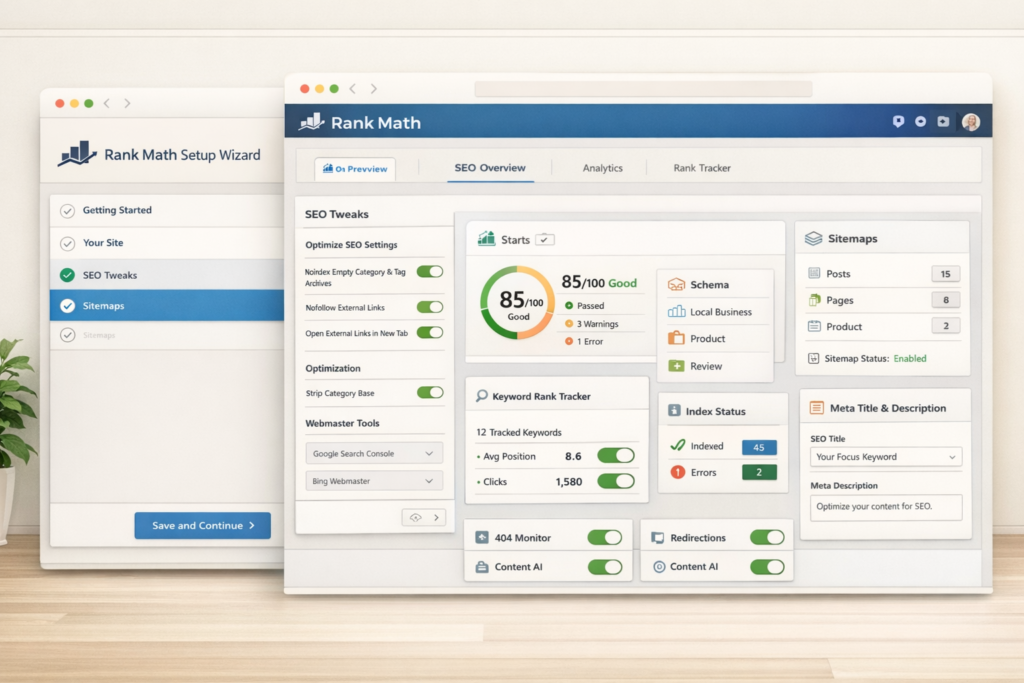
One reason Rank Math keeps coming up in serious WordPress SEO discussions is that it is no longer a lightweight plugin that only handles meta titles and descriptions. It has grown into a broader optimization platform for WordPress sites. It now covers content optimization, schema control, search analytics, rank tracking, internal linking assistance, broken-link workflows, indexing visibility, and more. That matters because modern SEO is not just about putting a keyword into a headline. Ranking today depends on many moving parts: crawlability, indexability, internal linking, content usefulness, search intent alignment, structured data, technical cleanliness, and performance feedback loops.
This is also why Rank Math has become attractive for affiliate sites, niche blogs, business websites, WooCommerce stores, and agency workflows. Instead of stitching together five or six different plugins, many site owners can cover a large share of their SEO operations from one place. That does not automatically make it the perfect choice for everyone, but it does make it one of the most practical choices for WordPress users who want a broader SEO toolkit without building a messy plugin stack.
What Is Rank Math?
Rank Math is a WordPress SEO plugin built to help site owners improve organic visibility by managing both content-side SEO and technical SEO from inside WordPress. At a basic level, it helps with titles, descriptions, focus keywords, schema, XML sitemaps, breadcrumbs, redirects, and 404 tracking. At a more advanced level, it adds integrations for Google Search Console and Google Analytics, keyword rank tracking, index status monitoring, AI-assisted optimization, advanced schema workflows, and internal linking support.
That broader positioning matters because site owners often underestimate how much SEO friction comes from fragmentation. One tool handles metadata, another handles redirects, another handles schema, another handles analytics, and another handles content optimization. Rank Math’s core appeal is that it reduces that fragmentation. Instead of forcing you to jump between multiple plugins and dashboards, it tries to make WordPress SEO more centralized and operationally simpler.
Why Rank Math Matters More in 2026
SEO has become more layered than it was a few years ago. It is no longer enough to publish a post with a decent title and wait for Google to figure it out. Publishers now need stronger internal linking, clearer structure, richer entity signals, more consistent indexing checks, and better feedback on what is actually driving organic traffic. On top of that, AI-assisted search experiences have changed the way many users discover and compare products. That means content needs to be clearer, more complete, easier to quote, and better structured for both humans and machines.
Google’s own documentation makes this point in a subtle but important way: there are no special extra technical requirements for appearing in AI Overviews or AI Mode beyond normal search eligibility and snippet eligibility. In other words, strong foundational SEO still matters. Pages still need to be crawlable, indexable, text-rich, internally linked, and supported by accurate structured data where appropriate. Rank Math is appealing because many of its strongest features map directly to those enduring foundations rather than chasing gimmicks.
For a site owner trying to rank a commercial review article, that makes Rank Math more relevant than a plugin that only offers superficial on-page scoring. The real job is not to chase a green SEO score. The real job is to publish a page that search engines can understand, users can trust, and your site architecture can support over time.
Rank Math’s Biggest Strength: It Consolidates Multiple SEO Jobs
The biggest reason many users choose Rank Math is not one single feature. It is consolidation. Rank Math does not just give you one nice SEO box in the post editor. It combines several categories of SEO work that often get separated across multiple tools.
| SEO Job | How Rank Math Helps | Why It Matters |
|---|---|---|
| On-page optimization | Titles, descriptions, focus keywords, SEO analysis | Improves relevance, clarity, and search snippet control |
| Structured data | Built-in schema types, templates, custom schema workflows | Helps search engines understand page type and entity context |
| Technical SEO basics | XML sitemaps, breadcrumbs, robots controls, redirections, 404 monitor | Supports crawlability, UX, and site hygiene |
| Analytics visibility | Search Console, Analytics, tracked keywords, position history | Reduces guesswork after publication |
| Index diagnostics | Index status and indexing-related visibility | Helps diagnose why pages are not getting picked up |
| Internal linking workflows | Link suggestions, AI Link Genius positioning, linking assistance | Supports topic clusters and crawl paths |
| Migration | Import tools from Yoast, AIOSEO, SEOPress, Redirection, and more | Makes switching easier for established sites |
That breadth is what makes Rank Math attractive to SEO-driven publishers. It is not necessarily because each individual feature is the absolute deepest specialist tool in its category. It is because the plugin gets a lot of important jobs done in one place, which is valuable for real-world site operations.
Core Rank Math Features That Matter Most
When people search for a Rank Math review, they usually do not just want a feature list copied from a homepage. They want to know which features actually matter for rankings, publishing workflows, and long-term site management. The features below are the ones that deserve the most attention.
1. Setup Wizard and Easier Initial Configuration
Rank Math’s setup wizard is one of its most practical advantages. Many WordPress users do not fail at SEO because they chose the wrong plugin. They fail because they leave critical settings half-configured, conflict with other SEO plugins, or never connect the data sources that would show what is actually happening. Rank Math’s setup wizard walks users through account connection, import, site settings, analytics, sitemaps, optimization, advanced settings, role manager, redirections, and schema-related setup. That lowers configuration friction, especially for users who want a guided experience instead of manually hunting through settings pages.
2. Schema Markup Depth
Schema is one of Rank Math’s strongest areas. A lot of SEO plugins technically “support schema,” but the real question is how flexible that support is once your site grows. Rank Math gives users a wider schema toolkit than many casual site owners will ever fully use. That is valuable for review posts, how-to content, local business pages, WooCommerce pages, service pages, and comparison content where structured data can improve clarity and eligibility for enhanced search appearances.
For publishers trying to build topical authority, schema depth matters because it helps reinforce page type and entity signals. It will not rescue weak content, but it can make strong content easier for search engines to interpret correctly.
3. Analytics and Search Console Visibility Inside WordPress
This is one of the plugin’s more underrated strengths. A lot of WordPress site owners say they care about SEO, but they rarely look at the actual feedback that should guide optimization decisions. Rank Math brings search and analytics data into WordPress so users can see keyword performance, impressions, clicks, CTR, average position, and other useful signals without constantly switching dashboards. That does not replace dedicated external analysis forever, but it dramatically lowers the barrier to actually checking performance.
For sites that publish frequently, this matters because SEO improvement is iterative. You need to know what is winning, what is losing, what is indexed, what is stagnating, and where content updates should be prioritized.
4. Index Status and Search Visibility Diagnostics
One of the most frustrating SEO problems is publishing content that never meaningfully gets indexed or surfaced. Rank Math’s index status layer helps reduce that blind spot. For many site owners, this is far more useful than a generic “SEO score,” because it gets closer to the real problem: whether pages are actually being discovered, crawled, and indexed as expected.
5. Redirections and 404 Monitoring
These features do not look glamorous, but they are important. As sites expand, deleted posts, changed URLs, and broken pathways accumulate. If you ignore them, you hurt user experience, waste crawl equity, and leave avoidable SEO damage in place. Rank Math’s built-in redirection manager and 404 monitoring tools help clean up that mess without needing a separate plugin for basic redirect management.
6. Internal Linking Assistance
Internal linking is one of the most overlooked levers in content SEO. As your site grows, manual linking becomes inconsistent and time-consuming. Rank Math has long included internal link suggestions, and its newer AI Link Genius positioning makes it clear that the company sees internal linking as a strategic part of modern SEO, not just a nice extra. This is especially useful for content-heavy sites that are building clusters around categories, comparisons, tutorials, reviews, and alternatives.
Rank Math Content AI: Useful Tool or Just Extra Hype?
Content AI is one of the areas where Rank Math tries to separate itself from more traditional SEO plugins. The product pitch is clear: help users create and optimize SEO-friendly content directly inside WordPress with AI-assisted workflows. In practice, the value of Content AI depends heavily on how you use it.
If you expect Content AI to replace human judgment, original research, brand voice, and search intent analysis, you will be disappointed. That is not a Rank Math problem. That is an unrealistic expectation problem. But if you use it as a workflow accelerator for outlining, idea expansion, SEO support, meta generation, content refinement, and optimization prompts, it becomes far more useful.
The smart way to think about Content AI is this: it helps reduce publishing friction, but it does not remove the need for editorial standards. That matters especially for commercial pages like reviews, comparisons, and alternatives posts, where originality, judgment, and trust still make the difference between thin content and ranking content.
| Content AI Can Help With | What You Still Need to Do Yourself |
|---|---|
| Idea expansion | Validate real search intent |
| Outline generation | Decide the best content structure |
| SEO support prompts | Add product-specific insight and original judgment |
| Meta generation | Refine for CTR and brand tone |
| Optimization assistance | Ensure the page is genuinely useful and not generic |
| Workflow speed | Maintain accuracy and trustworthiness |
That balance is important because Google’s guidance remains clear: AI use is not inherently a problem, but scaled low-value content is. So if you use Rank Math’s AI features, use them to improve quality and structure, not to flood your site with commodity pages.
Rank Math Pricing: Free vs PRO vs Business vs Agency
Pricing is one of the most important parts of any Rank Math review because the plugin is attractive partly due to how much functionality it packs into each tier. The free version is strong enough to be genuinely useful, while the paid plans are built for users who want more tracking, deeper analytics, broader usage rights, and additional advanced workflows.
| Plan | Who It Is For | Current Price | Website Scope | Tracked Keywords | Best Fit |
|---|---|---|---|---|---|
| Free | Beginners and small sites | $0 | Basic usage | Limited vs paid tiers | Learning Rank Math and handling core SEO basics |
| PRO | Bloggers, individuals, solopreneurs | $7.99/month billed annually | Unlimited personal websites | 500 | Most content publishers and affiliate site owners |
| Business | Freelancers, businesses, agency owners | $24.99/month billed annually | 100 client websites | 10,000 | Freelancers and multi-site operators |
| Agency | High-volume agencies | $54.99/month billed annually | 500 client websites | 50,000 | Large-scale client SEO operations |
For most blog owners, affiliate marketers, review-site publishers, and solo operators, the PRO plan is the most realistic paid plan. It is the tier that makes the most sense if your site earns money or is intended to earn money, because it gives you more room to use Rank Math as an operating system rather than just a basic SEO add-on.
The Business plan becomes more attractive if you manage multiple client sites or want substantially more rank-tracking capacity. Agency is really for scale. If you do not have a true client-site workflow, you probably do not need to jump that high.
Is Rank Math Free Good Enough?
For many websites, yes. The free version is not a crippled teaser. It is a legitimately capable SEO plugin that already covers more than some site owners use in paid tools. If you are launching a new blog, building your first niche site, or moving from a lighter SEO setup, Rank Math Free is a credible starting point.
That said, the answer depends on your business model. If your website is a hobby site, a small informational site, or an early-stage project, free may be enough for quite a while. If your site is a revenue asset and you care about keyword tracking, stronger analytics, advanced schema workflows, and better operational visibility, the paid tiers become much easier to justify.
Rank Math for Bloggers, Affiliate Sites, and Review Publishers
Rank Math is especially relevant for the kind of site that publishes buying guides, software reviews, alternatives posts, tutorials, and comparison articles. That is because these content models benefit from several Rank Math strengths at once: clearer metadata, stronger schema options, internal linking assistance, analytics visibility, and easier ongoing optimization.
For example, if you publish a review article like this one, you usually need more than a keyword field. You need a strong title, compelling meta description, clean heading structure, product entity clarity, review-friendly schema decisions, strong internal links to related content, and a way to monitor how the page performs after publication. Rank Math helps connect those dots.
It is also a good fit for content-heavy affiliate sites because those sites tend to suffer from internal-link inconsistency, metadata neglect, and missed update opportunities once the content library grows. A tool that helps surface performance, link opportunities, and site hygiene can become more valuable as the site scales.
Rank Math for WooCommerce and Business Websites
WooCommerce and business websites often need more structured SEO control than a simple blog. Product pages, category pages, service pages, local pages, and branded pages benefit from metadata consistency, schema flexibility, breadcrumbs, image SEO support, redirects, and analytics visibility. Rank Math’s breadth makes it a practical option for these websites because it can cover a wide mix of page types without requiring a patchwork of separate plugins.
For local businesses, schema support and business-type configuration can be especially useful. For online stores, WooCommerce SEO support matters because product metadata and structured data become more central to visibility. For service sites, the plugin’s balance of content optimization and technical SEO basics is often enough to cover what matters most.
Rank Math vs Simpler SEO Plugins
A fair question in any Rank Math review is whether you really need a plugin this broad. The answer depends on your goals. If you want the simplest possible plugin to edit titles and descriptions and you do not care much about analytics, schema depth, internal linking help, or built-in tracking visibility, a simpler plugin may feel easier. But you are also giving up operational depth.
Rank Math’s advantage is not that every user needs every feature. Its advantage is that as your site matures, you are less likely to outgrow it quickly. That makes it attractive for site builders who want a plugin that can scale with the site instead of forcing a stack rebuild later.
| If You Want… | Rank Math Fit |
|---|---|
| A lightweight basic SEO setup | Good, but may feel feature-rich |
| One plugin for multiple SEO jobs | Excellent fit |
| Schema flexibility | Excellent fit |
| On-site analytics visibility | Strong fit |
| Internal linking support | Strong fit |
| Client-site licensing | Business and Agency are strong options |
| A long-term growth-oriented WordPress SEO stack | Very strong fit |
Rank Math Setup and Migration Experience
Switching SEO plugins can make site owners nervous, especially if the current site already has traffic. That is why migration support matters more than many review articles acknowledge. Rank Math’s import workflows are a meaningful advantage here. It supports importing data from major SEO and redirect-related plugins, which lowers switching friction for existing sites.
If you are migrating from Yoast, All in One SEO, SEOPress, Redirection, Schema Pro, or All in One Schema, Rank Math is clearly designed to make that transition easier. That does not mean switching is totally risk-free in every case. You should still audit titles, descriptions, schema behavior, redirects, and indexing after a migration. But the presence of a guided import path is still a major operational plus.
This is one of the reasons Rank Math is often attractive to intermediate users. Beginners like the setup wizard. More experienced users like that migration is not treated as an afterthought.
Rank Math and AI Search Optimization
Many people now ask whether a plugin is “good for AI SEO.” That phrase can be misleading, because there is no magic switch that makes a page appear in AI results. What Rank Math can do is help with the fundamentals that continue to matter: crawlability, metadata, schema, internal links, content structure, performance visibility, and index status awareness.
That is the right way to think about Rank Math in the AI-search era. It is not a shortcut around quality. It is an operational aid that helps you publish more search-friendly pages and monitor them more intelligently. If you pair it with original, people-first content that actually answers complex questions well, it becomes much more valuable.
In other words, Rank Math helps create the conditions for stronger search visibility, including AI-assisted search contexts, but it does not replace the need for genuinely useful content. That distinction matters if you are building content intended to rank in competitive software, SaaS, hosting, or marketing niches.
Pros and Cons of Rank Math
| Pros | Cons |
|---|---|
| Feature-rich all-in-one SEO plugin for WordPress | Can feel overwhelming for users who want extreme simplicity |
| Strong schema support and templates | Some advanced workflows are tied to paid tiers |
| Setup wizard lowers configuration friction | Broad scope means more settings to learn properly |
| Useful analytics and keyword visibility inside WordPress | Best experience depends on thoughtful setup, not defaults alone |
| Migration support from major SEO plugins | Not relevant if you are not on WordPress |
| Good fit for bloggers, affiliate sites, businesses, and agencies | Using multiple SEO plugins together is not recommended |
| Internal linking and site-structure support are increasingly strong | AI-assisted features still need human oversight |
Who Should Use Rank Math?
Rank Math is a particularly strong fit for bloggers, affiliate publishers, content sites, WooCommerce stores, local businesses, freelancers, and agencies that want more than the bare minimum from an SEO plugin. If your site publishes commercial content, comparison content, reviews, tutorials, or topical clusters, Rank Math’s broader toolkit is often genuinely useful.
It is also a good fit for users who want to reduce tool sprawl. If you are tired of using one plugin for schema, one for redirects, one for analytics snippets, and one for basic SEO, Rank Math’s consolidation is one of its strongest practical advantages.
Who Might Prefer Something Else?
If you are not using WordPress, Rank Math is not relevant. If you want the lightest possible interface and truly do not care about broader SEO workflows, you may prefer a simpler plugin. If you already have a clean, stable stack that covers schema, redirects, analytics, and on-page SEO exactly the way you want, Rank Math may be more migration effort than you need right now.
That said, many users who initially think Rank Math looks too feature-heavy later realize that the extra depth becomes helpful as the site grows. The question is not whether the plugin has many features. The question is whether your site strategy will eventually benefit from them.
Is Rank Math Worth It?
For many WordPress users, yes. Rank Math is worth it when your site is not just a casual publishing project but a search asset you want to grow. The plugin’s real value comes from helping you manage multiple SEO responsibilities from a single operational hub: metadata, schema, redirects, 404s, analytics visibility, index status, keyword tracking, and AI-assisted content workflows.
If your site earns money, plans to earn money, or supports a business, the jump from a basic free setup to Rank Math PRO can be justified much more easily than many people think. The cost is relatively modest compared with the value of stronger search visibility, better diagnostics, and reduced plugin sprawl. If you are running client sites, the Business tier becomes even easier to rationalize.
But the best answer is this: Rank Math is worth it if you will actually use its broader capabilities. If you are the kind of site owner who wants performance visibility, content improvement loops, cleaner structure, better schema control, and long-term scalability, it is a very strong choice. If you only want to change titles and meta descriptions, the free version may already be enough.
Final Verdict
Rank Math is one of the best all-in-one SEO plugins for WordPress users who want more than a basic optimization checklist. It is strong because it combines setup guidance, schema depth, analytics visibility, migration support, technical SEO basics, and increasingly sophisticated content and linking workflows in one place. That combination makes it especially attractive for serious content publishers, affiliate sites, WooCommerce stores, local businesses, and agencies.
It is not perfect for everyone. Some users will want something simpler. Some will never use half of its advanced capabilities. But if your goal is to build a search-focused WordPress site that can scale, Rank Math is absolutely worth considering. The free version is already strong, and the paid plans become more compelling as your site becomes more performance-sensitive and commercially important.
My verdict is simple: if you want a serious WordPress SEO plugin with room to grow, Rank Math is one of the smartest options available today.
👉 Get started with Rank Math and build a cleaner, more scalable SEO workflow inside WordPress.
Frequently Asked Questions
Is Rank Math free?
Yes. Rank Math has a free version that already includes a strong set of SEO features. Paid plans add broader tracking, licensing, analytics depth, and more advanced workflows for users who need more than the basics.
Is Rank Math good for beginners?
Yes. The setup wizard and guided configuration make it friendly for beginners, but the plugin also has enough depth that users may need time to understand which modules and workflows matter most for their site.
Is Rank Math better than simpler SEO plugins?
It depends on your needs. If you want broader SEO coverage, stronger schema options, on-site analytics visibility, internal linking support, and better long-term scalability, Rank Math is often the stronger choice. If you only want basic title and meta controls, a simpler plugin may be enough.
Can Rank Math help with AI search optimization?
Rank Math can help with the foundations that continue to matter in AI-assisted search contexts, such as indexing, internal linking, textual clarity, schema, and search visibility. It is not a shortcut around content quality, but it can support a stronger publishing workflow.
Can I switch from Yoast or another SEO plugin to Rank Math?
Usually yes. Rank Math includes import workflows for major SEO plugins and related tools, which makes migration easier than doing everything manually. Even so, you should still audit key pages after switching.
Which Rank Math plan is best for most bloggers?
For most bloggers, affiliate publishers, and solo site owners, Rank Math PRO is the most sensible paid plan. It gives you more room to grow without jumping into client-site licensing that you may not need yet.
About the Author
Xu Xun
Contact: xuxun1208@gmail.com
Last Updated: June 2026