
Internal linking is one of the most overlooked parts of on-page SEO. Most site owners know it matters, but once a website grows past a few dozen posts, internal linking becomes time-consuming, repetitive, and easy to ignore. That is exactly why tools like Link Whisper have become popular with bloggers, affiliate marketers, niche site owners, agencies, and WordPress publishers who want a more systematic way to strengthen site structure.
If you are searching for a serious Link Whisper review, you are probably not looking for a shallow summary. You want to know what the plugin actually does, how useful it is in the real world, whether the pricing makes sense, what the free version can do, what the premium version adds, and whether this tool can genuinely help you improve rankings, crawlability, content discoverability, and internal link coverage.
This guide is written with exactly that goal in mind. Instead of giving you a short overview, this article breaks Link Whisper down from multiple angles: features, SEO value, usability, pricing, strengths, weaknesses, ideal users, practical use cases, and whether it deserves a place in a serious WordPress SEO workflow.
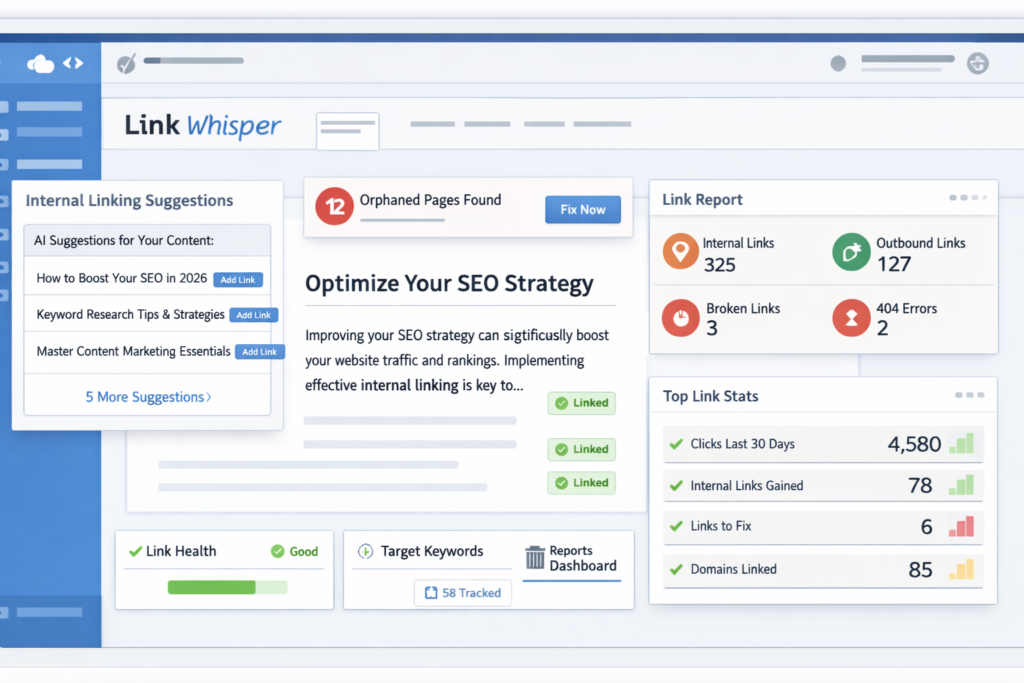
Quick Verdict: Is Link Whisper Worth It?
Yes, Link Whisper can be worth it if you run a content-heavy WordPress site and internal linking has become difficult to manage manually. Its biggest value is not that it magically makes weak content rank. Its value is that it helps you build and maintain a better internal linking system at scale, which can improve content discoverability, support topic clusters, reduce orphaned pages, and make it easier for search engines to understand your site architecture.
For very small websites, the free version may be enough. For growing blogs, affiliate sites, editorial sites, and agencies managing multiple WordPress properties, the premium version is where Link Whisper becomes much more compelling. That is especially true if you want more than just suggestions while writing and need reporting, automation, link maintenance, and deeper internal link visibility across a larger archive.
| Category | Verdict |
|---|---|
| Best for | WordPress publishers who want faster, more systematic internal linking |
| Strongest advantage | Saves time and helps uncover missed internal link opportunities |
| Weakest point | WordPress-only and still requires editorial judgment |
| Free version | Useful for testing suggestions and basic link health visibility |
| Premium version | Much better for scaling internal link work across larger sites |
| Overall recommendation | Worth considering if internal linking is a real SEO bottleneck on your site |
What Is Link Whisper?
Link Whisper is a WordPress plugin built specifically for internal linking. Unlike broad SEO plugins that try to cover every area of site optimization, Link Whisper focuses on one job: helping you discover, create, manage, and improve internal links more efficiently.
That specialization is a big part of its appeal. Many website owners already use another SEO plugin for titles, meta descriptions, XML sitemaps, schema, and other foundational settings. Link Whisper is not trying to replace all of that. Instead, it aims to solve a narrower but extremely important problem: most websites do not build enough high-quality internal links consistently, especially as they grow.
Link Whisper is designed for self-hosted WordPress sites where you can install plugins. If your site is not on WordPress, this tool is not the right fit. That is an important limitation to understand up front, because Link Whisper is not a universal SEO SaaS platform. It is a WordPress-first internal linking solution.
Why Internal Linking Matters More Than Most Site Owners Think
Before evaluating Link Whisper itself, it helps to understand why internal linking deserves dedicated attention in the first place.
Internal links do much more than connect one blog post to another. They help search engines discover content, understand topical relationships, identify important pages, and crawl your site more efficiently. They also help users move through your website in a way that feels natural, which can increase page depth, support conversions, and keep valuable content from being buried in the archive.
For SEO, strong internal linking can support your site in several ways:
- It improves crawlability by making pages easier to find.
- It helps search engines interpret content relationships and topic clusters.
- It can distribute internal authority more effectively across your site.
- It reduces the chance that useful pages become orphaned or weakly connected.
- It gives readers more relevant next steps instead of forcing them to bounce.
That is why internal linking is not just a housekeeping task. On larger content sites, it becomes a structural SEO job. The bigger your archive becomes, the harder that job gets if you rely only on manual workflows.
In other words, Link Whisper is not valuable because internal links are trendy. It is valuable because internal linking is one of the rare SEO activities that can improve user navigation, crawl efficiency, topical organization, and support for high-priority pages at the same time.
How Link Whisper Works
At a practical level, Link Whisper analyzes the content on your WordPress site and looks for relevant opportunities to connect posts and pages. Its core promise is speed: instead of manually searching your site for related articles every time you publish something new, the plugin helps surface those opportunities for you.
The basic workflow usually looks like this:
- Install Link Whisper on your WordPress site.
- Let it process your site content.
- Review internal link suggestions while editing or from report views.
- Approve or refine the links you actually want.
- Use premium tools such as auto-linking, broken-link reporting, click data, and broader site-level reporting if needed.
What makes this useful is not just that suggestions appear. It is that the plugin turns internal linking into an ongoing workflow instead of a once-in-a-while manual cleanup task. That shift from occasional maintenance to repeatable system is where a lot of the real value comes from.
For a content publisher, this matters in two directions. First, new posts can more easily link to old ones. Second, older posts can receive more inbound internal links from newer content, which is often where site owners miss opportunities.
Top Link Whisper Features Explained
A good Link Whisper review should not just list features. It should explain why those features matter. Below is a closer look at the capabilities that make the plugin stand out for WordPress SEO users.
1. AI-Powered Internal Link Suggestions
This is the feature most buyers care about first. Link Whisper suggests relevant internal links based on your site content, helping you identify which pages should connect. In practice, this saves time because you do not need to manually search your archive every time you want to add contextual internal links to a new article.
For publishers with a growing content library, this alone can remove a major bottleneck. Even if you know internal linking matters, manually finding the best candidate pages across a large site can be slow. Link Whisper reduces that friction and makes it easier to add links while content is still being written or updated.
2. Auto-Linking
Auto-linking is one of the more powerful premium features because it allows you to apply internal linking rules more systematically. If you repeatedly want a certain keyword or phrase to point to a particular page, Link Whisper can help automate that process instead of forcing you to insert the same type of link manually over and over again.
This is especially useful for cornerstone pages, service pages, evergreen tutorials, or category-defining resources that should regularly receive support from related articles. Used well, auto-linking can save a great deal of time. Used carelessly, it can create repetitive or awkward linking patterns. That is why Link Whisper works best when automation is paired with editorial review.
3. Orphan Page Detection
Orphan pages are pages with no internal links pointing to them. These pages are easy to miss on growing sites, especially if your editorial process is inconsistent or if you publish a lot of content quickly. Orphaned content often underperforms not because it is low quality, but because it is poorly connected.
One of Link Whisper’s most practical advantages is helping surface these pages so you can decide whether to improve, connect, consolidate, or remove them. For SEO, that visibility is extremely valuable because weakly linked content is often a hidden structural problem rather than a content problem.
4. Broken Links and Link Health Visibility
Premium users get broader visibility into link issues such as broken links and other internal link health signals. This matters because internal linking is not only about adding more links. It is also about maintaining the quality of the links you already have. A site can look well interlinked on paper but still suffer from 404 targets, outdated paths, or structural decay over time.
If you publish frequently, rename URLs, update content structures, or clean up older pages, this kind of reporting can help you catch issues before they quietly weaken the user experience or reduce the effectiveness of your site’s internal navigation.
5. Click Tracking
Click tracking adds another layer of value by showing how visitors interact with your links. This is useful because it helps you move beyond theory. Instead of assuming your internal links are working, you can see whether readers are actually clicking them.
That can influence how you think about anchor placement, content flow, call-to-action positioning, and which supporting articles deserve stronger internal promotion. For publishers who care about both SEO and on-site behavior, click tracking makes Link Whisper more than just a suggestion engine.
6. Google Search Console Integration
Google Search Console integration helps connect your internal linking work with actual organic search performance. That matters because internal linking decisions are more useful when they are tied to real search visibility, not just guesswork.
For example, if a page is already getting impressions or clicks from search but has weak internal support, that may be a strong candidate for additional internal links. Likewise, if an important page is central to your topic cluster strategy, seeing it in the context of search performance can help you prioritize how and where to strengthen its support.
7. Visual Sitemaps and Topic Relationship Mapping
Visual sitemaps and AI sitemap-style clustering are among the most interesting higher-level features in Link Whisper because they help you look at your content as a network rather than a pile of individual posts. Instead of only thinking page by page, you can think cluster by cluster.
This is useful when you are building content hubs, strengthening supporting articles around a primary page, or trying to identify where related content exists but linking relationships are still missing. It is one of the features that makes Link Whisper feel more strategic on larger sites.
Link Whisper Features at a Glance
| Feature | What It Helps With | Why It Matters |
|---|---|---|
| AI link suggestions | Finding relevant internal linking opportunities faster | Reduces manual search and speeds up content optimization |
| Auto-linking | Applying repeatable link rules across your site | Useful for scaling internal linking on larger archives |
| Orphan page detection | Spotting pages with no inbound internal links | Helps rescue buried or under-supported content |
| Broken link reporting | Finding unhealthy links and problem URLs | Improves site maintenance and user experience |
| Click tracking | Measuring how readers interact with links | Shows whether internal links are actually being used |
| GSC integration | Adding search performance context to reports | Helps prioritize pages with stronger SEO potential |
| Visual sitemaps | Viewing content relationships more strategically | Useful for topic clusters and structural audits |
| CSV export | Exporting data for audits or team workflows | Helpful for larger sites and agencies |
Link Whisper Free vs Premium
This is one of the most important parts of any Link Whisper review because many users start by asking whether the free version is already enough.
The answer depends on your site size, workflow, and goals.
If your website is still relatively small and you mainly want help spotting internal linking opportunities while writing, the free version can deliver real value. It gives you a practical way to test whether Link Whisper fits your workflow without paying immediately.
If you manage a larger site, want more reporting depth, prefer bulk actions, care about broken links, or want more automation and visibility across the whole site, premium is the version that makes the plugin feel substantially more powerful.
| Area | Link Whisper Free | Link Whisper Premium |
|---|---|---|
| Internal link suggestions | Yes | Yes |
| Basic link visibility | Yes | Yes |
| Orphan page awareness | Yes | Yes, with stronger workflow value |
| Bulk link actions | Limited | Much stronger |
| Broken link reporting | No | Yes |
| Click tracking | No | Yes |
| Domain and deeper reports | No | Yes |
| Automatic insertion after approval | More limited/manual | Yes |
| Best fit | Small sites testing the plugin | Serious publishers, affiliates, and agencies |
The simplest way to think about it is this: the free version helps you experience the core idea, but the premium version is what turns Link Whisper into a full internal linking workflow tool.
Link Whisper Pricing
Pricing matters because internal linking tools can easily become unnecessary expenses if they do not save enough time or create enough SEO value.
Link Whisper’s current public pricing is structured by number of sites, which makes sense for solo bloggers, portfolio site owners, and agencies alike. The more sites you manage, the lower the effective cost per site becomes.
| Plan | Sites | Annual Price | Approx. Monthly Equivalent | Best For |
|---|---|---|---|---|
| Starter | 1 site | $97/year | About $8/month | Solo bloggers and single-site owners |
| Growth | 3 sites | $197/year | About $5.47 per site/month | Users with a small portfolio of sites |
| Pro | 10 sites | $297/year | About $2.48 per site/month | Niche site builders and small teams |
| Agency | 50 sites | $497/year | About $0.83 per site/month | Agencies and large multi-site operators |
For one site, Link Whisper is not cheap in the sense of being an impulse purchase. But it is still reasonably priced compared with the amount of manual work it can potentially replace. For agencies or publishers with multiple content sites, the higher-tier plans become much easier to justify because the per-site cost drops sharply.
When evaluating the price, the right question is not just “Is $97 expensive?” The better question is “How much time am I currently wasting on manual internal linking, and how much value am I losing by leaving important content weakly connected?” If the answer is “a lot,” then Link Whisper becomes more attractive very quickly.
What Link Whisper Does Better Than Manual Internal Linking
Manual internal linking gives you maximum control, but it breaks down at scale. The more pages you publish, the less realistic it becomes to remember every relevant existing article, find it quickly, insert the link naturally, and repeat that process across your entire archive.
Link Whisper improves that workflow in several important ways.
| Factor | Manual Workflow | Using Link Whisper |
|---|---|---|
| Finding related content | Slow and inconsistent | Much faster |
| Maintaining old content | Easy to neglect | More systematic |
| Spotting orphan pages | Requires manual auditing | Far easier |
| Scaling across large sites | Difficult | Much better |
| Broken link awareness | Usually needs another tool | Available in premium workflows |
| Behavior insight | Limited | Improved through click data |
The biggest strategic advantage is consistency. With manual linking, quality depends on memory, discipline, and available time. With Link Whisper, internal linking becomes more process-driven. That is a major difference for serious SEO work.
Where Link Whisper Is Most Useful
Not every website needs a dedicated internal linking plugin right away. Link Whisper becomes most useful when your site is large enough that internal linking is no longer easy to manage from memory.
Here are the scenarios where it tends to provide the most value:
| Use Case | Why Link Whisper Helps |
|---|---|
| Growing blogs | Helps connect new posts to older content without manual archive digging |
| Affiliate sites | Supports money pages and comparison pages with stronger internal link flow |
| Content-heavy niche sites | Makes it easier to keep hundreds of posts interconnected |
| Agencies | Improves repeatability across multiple WordPress sites |
| Topic cluster strategies | Supports better pillar-and-supporting-article relationships |
| Old content audits | Helps surface pages that are weakly linked or overlooked |
If you publish content regularly, the plugin can save time immediately. If you have already built a large archive but know your internal linking is inconsistent, the value may be even greater because the hidden opportunities are usually larger.
Who Should Buy Link Whisper?
Link Whisper is not for every site owner, but it is a strong fit for several types of users.
- Bloggers: especially those publishing informational content across multiple categories or clusters.
- Affiliate marketers: especially if you rely on supporting articles to strengthen high-value review and comparison pages.
- Niche site owners: because larger content libraries often suffer from inconsistent internal linking.
- SEO agencies: because multi-site plans and repeatable workflows make the tool more scalable.
- Publishers with old archives: because many older posts can be revived or strengthened through better internal support.
It is especially appealing if you already know internal linking is a weak point in your SEO process. That awareness matters. Link Whisper is most valuable when it is solving a bottleneck you actually feel on a day-to-day basis.
Who Should Probably Skip It for Now?
Even a good tool is not automatically a good purchase for everyone.
- If your site is extremely small and you only have a limited number of pages, you may not need it yet.
- If you are not using self-hosted WordPress, Link Whisper is not the right platform fit.
- If your bigger SEO issues are content quality, technical problems, or weak keyword targeting, internal linking may not be your first priority.
- If you rarely update older posts and do not publish often, the time-saving effect may be less significant.
This does not mean Link Whisper is weak. It simply means its value depends on context. The more content you publish, the more likely it is to become worthwhile.
Real SEO Benefits You Can Potentially Get From Link Whisper
A lot of reviews stop at features, but features only matter if they create useful outcomes. Here are the practical SEO gains Link Whisper can potentially support when used properly.
Better support for important pages
Many site owners have pages they care about most: money pages, service pages, cornerstone content, pillar posts, or major reviews. These pages often deserve more internal links than they currently have. Link Whisper helps identify where those supporting links can come from.
Stronger content clusters
If your SEO strategy involves topic clusters, internal linking is not optional. It is the connective tissue of the cluster. Link Whisper makes it easier to build those relationships across supporting content, which can help your site structure feel more intentional to both users and search engines.
More visibility for older articles
Older content often becomes underlinked simply because new posts are published faster than old posts are updated. Link Whisper can help you reconnect those older articles to newer content, which may improve discovery and keep useful assets from fading out of your site structure.
Less structural waste
A site can have good content and still underperform because its structure is inefficient. Orphaned pages, weak internal support, broken links, and random linking patterns all create structural waste. Link Whisper helps reduce that waste by making the architecture more visible and easier to improve.
More repeatable on-page SEO processes
For larger sites, SEO improvements need systems. Link Whisper helps turn internal linking into a repeatable editorial process instead of a vague best practice you intend to handle later.
What I Like About Link Whisper
After looking at the product from a ranking-focused publisher perspective, these are the biggest advantages.
| Pros | Why They Matter |
|---|---|
| Focused on one high-value SEO task | It solves a real workflow problem instead of trying to be everything |
| Saves time | Manual internal linking becomes harder as content archives grow |
| Useful for both new and old content | Helps while writing and while auditing your archive |
| Supports structural SEO work | Orphan pages and weak internal support become easier to spot |
| Premium becomes cost-effective at scale | Multi-site pricing is attractive for portfolios and agencies |
| Offers more than suggestions | Reporting, click visibility, and sitemap-style views add strategic value |
What Could Be Better
No review should pretend the tool is perfect. These are the main limitations or caveats you should keep in mind.
| Cons | Why They Matter |
|---|---|
| WordPress-only | It is not useful if your site is not on self-hosted WordPress |
| Still requires judgment | Automation can help, but you still need to review relevance and anchor quality |
| May be more than small sites need | Tiny websites may not feel enough ROI yet |
| Not an all-in-one SEO suite | You still need other tools or plugins for many SEO tasks |
| Some value depends on site scale | The more content you have, the easier the premium plan is to justify |
One more practical point: Link Whisper can save time, but it does not replace thoughtful internal linking strategy. You still need to know which pages matter most, which clusters you are building, and what kind of user journey you want across your site. The plugin helps you execute better. It does not replace strategic thinking.
Link Whisper vs General SEO Plugins
One common hesitation is whether Link Whisper is redundant if you already use a major WordPress SEO plugin. In most cases, it is not redundant because it is more specialized.
A broad SEO plugin usually helps you manage titles, meta descriptions, technical settings, maybe schema, and other general optimization features. Link Whisper focuses specifically on internal linking depth, internal link workflows, and site-level internal link visibility. That means it can complement an existing SEO stack rather than compete directly with it.
If internal linking is not your bottleneck, you may not need another plugin. But if your site has grown enough that internal linking feels chaotic or neglected, a specialized tool can make much more sense than trying to force that job into a general SEO workflow.
How to Get the Most Value From Link Whisper
Buying the plugin is not enough by itself. To get strong value from Link Whisper, it helps to use it with a clear process.
- Prioritize your key pages first. Decide which pages deserve the strongest internal support and make sure they are receiving it.
- Audit old content in batches. Do not try to perfect your whole site at once. Work through categories or clusters systematically.
- Review anchor text quality. Relevance matters more than volume.
- Use automation carefully. Auto-linking is powerful, but it should still feel natural to readers.
- Monitor orphan pages regularly. This is often where the most overlooked opportunities live.
- Use click data as feedback. Internal links are more valuable when they genuinely help readers move through your site.
The publishers who get the most from Link Whisper are usually not the ones who treat it as a magic button. They are the ones who use it as a leverage tool inside a real content strategy.
Is Link Whisper Good for Affiliate Sites?
Yes, Link Whisper can be especially useful for affiliate sites, but not because it is an “affiliate plugin.” Its value comes from helping affiliate publishers support their money pages more intelligently.
Many affiliate sites depend on a structure where informational posts feed authority and traffic into commercial pages like reviews, comparisons, alternatives articles, or best-of roundups. That structure only works well if the internal links are strong and consistent.
If your site has a lot of informational content but your review pages still feel isolated, Link Whisper can help close that gap. It becomes easier to find which supporting articles should link to your monetized content, and easier to maintain those relationships as the site expands.
This does not guarantee higher rankings or higher affiliate revenue on its own. But it can improve one of the structural pieces that often supports those outcomes.
Is Link Whisper Easy to Use?
Overall, Link Whisper appears to be built with usability in mind. It is not trying to force you into a complicated external dashboard or require a separate SEO operations stack. The value proposition is straightforward: install it inside WordPress, let it analyze your site, and use its suggestions and reports to improve internal links faster.
That said, the easiest part is understanding the tool. The harder part is deciding how far you want to take your internal linking process. Small sites can use it lightly. Larger sites can use it as a central internal-linking workflow tool. The learning curve is therefore not just about the plugin interface. It is also about how advanced your SEO process already is.
Is Link Whisper Safe to Use?
For most users, the more realistic question is not whether the plugin is “safe” in an abstract sense, but whether it gives you enough control. On that front, Link Whisper is much more useful when you review suggestions intentionally rather than applying everything blindly.
The strongest way to use Link Whisper is as an assistant, not as a replacement for editorial quality control. Relevance, readability, and user intent still matter. Internal links should feel helpful, not forced. If you treat the tool as support for better judgment, it is much more likely to improve your site than to clutter it.
My Final Verdict on Link Whisper
Link Whisper is one of the most practical specialized SEO plugins for WordPress publishers who care about internal linking. It focuses on a real problem, it addresses a part of SEO that many site owners neglect, and it seems especially valuable once a content library grows beyond the point where manual linking stays manageable.
Its biggest strength is not hype. Its biggest strength is workflow improvement. It helps turn internal linking from an inconsistent, easy-to-delay task into something more systematic and scalable. That matters because internal linking can influence how well your content is discovered, supported, and understood across the site.
If you run a very small site, the free version may be enough for now. If you run a growing or established WordPress content site and internal linking is already becoming messy, Link Whisper is a serious tool worth considering.
Overall, I would describe Link Whisper as a strong fit for ranking-focused WordPress publishers who want better internal link coverage without doing everything manually. It is not a replacement for good content or sound SEO strategy, but it can absolutely support both.
FAQ About Link Whisper
Is Link Whisper only for WordPress?
Yes. Link Whisper is designed for self-hosted WordPress sites where plugins can be installed. If your website is not on WordPress, this tool is not the right fit.
Does Link Whisper have a free version?
Yes. Link Whisper offers a free version that allows users to test the core internal linking concept and get basic value from link suggestions and link visibility before upgrading.
What does Link Whisper Premium add?
Premium adds stronger automation, broader reports, click tracking, broken-link visibility, and more complete internal link workflow features for users who need more than basic suggestions.
Is Link Whisper worth it for bloggers?
It can be, especially for bloggers with a growing archive who know they are underusing internal links. The larger the site gets, the easier it becomes to justify the tool.
Is Link Whisper worth it for affiliate marketers?
Yes, it can be very useful for affiliate marketers who rely on supporting informational content to strengthen review pages, alternatives pages, and comparison pages through better internal link flow.
Can Link Whisper replace my SEO plugin?
No. Link Whisper is best viewed as a specialized internal linking plugin, not a full replacement for a broader SEO plugin.
Should I start with the free version or go premium?
If your site is small, start with the free version. If your site has a large content archive and internal linking is already a weak point, premium will usually make more sense faster.
Does Link Whisper help with orphan pages?
Yes. One of its most useful strengths is helping you identify pages that have little or no inbound internal support, making them easier to fix.
Is Link Whisper a good long-term SEO tool?
It can be a good long-term tool for WordPress sites that continue publishing content and need ongoing internal link maintenance. Its value usually grows with the size and complexity of your content library.
About the Author
Xu Xun
Contact: xuxun1208@gmail.com
Last Updated: June 2026