
If you are searching for a serious Koala AI review, the short answer is this: Koala AI is one of the more practical AI content platforms for SEO publishers, affiliate marketers, and website owners who want to move from keyword to draft to publication faster without stitching together five different tools.
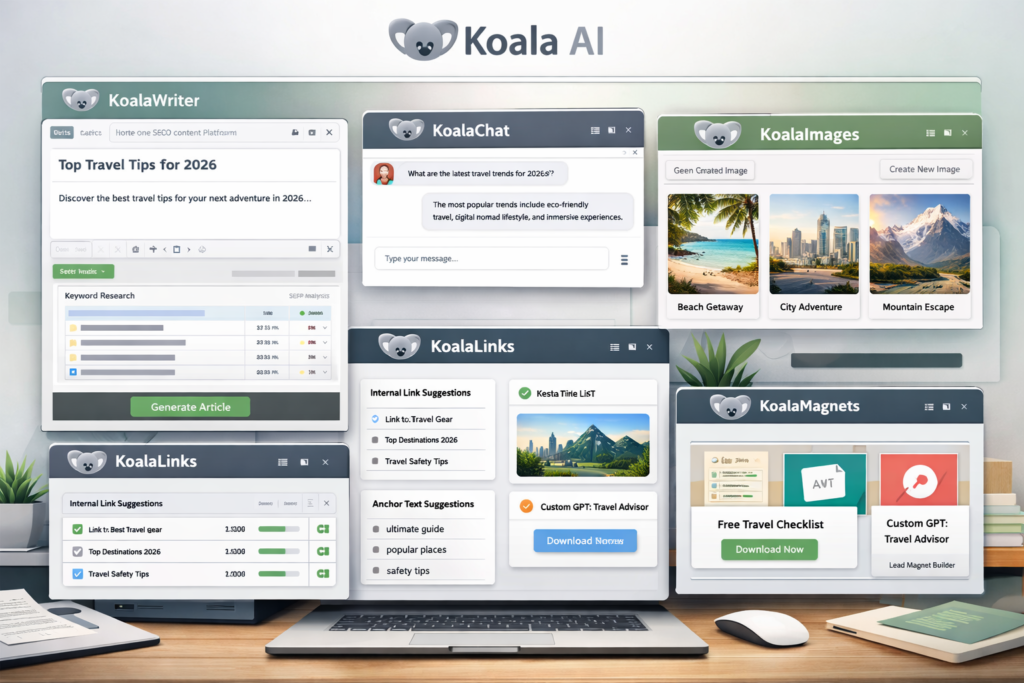
That matters because Koala AI is no longer just “an AI writer.” It now positions itself as an all-in-one content platform built around KoalaWriter, KoalaChat, KoalaImages, KoalaLinks, and KoalaMagnets. In other words, it is trying to cover the real workflow behind ranking content: research, outlining, drafting, formatting, internal linking, images, and publishing.
For people building niche sites, affiliate sites, SaaS blogs, agency content systems, or authority websites, that broader workflow is exactly what makes Koala AI worth a closer look. A lot of AI tools can produce text. Fewer can help you build a repeatable SEO publishing process.
In this in-depth review, I will break down what Koala AI does well, where it still needs human oversight, how its pricing works, which users will get the most value from it, and whether it is actually worth paying for if your goal is traffic, rankings, and content efficiency rather than casual experimentation.
Quick Verdict: Is Koala AI Worth It?
| Overall verdict | A strong fit for SEO-focused publishers who want faster article production with more structure than a generic AI chatbot |
| Best for | Affiliate marketers, bloggers, niche site builders, agencies, and content teams publishing at scale |
| Biggest strength | Purpose-built workflow for SEO content, including real-time data, outlining, images, internal linking, and direct publishing |
| Biggest weakness | You still need editing if you care about originality, brand voice, accuracy, or conversion quality |
| Free trial | Yes |
| Starting price | $9 per month |
| Best starter plan | Professional for most serious website owners |
If your main goal is to publish search-focused content more efficiently, Koala AI is one of the more useful options in its category. If your main goal is highly original thought leadership, luxury-brand editorial writing, or expert-reviewed YMYL content, it is still better treated as a workflow accelerator than a one-click replacement for human writers and editors.
What Is Koala AI?
Koala AI is an AI-powered content platform designed for people who publish articles for search traffic, audience growth, or monetization. The platform includes several connected products rather than one isolated writing tool. KoalaWriter handles article generation, KoalaChat supports research and SEO-oriented assistance, KoalaImages generates visuals, KoalaLinks handles internal linking and schema-related enhancements, and KoalaMagnets is aimed at embedded custom GPT-style lead magnets and engagement tools.
That product structure is important because modern content publishing is rarely just about writing. You usually need current information, a clean outline, on-page structure, tables, internal links, media, and a practical way to publish to your site. Koala AI is clearly built around that reality.
It is also aimed far more at publishers and marketers than at general casual AI users. The messaging around the platform focuses heavily on articles that rank, SEO workflows, real-time data, current SERP analysis, affiliate content support, direct publishing, and scalable production. That makes Koala AI more specialized than a general AI assistant, which is exactly why it stands out to SEO-driven users.
Why Koala AI Stands Out in a Crowded AI Writing Market
The biggest reason Koala AI keeps coming up in SEO circles is simple: it does not behave like a blank chatbot that happens to write. It behaves more like a content production system. That changes the value proposition.
With many AI tools, the real workload begins after the draft appears. You still need to rework the structure, fill in missing sections, fix formatting, insert tables, add images, build internal links, and move everything into WordPress. Koala AI tries to reduce that post-draft cleanup by generating more publication-friendly output from the start.
That does not mean every article will be perfect. It means Koala AI is trying to reduce the number of steps between a target keyword and a publishable article. For people who are running multiple sites or publishing several articles per week, that difference can be enormous.
- It is built for SEO content, not generic chatting.
- It can pull current web information through real-time data.
- It gives you control over the article structure before writing begins.
- It supports AI-generated images and YouTube embedding.
- It can add internal linking as part of the workflow.
- It can publish directly to WordPress and other platforms.
Those advantages do not automatically guarantee rankings. But they do make Koala AI more useful for actual website operators than a tool that only generates paragraphs.
Koala AI Features: What You Actually Get
| Feature | What it does | Why it matters |
|---|---|---|
| KoalaWriter | Creates long-form articles from a target keyword or topic | Speeds up first drafts and article production |
| Real-Time Data | Pulls current information from the web into content generation | Useful for fresher, more accurate articles |
| Deep Research | Uses more context and deeper research during article creation | Reduces editing time on research-heavy topics |
| Outline Editor | Lets you add, remove, and reorder headings before writing | Improves editorial control and SEO structure |
| KoalaImages | Generates AI images directly inside the workflow | Reduces dependence on separate image tools |
| KoalaLinks | Adds internal links, related posts, and schema-related enhancements | Improves site structure and on-page SEO |
| WordPress Integration | Publishes articles directly to WordPress | Saves time on formatting and transfer |
| Other Integrations | Supports Shopify, Webflow, Ghost, webhooks, and more | Useful for multi-platform publishers |
| KoalaChat | SEO-oriented AI chat and research assistant | Helps with planning, research, and ideation |
| API Access | Lets developers automate content workflows | Helpful for agencies and advanced teams |
1. KoalaWriter: The Core Product Most Users Actually Care About
KoalaWriter is still the center of the platform. This is the feature most people are really buying when they sign up for Koala AI. Its job is straightforward: you give it a target keyword or topic, configure your preferences, and it generates a long-form article designed for search-friendly publishing.
What makes it more useful than a plain chatbot is that it is designed around article creation as a structured workflow. KoalaWriter is not only trying to write text. It is also trying to produce a usable title, a logical outline, appropriately broken sections, media options, and a cleaner path to publication.
For SEO users, that matters because good article production is rarely about “who writes the prettiest paragraph.” It is about whether the workflow gets you to a complete, competitive, properly structured page with less friction.
2. Real-Time Data and Deep Research: One of Koala’s Biggest Practical Advantages
One of Koala AI’s strongest selling points is that it can pull real-time data into the writing process. This is more important than it sounds. A lot of AI-written content fails because it relies too heavily on stale model knowledge, misses recent updates, or fills in details that should have been checked against current sources.
Koala AI’s real-time research workflow is especially useful for software reviews, SaaS comparisons, AI tool writeups, pricing discussions, alternative pages, affiliate content, and any topic where products change quickly. If a tool updates its features, changes its pricing, adds integrations, or shifts its positioning, current research becomes part of the ranking equation.
Deep Research pushes that idea further. Instead of only lightly supplementing the draft, it uses substantially more context to build stronger titles, outlines, and content. In practice, this makes Koala AI more appealing for buyers who are tired of shallow, generic AI drafts that need almost as much repair work as writing from scratch.
That said, real-time data is not a substitute for judgment. You still need to check whether the article is making sensible comparisons, presenting information with the right nuance, and speaking to the actual reader intent behind the keyword.
3. Outline Editor: A Small Feature That Has a Huge Impact on Final Quality
Many AI writing tools generate a rigid outline and force you to work around it. Koala AI gives you an Outline Editor that lets you add, delete, edit, and reorder H2s and H3s before the article is written.
This is one of those features that looks minor in a marketing list but matters a lot in real publishing. The quality of an article is often decided before the paragraphs even exist. If the structure is weak, the article is weak. If the structure is aligned with search intent, buyer questions, and logical content flow, the final piece becomes much easier to optimize.
For affiliate sites and review content, this control is especially valuable. You can push more useful sections higher, remove fluff, insert comparison-style subheadings, and make sure the article actually helps a reader decide, not just skim.
4. KoalaImages: Useful for Speed, But Not a Replacement for Strong Visual Strategy
KoalaImages gives you in-workflow AI image generation with multiple styles and placement controls. That is genuinely helpful if your bottleneck is speed and consistency rather than highly custom design.
For many publishers, the goal is not gallery-level artwork. It is having relevant images inside articles without constantly leaving the content workflow. On that level, KoalaImages makes sense. It can reduce tool-switching and make article completion faster.
Still, it is worth being realistic. If your content strategy depends on highly branded visuals, precise feature callouts, custom screenshots, or conversion-focused comparison graphics, you will probably still want to supplement KoalaImages with your own image process. The feature is useful, but it is not the entire visual strategy.

5. KoalaLinks: One of the Most Underrated Parts of the Platform
Internal linking is one of the least glamorous parts of SEO, which is exactly why so many site owners neglect it. KoalaLinks is compelling because it turns internal linking into a repeatable system instead of a manual cleanup job you never quite get around to finishing.
KoalaLinks is designed to analyze your site, add internal links, include related posts, and generate schema-oriented enhancements. For publishers with dozens or hundreds of articles, that can be a real operational advantage. Good internal linking helps both user navigation and search-engine understanding of your site architecture.
The practical appeal here is less about “AI magic” and more about labor reduction. If a tool can save you from constantly revisiting older posts to add contextual links manually, that can free up a surprising amount of time.
6. One-Click Publishing and Integrations Make Koala AI Much More Usable
One of the most frustrating parts of AI content workflows is the last mile: getting the content into your CMS without destroying structure, tables, images, or formatting. Koala AI is clearly trying to solve that with direct publishing integrations.
WordPress is the most important one for many users, and this alone makes Koala AI more practical for affiliate marketers and bloggers. If your site lives on WordPress, cutting down the time spent copying, pasting, fixing headings, and rebuilding article structure is a real advantage.
Koala AI also highlights integrations with Shopify, Webflow, Ghost, webhooks, Google Sheets, and API access. That broader ecosystem makes it more appealing for agencies, teams, and users who are building semi-automated content workflows instead of writing one post at a time.
Koala AI Pricing: Plans, Limits, and Which One Makes Sense
Koala AI starts at a low monthly entry point, which makes it easy to test. But the more important question is not the cheapest plan. The better question is: which plan actually matches a serious content workflow?
| Plan | Price | KoalaWriter allowance | KoalaChat allowance | Who it suits |
|---|---|---|---|---|
| Essentials | $9/month | 15,000 words | 250 messages | Testing the platform or running a very small site |
| Professional | $49/month | 100,000 words | 1,000 messages | Most serious solo site owners and small teams |
| Boost | $99/month | 250,000 words | 2,500 messages | Heavier content schedules |
| Growth | $179/month | 500,000 words | 5,000 messages | Agencies or multi-site operators |
| Elite | $350/month | 1,000,000 words | 10,000 messages | Large content operations |
| Advanced | $500/month | 1,500,000 words | 12,500 messages | Very high-volume publishing teams |
There are also higher-volume Scale plans for larger production environments. For most independent publishers, though, the real decision usually sits between Essentials, Professional, and Boost.
What the Entry Plan Gets You
The Essentials plan is inexpensive, but it is best viewed as a trial-style working plan, not the ideal long-term plan for an aggressive SEO publisher. It includes the core platform, real-time factual data, AI-powered SEO optimization, AI images, YouTube embedding, live Amazon data for affiliate articles, bulk writing mode, WordPress and webhook integrations, Google Sheets integration, and API access.
That is a strong feature bundle for the price. The issue is not feature access. The issue is usage depth. If you are publishing seriously, 15,000 words can disappear fast.
Why Professional Is Probably the Sweet Spot
For most people who actually care about search traffic, the Professional plan is the real starting point. It is where Koala AI begins to feel like a full publishing system rather than a lightweight experiment.
Professional adds 100,000 words, 1,000 chat messages, unlimited file and image uploads, automatic internal linking, Deep Research, AI-powered editing, KoalaLinks, KoalaMagnets, premium image models, custom image styles, and higher token limits in KoalaChat. That is the plan where the platform’s broader value proposition becomes easier to justify.
Annual Billing, Free Trial, and Refund Policy
Koala AI offers both monthly and annual billing. Annual billing saves 20%, and annual credits are available up front for the full year. The platform also offers a free trial, so new users can test the product before committing.
There is also a refund policy: if you are unhappy and have used less than 15,000 words and 100 messages, you can contact Koala AI within 15 days for a refund. That lowers the risk for buyers who want to test the workflow in a real project instead of just reading feature pages.
| Free trial | Yes |
| Current trial allowance | 5,000 words and 25 chat messages |
| Annual discount | 20% off |
| Refund window | 15 days if usage is under 15,000 words and 100 messages |
Koala AI Pros and Cons
| Pros | Cons |
|---|---|
| Purpose-built for SEO content workflows | Still needs human editing for high-quality publishing |
| Real-time data and Deep Research improve freshness | Output can still feel generic if you do not customize structure and prompts |
| Outline Editor gives useful editorial control | Not every user needs the full platform bundle |
| WordPress integration reduces formatting friction | Cheaper plans can feel tight if you publish often |
| KoalaLinks solves a neglected SEO task | Not ideal as a one-click solution for expert or regulated niches |
| Built-in AI images reduce tool switching | High-volume usage can become expensive if content quality is not disciplined |
Who Should Use Koala AI?
Koala AI is a strong fit for people who publish with a clear search or monetization goal. That includes:
- Affiliate marketers who need buyer-intent articles, product comparisons, and review content
- Niche site builders who want a repeatable way to scale informational and commercial content
- Agencies managing content across multiple clients or websites
- In-house SEO teams that need faster first drafts and better workflow control
- Bloggers and publishers who want current research, tables, media, and easier CMS publishing
- Advanced users who value APIs, bulk writing, and workflow automation
The more content you publish, the stronger Koala AI’s value proposition becomes. If you only write one short article occasionally, a simpler or cheaper setup may be enough. If content is central to your traffic strategy, Koala AI becomes much easier to justify.
Who Should Not Rely on Koala AI Too Much?
Koala AI is helpful, but it is not a magic publish button. There are several situations where you should be more cautious.
- YMYL topics such as medical, legal, or financial advice still need expert review
- High-end brand publishing may need more voice control and originality than AI-first workflows naturally provide
- Thought leadership content often performs better when it is shaped by real expertise rather than systematized generation
- Sites chasing conversion quality should still rewrite hooks, CTAs, verdict sections, and buyer guidance carefully
That does not mean Koala AI is a bad fit for these categories. It means the platform is best used as a drafting, structuring, and research accelerator, not as a substitute for real editorial standards.

How to Use Koala AI Effectively for SEO
Buying the tool is not the same as using it well. If you want stronger results, use Koala AI as part of a disciplined workflow rather than treating it like a shortcut machine.
- Start with a realistic keyword target. Do not expect any tool to rank a brand-new site for impossible queries just because the content looks polished.
- Use the Outline Editor before generating. This is one of the easiest ways to improve the final article.
- Enable real-time data for topics that change quickly. Product reviews, pricing, and software updates especially benefit from this.
- Use Deep Research for harder topics. It is worth the extra generation time when you need stronger accuracy and structure.
- Add genuine editorial differentiation after generation. Insert opinions, examples, comparisons, objections, and use-case clarity that generic AI output often misses.
- Improve verdict and CTA sections manually. These sections strongly affect conversion value.
- Use internal linking strategically. KoalaLinks and automatic internal linking help, but your site architecture still needs intention.
- Publish only after reviewing facts, tone, and user fit. Faster workflows are only useful if quality stays high enough to rank and convert.
This is the mindset that gets the best results from Koala AI. Let the tool compress labor. Do not let it replace judgment.
Koala AI vs ChatGPT for SEO Content
This comparison comes up constantly, and it is worth answering clearly. Koala AI and ChatGPT overlap, but they are not really trying to do the same job in the same way.
ChatGPT is broader. It can brainstorm, reason, rewrite, plan, explain, and help across many different tasks. Koala AI is narrower and more operational. It is built specifically to turn topics and keywords into more publication-ready content with research support, structured formatting, media support, internal linking, and publishing integrations.
If you want a flexible thinking assistant, ChatGPT has a broader range. If you want a specialized SEO publishing workflow, Koala AI often makes more practical sense. Many publishers will actually find the strongest setup is not choosing one over the other, but using them for different stages of the content process.
| Area | Koala AI | General AI chatbot |
|---|---|---|
| SEO article workflow | Stronger | Less specialized |
| Real-time content research | Built into the workflow | Varies by tool and setup |
| Direct publishing | Yes | Usually no |
| Internal linking workflow | Yes | Usually manual |
| Open-ended brainstorming | Good | Usually stronger |
| General-purpose reasoning | Not the main focus | Usually stronger |
Is Koala AI Good for Affiliate Marketing?
Yes, Koala AI is one of the more relevant AI platforms for affiliate marketers, especially those publishing software reviews, buyer-intent comparisons, alternatives articles, Amazon-style product content, and monetized informational content.
There are several reasons for that. First, Koala AI is clearly built with SEO article production in mind. Second, it includes support for live Amazon data in affiliate-focused content workflows. Third, it supports tables, structure, media, internal links, and CMS publishing in ways that matter for monetized sites.
Still, affiliate publishers should be careful not to become lazy with evaluation quality. The best affiliate content does more than summarize features. It helps readers decide. That means your article still needs sharper positioning, clearer user-fit analysis, stronger pros-and-cons framing, and a real buying recommendation.
If you use Koala AI to get to a strong first draft faster, then add real product judgment afterward, it can be an excellent affiliate content accelerator. If you treat it as a one-click shortcut to publish thin commercial pages, the results will be much weaker.
What I Like Most About Koala AI
The best thing about Koala AI is not any single feature. It is the way the features connect. That is the real selling point.
A generic AI assistant can help you think. Koala AI is trying to help you publish. That difference matters. Real-time data, outline editing, internal linking, image generation, WordPress publishing, and SEO-friendly article creation all support the same outcome: getting better content live faster.
I also like that the platform gives users an easier path to more structured output. Tables, headings, lists, and workflow-oriented content matter in ranking-focused publishing. Koala AI seems to understand that better than tools that still act like content creation is just a long text box.
What I Would Still Watch Out For
The biggest risk with Koala AI is the same risk that comes with many AI content tools: workflow convenience can tempt people to lower their standards.
A fast first draft is valuable. A publishable first draft is even better. But if you stop there, you often end up with content that is competent rather than memorable, complete rather than persuasive, and optimized rather than genuinely helpful.
That is why I would still review the intro, verdict, CTA sections, comparisons, and claims in every serious article. Those sections tend to matter most for reader trust, conversions, and differentiation. Koala AI can help you get there faster, but the final edge often still comes from human refinement.
Final Verdict: Should You Buy Koala AI?
If your content strategy depends on SEO publishing, Koala AI is easy to take seriously. It offers more than just article generation. It gives you a connected content workflow that includes current research, article structuring, AI images, internal linking, and direct publishing.
That makes it especially attractive for affiliate marketers, bloggers, agencies, and content teams who care about throughput and operational efficiency. The platform is not a replacement for editorial thinking, but it is a strong multiplier for it.
For most serious users, the key question is not whether Koala AI can save time. It clearly can. The more important question is whether you will use the time saved to improve quality, or whether you will let convenience lower your standards. If you choose the first path, Koala AI can be a very useful asset.
My bottom line is simple: Koala AI is worth trying if you want a specialized SEO content workflow, especially if you publish often and care about reducing content production friction. It is most valuable when used by people who still edit, still think, and still care about the final article beyond the first generated draft.

Frequently Asked Questions
Does Koala AI have a free trial?
Yes. Koala AI offers a free trial so you can test the platform before upgrading. At the time of writing, the trial includes 5,000 words and 25 chat messages.
How much does Koala AI cost?
Koala AI starts at $9 per month for the Essentials plan. Higher plans increase word limits, chat limits, and access to more advanced workflow features for larger publishing needs.
Is Koala AI good for SEO?
Koala AI is one of the more SEO-oriented AI content platforms because it focuses on article structure, current research, internal linking, and publishing workflows rather than only raw text generation. That said, results still depend on keyword choice, competition, content quality, and editorial review.
Can Koala AI publish directly to WordPress?
Yes. Koala AI supports direct WordPress publishing, which is useful for reducing copy-paste and formatting friction. It also promotes other integrations for platforms like Shopify, Webflow, Ghost, and custom workflows via webhooks and APIs.
Is Koala AI good for affiliate marketing?
Yes, especially for publishers creating review articles, comparison pages, roundup content, and search-focused commercial content. It is most effective when paired with human product judgment and stronger conversion-focused editing.
What is the best Koala AI plan for most users?
For casual testing, Essentials is enough. For serious SEO publishing, Professional is usually the more practical choice because it adds more usage room and stronger workflow features like Deep Research and internal-linking support.
Does Koala AI replace human writers?
No. It can reduce research, structuring, drafting, and publishing workload, but strong content still benefits from human editing, experience, opinion, and quality control.
