
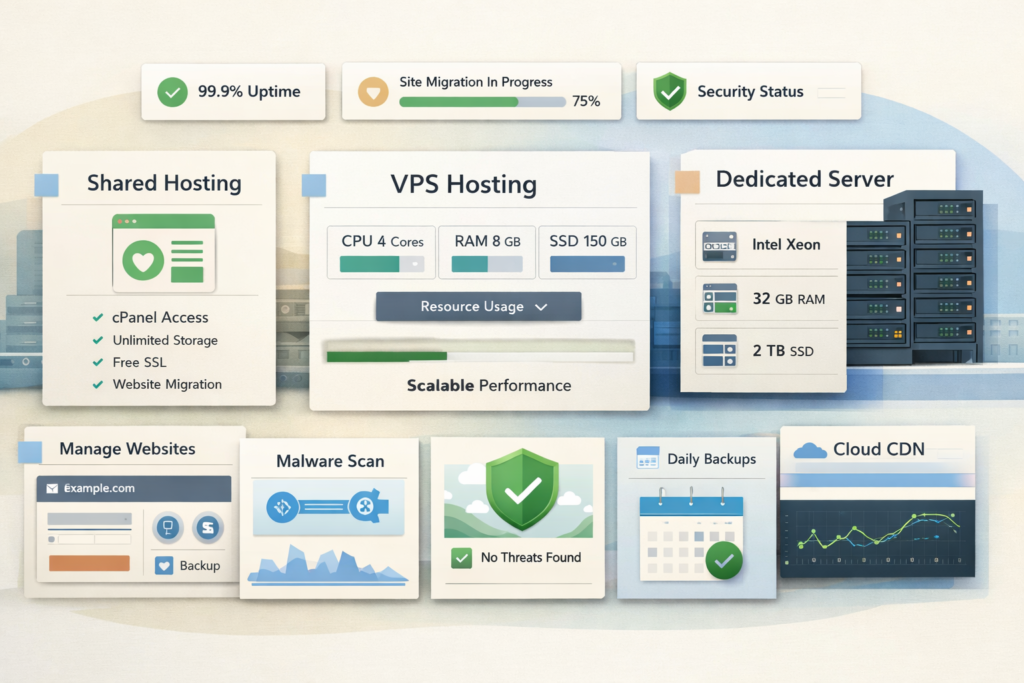
If you are searching for an honest InterServer review, you are probably trying to answer a practical question rather than a flashy one: is InterServer actually a good hosting provider for real websites, or is it just another budget host that looks cheap at checkout and becomes disappointing later? That is the right question to ask, because in hosting, low prices only matter if the service can still deliver stability, useful features, reasonable support, and room to grow.
InterServer is one of the longer-running hosting brands in the industry, and that alone makes it worth a closer look. It is not a trendy new host trying to win attention with aggressive branding. Instead, it positions itself as a practical, value-focused provider offering shared web hosting, WordPress hosting, VPS hosting, reseller hosting, dedicated servers, and colocation. That broader product range matters more than many people realize. A hosting company becomes much more useful when you can start on a low-cost plan and still have a realistic upgrade path later without rebuilding everything on a completely different provider.
What makes InterServer especially interesting is that it tries to compete on long-term value rather than just entry-level marketing. The official site emphasizes its low starting price for web hosting, free migration, security tooling, caching, support access, VPS scalability, and bare metal options. In other words, the brand is not only trying to sell a cheap first month. It is trying to sell a hosting ecosystem.
This review takes a full, search-focused look at InterServer from the perspective of someone choosing hosting for a real project. We will cover pricing, shared hosting, WordPress hosting, VPS, dedicated servers, infrastructure, security, support, usability, pros and cons, and the types of users who should seriously consider it. The goal is not to praise it blindly. The goal is to see where InterServer is genuinely strong, where it is more average, and whether it deserves a place on your shortlist in 2026.
Quick Verdict: Is InterServer Worth It?
Yes, InterServer is worth considering if your priority is value, straightforward pricing, practical features, and the ability to scale from shared hosting into VPS or dedicated infrastructure later. It is especially attractive for bloggers, affiliate marketers, small businesses, developers, and site owners who care more about real hosting utility than polished marketing language.
InterServer is not the most premium-looking hosting brand, and that is important to say up front. Some competitors feel more beginner-polished, more design-driven, or more “managed” in presentation. But InterServer has a different kind of strength. It offers a very affordable starting point, a surprisingly broad service catalog, strong security and caching language on the official site, free migration, and a much better long-term upgrade path than many entry-level hosts. For practical buyers, that can be more valuable than a sleek dashboard.
| Category | Verdict |
|---|---|
| Overall value | Very strong for cost-conscious users |
| Shared hosting | One of the most compelling parts of the platform |
| WordPress hosting | Good for users who want extra protection without going fully premium |
| VPS hosting | Affordable and scalable for growing projects |
| Dedicated servers | Useful for advanced users who want more control at a competitive starting price |
| Best for | Blogs, affiliate sites, small business websites, developers, resellers |
| Less ideal for | Users who want the most polished premium hosting experience |
What Is InterServer?
InterServer is a web hosting company founded in 1999. Over time, it expanded from basic hosting into a broader infrastructure provider covering standard web hosting, WordPress hosting, VPS hosting, reseller hosting, dedicated servers, and colocation. That broader service mix is one of the most important things to understand about the company.
Many hosting brands are easy to recommend only at one stage of growth. They may be fine for a first site, but less compelling once traffic increases, custom deployment needs appear, or multiple projects need more isolation. InterServer is more interesting because it can serve several different stages of growth under one roof. Someone can begin with cheap shared hosting, move into VPS later, and eventually graduate to a dedicated server if the business grows enough to justify it.
That makes InterServer more than just a “cheap hosting” option. It makes it a provider with a practical upgrade ladder. For long-term projects, that matters. Migrating hosts is not impossible, but it is never something site owners want to do more often than necessary. A provider that gives you room to grow can be much more valuable than one that only looks good at the starting point.
InterServer Pricing Overview
One of the biggest reasons InterServer gets attention is pricing. The brand keeps the entry point low, but it also has multiple product tiers for different needs. That combination makes it easier to recommend than a host that only has one attractive low-end offer.
| Product | Starting Price | Best For | Why It Matters |
|---|---|---|---|
| Standard Web Hosting | $2.50/month | Blogs, affiliate sites, business websites, niche sites | Very low entry cost with a generous feature set |
| Managed WordPress Hosting | $8/month | Single-site WordPress users who want added protection | Adds WordPress-focused backups and security features |
| Cloud VPS | $6/month | Developers, power users, fast-growing websites | Affordable path to more isolated resources and control |
| Reseller Hosting | $19.95/month | Agencies, freelancers, hosting resellers | Lets you host client accounts under one plan |
| Dedicated Servers | $99/month | Advanced deployments and higher-resource workloads | Strong upgrade path beyond VPS |
That pricing spread is useful because it covers several buyer intents in one brand. Someone searching “InterServer review” may actually be comparing shared hosting. Someone else may care about InterServer VPS or dedicated servers. A strong review should cover the full picture, because buying decisions often evolve once the reader sees what else is available.
Budget alone should never be the only reason to choose a host. But when a provider combines low pricing with free migration, uptime guarantees, support access, and infrastructure detail, the price stops being a gimmick and starts becoming part of a broader value proposition. That is where InterServer becomes more compelling.
What Makes InterServer Stand Out?
InterServer does not stand out because of flashy branding. It stands out because the official site presents a number of practical, decision-relevant features that many buyers care about far more than design.
The first is its in-house security positioning. InterServer promotes InterShield Security as a built-in solution that uses data gathered from thousands of servers and websites to detect attacks and replicate protection rules across the platform. The site also highlights a machine-learning firewall, automatic virus scanning, and an in-house malware database. For ordinary site owners, that is more meaningful than generic “we take security seriously” language.
The second is the performance stack it describes under Inter-Proxy Caching + CloudFlare. InterServer explains multiple layers of optimization, including MegaRaid SSD caching, RAM usage for small files, LSCache for dynamic content, and QUIC for reduced connection times. Whether every customer needs to understand each layer is not the point. The point is that InterServer is at least naming concrete mechanisms rather than making vague claims about speed.
The third is its migration and recovery positioning. InterServer advertises free migration, and it also promotes what it calls Inter-Insurance, which includes cleanup of compromised, hacked, or exploited accounts. That is highly relevant for WordPress users, site owners moving away from weak hosting, or anyone inheriting a project that may not be in perfect shape.
The fourth is the control panel and server-capacity messaging. InterServer highlights DirectAdmin as a simple web-based control panel and says it runs at 50% server capacity so websites have room to grow without overcrowding. Whether or not a user cares about hosting jargon, they do care about slowdowns, crowded servers, and avoidable migrations. This messaging speaks directly to that concern.
Those features together create a clear positioning: InterServer is trying to be the practical host that gives you more substance than its low price might initially suggest.
InterServer Shared Hosting Review
For most readers, the main attraction is still the standard web hosting plan. This is where InterServer makes its strongest first impression, because the official site combines a very low entry price with a feature list that does not look stripped down.
The standard plan is positioned as a general-purpose hosting package for websites and blogs. The official plan comparison shows unlimited storage space, unlimited data transfer, weekly backups, unlimited FTP accounts, Cloud Apps, SSD caching servers, RAID-10 storage, speed optimization, LiteSpeed on the standard monthly plan, Cloud Linux OS, 10GB Cisco network references, Free CloudFlare CDN, free migration, a 30-day guarantee, a Price Lock Guarantee, a 99.9% uptime guarantee, and 24/7 support. It also lists unlimited websites/domains, unlimited parked domains, unlimited subdomains, discounted domain registration, and free SSL certificates on the standard plan.
That is a generous feature mix for entry-level hosting. A lot of low-cost hosts force users into higher tiers just to remove basic limitations. InterServer looks more flexible by comparison. Unlimited websites alone can be useful for buyers who manage multiple niche sites, test projects, or side businesses. Weekly backups and free SSL cover essentials that many site owners would otherwise have to think about separately. Cloudflare CDN inclusion adds another practical layer of value.
The standard plan also has a strong appeal for affiliate marketers and content-site owners. These users often care about three things above all else: keeping fixed costs low, maintaining uptime, and having a simple upgrade path when traffic starts to grow. InterServer checks all three boxes fairly well. You can start cheap, use the included platform features, and later move into VPS if a site becomes more demanding.
Another underrated part of the standard plan is its balance between beginner use and technical credibility. The site mentions LiteSpeed, RAID-10 storage, SSD caching, Cloud Linux OS, and network capacity, which gives more confidence than a generic sales page that only says “fast hosting.” Even buyers who are not deeply technical often understand that named infrastructure features usually signal a more serious product.
The main weakness is not the plan itself. It is the experience around it. InterServer feels more functional than premium. Some users love that because it suggests less marketing fluff. Others prefer a more modern onboarding flow and more polished design. Whether that matters depends on your priorities. For many budget-focused buyers, it will not be a deal-breaker.
InterServer WordPress Hosting Review
InterServer also offers a separate managed WordPress hosting plan, and this is where the platform becomes more relevant to readers who want a WordPress-specific option without jumping to expensive boutique hosting brands.
The official WordPress plan includes unlimited storage space, unlimited data transfer, weekly backups, unlimited FTP accounts, Cloud Apps, SSD caching servers, RAID-10 storage, speed optimization, Cloud Linux OS, Free CloudFlare CDN, free migration, a 30-day guarantee, a Price Lock Guarantee, a 99.9% uptime guarantee, and 24/7 support. On top of that, the WordPress-specific section lists an easy WordPress installer, daily backups, weekly backups, daily Git revisions, Atomic Mod Security, hacked WordPress cleanup, daily virus scan, and support for using any plugin.
That combination is meaningful because it addresses several common WordPress concerns directly. Site owners do not just want the site to load. They want to recover quickly if something breaks, avoid security disasters, update with less risk, and keep plugins flexible. Daily backups and hacked-site cleanup are especially relevant because WordPress problems are rarely about uptime alone. They are often about plugin conflicts, outdated themes, malware, or poor site hygiene after migration.
InterServer’s WordPress plan is also clearly positioned around practicality rather than luxury branding. It does not try to present itself as an ultra-premium concierge platform. Instead, it offers a useful middle ground: more WordPress-specific protection than generic shared hosting, but without pushing the price into a much higher tier. That makes it attractive for bloggers, small business owners, and content publishers who want more confidence than basic shared hosting but do not want to pay premium managed WordPress prices.
One thing to keep in mind is that the official plan details show one website/domain and one parked domain under the WordPress package. For users who only need one main WordPress site, that is fine. But users running multiple sites may find the standard shared plan or a VPS more flexible, depending on how they want to manage their setup.
InterServer VPS Review
InterServer becomes even more interesting when you move beyond shared hosting into VPS. This is where the company stops looking like a simple budget host and starts looking more like a genuine infrastructure provider.
The Cloud VPS line starts at a very accessible price point, and the first listed plan includes 1 core, 4GB of memory, 80GB SSD storage, 4TB transfer, and a 10Gbps shared port. From there, the plans scale upward in a slice-based system, increasing CPU, memory, storage, and bandwidth allocation step by step. That kind of modular scaling is useful for users who want a clearer path upward without jumping abruptly into a much more expensive managed cloud environment.
VPS hosting matters for several categories of buyers. The first is developers who want more control than shared hosting can offer. The second is growing websites that need more isolated resources. The third is site owners running multiple projects, heavier plugins, or custom software stacks that shared hosting simply is not designed to handle gracefully. InterServer’s VPS pricing helps bridge the gap between entry-level hosting and more serious deployments.
For SEO and affiliate projects, VPS is often where a site portfolio ends up once traffic and plugin complexity rise. If you only ever plan to run one small site, you may never need it. But if you are building several projects and want more consistent performance control, VPS becomes much more relevant. InterServer’s strong point here is not that it is the most luxurious VPS provider on the market. Its strength is that it keeps the barrier to entry low while still offering a wide scaling ladder.
That makes InterServer VPS especially appealing to users who want to graduate from shared hosting without immediately moving to a much more expensive cloud stack. It is a practical next step, not a dramatic leap.
InterServer Dedicated Server Review
The dedicated server catalog adds another layer of credibility to InterServer as a long-term hosting provider. Plenty of budget hosts offer shared hosting and maybe some VPS products, but fewer have a meaningful bare metal lineup that makes sense as a real upgrade path.
InterServer’s customizable dedicated server page shows an AMD Ryzen 5900X configuration starting at $99 per month, with 12 cores, 64GB memory, 1Gbps unmetered connectivity, IPMI Console, and DDoS Protection. Higher configurations then scale upward with stronger CPUs and more resources. This matters because it shows InterServer is not only trying to capture entry-level customers. It is also set up to keep advanced users inside the ecosystem.
Dedicated servers are not relevant to every buyer, but they matter for brand evaluation. When a host can serve small sites, WordPress sites, developers, resellers, and higher-performance custom deployments, it becomes easier to recommend as a platform rather than a single cheap plan. That broader service range often reduces the need to switch providers later, which can save time and risk.
For agencies, advanced application users, larger e-commerce setups, gaming-related deployments, or businesses with special performance and access needs, dedicated servers are often the right stage of growth. The fact that InterServer already has this catalog in place improves its long-term value proposition even for users who are not ready for bare metal today.
Performance, Network, and Data Center Positioning
Hosting reviews often become repetitive because many providers say the same thing: fast, reliable, secure. The difference is whether the site gives enough detail to suggest there is real infrastructure behind the promise. InterServer does a better job here than many price-focused competitors.
The network page states that InterServer is powered by a mesh of 100Gbps Ethernet connections, connected to multiple Tier 1 IP backbone providers, and uses intelligent BGPv4 routing to direct traffic to the fastest and closest backbone provider. It also states that the company maintains an N+1 network upgrade policy for immediate failover readiness. Those are specific technical details, and they strengthen the impression that InterServer is infrastructure-conscious rather than purely marketing-driven.
The data center page also adds useful context. InterServer states that its main data centers are near NYC in Secaucus, New Jersey and that its facilities guarantee 100% power uptime and 99.9% network uptime. The page lists multiple Secaucus-area facilities, including feature details around power, cooling, physical security, and connectivity. That matters because reliability depends on far more than just the plan page. It depends on the physical and network environment underneath the service.
InterServer’s About page says the company now operates two data centers in Secaucus, NJ and one in Los Angeles, CA. Its network and location navigation also reference Dallas. For most ordinary site owners, the key point is not the exact number of facilities. It is that InterServer has a meaningful physical infrastructure story and publishes enough detail to support its reliability claims.
Compared with many bargain hosts that feel like anonymous front-ends selling low-cost plans, InterServer comes across as more operationally grounded. That does not automatically make it the best host for everyone, but it does make the value proposition more believable.
Ease of Use and Support
Ease of use is one of the more nuanced parts of this review. InterServer explicitly highlights DirectAdmin as a simple, web-based dashboard for managing websites, email, and databases. It describes the interface as beginner-friendly, lightweight, and suitable for site owners, admins, and resellers. If your priority is functional account management, that is a solid positive.
At the same time, some competing hosts feel more polished in branding and onboarding. So the user experience question depends on what you mean by “easy.” If you mean a practical control panel with standard hosting functions and less bloat, InterServer can be very reasonable. If you mean the most modern-looking premium setup flow in the industry, InterServer is less likely to impress you.
Support is easier to judge positively because the company emphasizes around-the-clock customer support with live representatives available 24/7. The homepage and About page both reinforce support accessibility as part of the brand’s identity. That matters a lot for budget hosting, because low prices stop being attractive very quickly if support disappears when you need it most.
Free migration also plays into usability. Many users are not choosing a first-ever host. They are moving away from another provider. A host that offers free migration and promotes a hands-off transfer process removes one of the biggest friction points in switching. That improves the real customer experience more than cosmetic polish does.
InterServer Pros and Cons
| Pros | Cons |
|---|---|
| Very affordable starting price for shared hosting | Branding and interface feel more functional than premium |
| Broad product lineup from shared hosting to dedicated servers | Less polished onboarding than some mainstream competitors |
| Strong feature set on the standard plan | May feel old-school to users who want a more modern front-end experience |
| Free migration and 24/7 support positioning | Not the most luxury-positioned managed WordPress option |
| Useful built-in security and caching messaging | Some users may prefer a host with a more global premium brand image |
| Good upgrade path as projects grow | The value-first approach will appeal more to practical buyers than style-driven buyers |
Who Should Use InterServer?
InterServer is a strong fit for several types of users.
- Bloggers and affiliate marketers who want low-cost hosting with enough features to avoid constant upsells
- Small businesses that need a practical, affordable hosting platform with migration help and support availability
- WordPress users who want added protections like daily backups, daily virus scanning, and hacked-site cleanup
- Developers and technical users who may eventually need VPS or dedicated resources under the same provider
- Agencies and freelancers who want reseller options or room to scale client projects over time
InterServer works particularly well for buyers who think in terms of long-term hosting value rather than surface-level presentation. If you care about total cost, migration convenience, practical features, and future flexibility, it becomes easier to appreciate what the platform offers.
Who Should Skip InterServer?
InterServer may not be the best fit for everyone.
- Users who want the most premium-feeling onboarding and dashboard experience
- Buyers who choose hosts mainly based on sleek presentation and brand polish
- Customers who want boutique managed WordPress branding first and pricing second
- Users who strongly prefer a more curated, hand-held hosting ecosystem over a value-first one
None of those points make InterServer a weak host. They simply reflect that its strengths are practical rather than luxurious. Some readers will see that as a drawback. Others will see it as exactly the reason to choose it.
Is InterServer Good for SEO-Focused Websites?
Yes, InterServer can be a good option for SEO-focused websites, especially content sites, affiliate blogs, local business websites, and niche publishing projects that need to stay cost-efficient while still having room to grow. Good SEO hosting is not about hype. It is about stability, sensible performance features, security, and the ability to upgrade before hosting becomes the bottleneck.
InterServer’s standard hosting plan is particularly relevant here because it combines low cost with multiple features site owners actually use: weekly backups, free SSL, Cloudflare CDN, LiteSpeed on the standard plan, free migration, 24/7 support, and an official stance against overcrowding through its 50% server capacity messaging. For many content-driven websites, that is a practical combination.
SEO-focused site owners also tend to think ahead. A site that ranks well may eventually need stronger resources, more flexibility, or greater isolation. This is where InterServer’s broader catalog helps. You are not limited to shared hosting only. If traffic grows, VPS and dedicated options already exist within the same ecosystem.
That does not mean hosting alone will make a site rank. It will not. But choosing a host that stays affordable, stable, and scalable makes it easier to build without unnecessary friction. InterServer is a reasonable choice on that front.
Final Verdict: Should You Choose InterServer?
InterServer is not the flashiest hosting company in the market, but that is also part of its appeal. It feels like a provider that wants to compete on practical value rather than design theatrics. The standard shared hosting plan is attractively priced, the WordPress plan adds useful protection features, the VPS lineup offers an affordable next step for growing projects, and the dedicated server catalog gives the brand far more long-term depth than many budget hosts.
If your top priority is a premium-feeling interface or the most polished beginner experience, you may prefer a more design-led competitor. But if your priority is finding a host that starts cheap, includes useful features, offers free migration, takes infrastructure seriously, and gives you room to grow, InterServer deserves a place on your shortlist.
For bloggers, small businesses, affiliate marketers, WordPress site owners, and developers who want substance over polish, InterServer is a solid value-driven option in 2026.
Frequently Asked Questions
Is InterServer good for beginners?
InterServer can be good for beginners, especially those who value practical pricing, free migration, and straightforward hosting tools. It is not the most premium-looking hosting experience, but it gives users the essentials without forcing them into expensive upgrades too early.
Does InterServer offer WordPress hosting?
Yes. InterServer offers a dedicated WordPress hosting plan with WordPress-specific features such as daily backups, daily virus scanning, daily Git revisions, Atomic Mod Security, and hacked WordPress cleanup.
Does InterServer offer VPS hosting?
Yes. InterServer offers Cloud VPS hosting with low entry pricing and multiple slice-based scaling options, making it suitable for users who need more control or isolated resources than shared hosting can provide.
Does InterServer offer dedicated servers?
Yes. InterServer offers dedicated server options for users who need stronger hardware, more control, and infrastructure suited to heavier workloads or advanced custom deployments.
What is InterServer best known for?
InterServer is best known for affordable hosting, a broad range of infrastructure services, practical feature sets, free migration, and a value-oriented approach that gives users multiple upgrade paths as their projects grow.
About the Author
Xu Xun
Contact: xuxun1208@gmail.com
Last Updated: June 2026