
If you are researching the best way to start a U.S. business and keep the back office under control, this doola review is worth a serious look. Most founders first hear about doola because of LLC formation. But the real reason people consider it is much bigger than formation alone.
doola is designed to help entrepreneurs handle the operational side of business: forming a company, getting core documents in place, staying compliant, managing bookkeeping, handling tax workflows, and, in some cases, getting visibility into e-commerce performance. That positioning makes it very different from a basic filing service that only helps you submit formation paperwork and then leaves you on your own.
That difference matters for SEO and buyer intent too. People searching for “doola review” are often not just looking for the cheapest way to form an LLC. They want to know whether doola is worth paying for, whether it can replace multiple tools or service providers, and whether it is a smart option for international founders, online businesses, consultants, agencies, and e-commerce brands.
In this guide, I’ll break down what doola does, how its pricing works, what each plan includes, its biggest strengths and weaknesses, who it is best for, and when it may not be the right fit. I’ll also cover how doola compares to simple formation-only services and why its all-in-one model can either save you time or cost you more than you need, depending on your business stage.
Quick Verdict
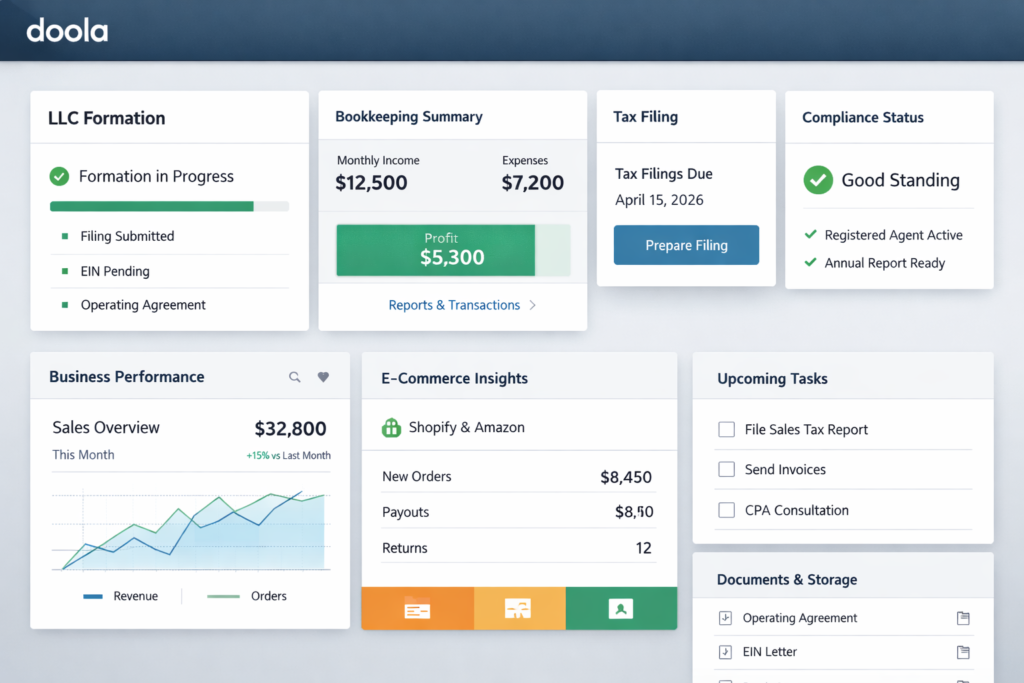
doola is one of the more compelling choices for founders who want more than LLC filing. Its strongest value comes from combining company formation, compliance support, bookkeeping workflows, tax-related support, and founder-friendly guidance in one ecosystem. That makes it especially attractive for non-U.S. founders, online business owners, e-commerce sellers, and busy entrepreneurs who would rather not assemble a separate stack for formation, registered agent service, bookkeeping, annual filings, and operational admin.
If you only want the cheapest possible LLC formation, doola is not the most obvious pick. But if you want one platform that can help you launch and keep the business organized after launch, it becomes much more competitive. In other words, the best way to evaluate doola is not as a bargain filing site. It makes more sense as a founder operations platform.
What Is doola?
doola is a business setup and back-office platform for entrepreneurs. Instead of stopping at company formation, it extends into registered agent service, EIN-related workflows, business documents, bookkeeping, tax filing support, and analytics. It is clearly positioned around helping founders reduce administrative friction so they can focus on building and selling.
This matters because one of the biggest problems new founders face is not forming the business itself. The harder part is everything that comes immediately after: staying compliant, keeping books clean, understanding what filings are due, separating personal and business finances, collecting the right documentation, and making sure nothing important slips through the cracks.
doola tries to solve that by putting the business back office into one environment. For some founders, that is a premium convenience. For others, especially cross-border entrepreneurs and fast-moving online businesses, it can be a real operational advantage.
What Makes doola Different From Basic LLC Formation Services?
A lot of LLC services are mostly checkout funnels. They help you file paperwork, maybe sell you a few add-ons, and then leave the rest of the operational burden to you. doola’s pitch is broader. It is trying to help founders not only form the company, but also manage the messy, recurring work that comes after formation.
That broader positioning is the key reason the product gets attention. When you buy only formation, you still need to think about registered agent coverage, EIN timing, business address needs, bookkeeping structure, state filings, IRS paperwork, and often tax support. doola tries to reduce the number of separate providers you need to manage.
For founders who value simplicity, that is a major selling point. For founders who already have a CPA, a bookkeeper, a compliance process, and a clean financial stack, it may be less compelling.
doola Pricing Overview
One of the biggest reasons people search for a doola review is pricing. The product looks straightforward at first, but the real value depends on which layer of service you actually need.
| Plan | Price | Best For | Main Value Angle |
|---|---|---|---|
| Starter | $297/year + state fees | First-time founders who need the basics | Formation essentials without paying for the full back-office stack |
| Pulse | 30-day free trial, then $300/year | Businesses focused on bookkeeping and analytics | Software-led visibility into finances and performance |
| Tax and Compliance | $1,999/year + state fees | Founders who want ongoing compliance and tax support | Formation plus ongoing administrative relief |
| Business-in-a-Box | $2,999/year + state fees or $329/month + state fees | Founders who want the most complete support | The most hands-on package, including dedicated bookkeeping support |

Starter Plan
The Starter plan is the entry point for entrepreneurs who mainly want to launch the company and get core formation items in place. It is the most realistic option for budget-conscious founders who still want doola’s ecosystem, but do not yet need full tax and bookkeeping support.
From an evaluation standpoint, Starter makes sense when your goal is to get the business formed, secure the main documents, and create a path toward business banking and payments. It is not the plan that fully showcases doola’s “all-in-one” promise, but it does give you a lower-risk way to enter the platform.
Pulse
Pulse is more software-oriented. It is aimed at bookkeeping and analytics rather than formation-heavy support. This makes it more relevant for businesses that already exist and now want clearer visibility into financial activity, payouts, expenses, and business performance.
For readers landing on this article from commercial search, Pulse is not usually the headline plan. Still, it matters because it shows doola is not just a formation brand. The company is also trying to own more of the founder operating layer after the business is already running.
Tax and Compliance
This is where doola becomes more interesting. Tax and Compliance is the plan that best reflects the platform’s broader promise: not just getting the business created, but keeping it legally and operationally organized. If you are a founder who gets stressed by deadlines, tax tasks, recurring compliance, or scattered admin, this is the tier that will feel most aligned with the reason you considered doola in the first place.
For many users, this will likely be the most balanced plan. It is much more expensive than a basic formation package, but it also solves a much bigger problem.
Business-in-a-Box
Business-in-a-Box is the full-service tier. It is built for founders who want the most complete operational setup and prefer not to manage bookkeeping support separately. If you want maximum convenience and a more guided experience, this is the premium path.
This plan will not be the best fit for every founder, but it is appealing for higher-velocity businesses, international founders who need extra confidence, and operators who would rather pay more to reduce complexity.
What Features Do You Actually Get With doola?
The best way to evaluate doola is by looking at the full operational stack instead of focusing on one checkbox feature. Below is what really matters when deciding whether doola is worth the money.
1. U.S. Company Formation
doola helps founders form a company in the United States and presents this as a streamlined process that can work across all 50 states. This is the entry point for most users. If your immediate goal is to create a legal business entity and move toward a U.S. operating setup, this is the first layer of value.
Formation by itself is not unique. What matters is what comes bundled around it. doola’s formation story is stronger because it is tied to documents, compliance, and post-formation workflows rather than treated as a one-time transaction.
2. EIN and Business Documentation Workflows
New founders often underestimate how important documentation is. If you want to open a business bank account, apply for payment processors, separate finances properly, or prepare for tax tasks, clean documentation matters. doola puts a lot of emphasis on making these business documents easier to obtain and organize.
That is especially useful for international founders. The challenge is not just “can I form the company?” It is “can I get the documents, the EIN, the banking path, and the business setup organized in a way that actually supports operations?” doola is clearly designed around that question.
3. Registered Agent Service
Registered agent service is one of those features that sounds boring until you need it. It matters because it helps ensure you receive important government documents and maintain compliance. doola includes registered agent support as part of its formation-oriented offering, which makes the platform more complete than a bare filing-only product.
For founders who live outside the U.S. or do not want to think about recurring formalities, this is a meaningful convenience rather than a throwaway add-on.
4. Bookkeeping
Bookkeeping is one of doola’s most important differentiators. Many founders start with spreadsheets, then gradually realize they are losing visibility into transactions, expenses, and reporting. doola’s bookkeeping layer is designed to bring financial activity into one place, with stronger support in higher tiers.
This is where doola becomes more than a startup setup tool. It starts acting like an operating system for the business back office. If your company is already transacting, getting paid, paying contractors, buying software, or managing online sales, bookkeeping quality can matter more than the original formation step.
5. Tax Filing and Compliance Support
Taxes and ongoing compliance are where many founders get stuck. They know they need to stay in good standing, but they are unclear on what is due, when it is due, how state obligations differ, and how bookkeeping feeds into tax readiness. doola’s stronger tiers are built around solving exactly that pain point.
This is one of the main reasons the platform can justify premium pricing. A missed filing or sloppy tax workflow can cost more than the subscription. For the right user, the value is not “cheap formation.” It is “fewer opportunities to make expensive admin mistakes.”
6. E-Commerce Analytics and Operational Visibility
doola is not positioned only for consultants or freelancers. It also speaks directly to e-commerce founders. That matters because e-commerce businesses often need tighter coordination between formation, books, taxes, payout tracking, transaction visibility, ad monitoring, and business performance. The analytics angle makes doola feel more like a founder operations platform than a generic admin service.
If you run Shopify, Amazon, or another online business model, this can make doola more attractive than a standard filing service that never evolves beyond entity setup.

7. AI Co-Founder
AI Co-Founder is one of doola’s more modern differentiators. Instead of just offering static help documentation, doola is trying to make its platform easier to navigate with contextual AI support. That can improve user experience, especially for founders who are overwhelmed by terms like EIN, state filings, bookkeeping questions, compliance deadlines, and tax documentation.
What matters here is expectation-setting. AI Co-Founder can make the platform feel more helpful and responsive, but it should not be treated as a replacement for licensed professional advice. Think of it as a founder assistance layer, not a substitute for legal or tax judgment.
Who Is doola Best For?
The right customer for doola is not simply “someone who needs an LLC.” The best fit is usually someone who wants the business infrastructure organized, not just created.
| User Type | Why doola Can Be a Strong Fit |
|---|---|
| Non-U.S. founders | doola is clearly designed to help international founders form a U.S. business and move toward banking, documents, and compliance workflows. |
| E-commerce business owners | The analytics, bookkeeping, transaction tracking, and tax/compliance angle fit online selling better than a simple filing service. |
| Busy solo founders | If you do not want to coordinate multiple vendors, doola’s all-in-one positioning becomes more valuable. |
| Agencies and service businesses with growing admin needs | Once revenue and expenses become more complex, bookkeeping and compliance support can save time and reduce friction. |
| Founders who worry about missing filings | The platform is strongly oriented around staying compliant and reducing administrative confusion. |
Who Should Probably Skip doola?
Not every founder needs doola. In some cases, it can be more product than you actually need.
| User Type | Why It May Not Be the Best Fit |
|---|---|
| Price-first founders | If your only goal is the cheapest possible LLC filing, simpler options can cost less. |
| Founders with an existing CPA and bookkeeper | You may already have the core support stack doola is trying to replace. |
| Very simple side projects | If there is minimal revenue, no complexity, and no near-term compliance pressure, premium tiers may be overkill. |
| People expecting legal advice from software | doola’s AI and platform support are useful, but they are not a substitute for personalized legal or tax advice. |
doola Pros and Cons
| Pros | Cons |
|---|---|
| Broader than a typical LLC filing service | Not the cheapest option for formation-only users |
| Strong fit for international founders | State fees are extra |
| Includes compliance, bookkeeping, and tax-oriented support in premium tiers | Some of the most attractive benefits sit behind higher-priced plans |
| E-commerce and analytics positioning make it more relevant for online businesses | Budget users may not fully use everything they pay for |
| Business-in-a-Box offers a more hands-off experience | You still need to choose the right tier carefully to avoid overspending |
Is doola Worth It?
For the right founder, yes. But the value depends entirely on what problem you are trying to solve.
If your problem is “I need the cheapest way to file an LLC,” doola may feel expensive. If your problem is “I want one place to help me launch, stay compliant, keep the books cleaner, organize my business documents, and reduce administrative stress,” the value case becomes much stronger.
This is the best framework for making the decision. doola is not primarily a low-cost filing product. It is an operational simplification product. For some founders, that difference is exactly why it is worth paying for.
It becomes especially compelling in three situations. First, you are a non-U.S. founder and want a smoother path into a U.S. entity structure. Second, you run an online business and want better alignment between bookkeeping, compliance, and sales visibility. Third, you are a busy founder who knows that neglected admin eventually becomes expensive admin.
👉 Want one platform to help you launch and keep your business organized? Explore doola here.
doola for Non-U.S. Founders
doola is especially relevant for international entrepreneurs. A lot of founders outside the U.S. want access to U.S. business infrastructure, but the process can feel fragmented. You need formation, documentation, EIN-related progress, banking readiness, and a clearer path to accepting payments. Managing all of that across multiple providers is one reason international founders are often drawn to doola.
For that audience, doola’s value is not only convenience. It is clarity. The company is very explicit about serving founders from anywhere and helping them move toward a usable U.S. business setup rather than just a legal entity on paper.
This does not mean every international founder should automatically choose doola. But it does mean the platform is more aligned with global founder needs than many generic LLC sites that mostly assume a domestic customer.
doola for E-Commerce Sellers
doola also deserves attention from e-commerce founders. Online sellers often need more than formation. They care about orders, payouts, transaction records, ad visibility, bank connections, tax tracking, reseller-related needs, and staying organized while the business grows. That is one reason doola’s e-commerce positioning stands out.
If your business lives in Shopify, Amazon, or similar environments, doola’s broader visibility and operational support can be more useful than a formation-only provider. The platform is trying to live closer to the actual rhythm of an online business, not just the legal birth of one.
That does not automatically make it the best e-commerce platform overall. But it does make it a more relevant option for online sellers than many founder tools that stop at entity creation.
How doola Compares to Basic Formation-Only Services
One of the smartest ways to judge doola is to compare it not against every business tool on earth, but against the simpler formation-only category.
| Evaluation Point | Basic Formation Service | doola |
|---|---|---|
| LLC formation | Usually yes | Yes |
| Registered agent support | Sometimes included, often upsold | Built into the broader founder setup story |
| Bookkeeping | Usually no | Yes, with deeper value in premium tiers |
| Tax/compliance workflows | Often limited or separate | A core part of premium plan value |
| International founder fit | Often weaker | One of doola’s strongest positioning angles |
| E-commerce analytics angle | Rare | Yes |
| All-in-one convenience | Usually low | A major selling point |
| Lowest possible price | Often better | Usually not the cheapest |
The takeaway is simple: if you are comparing doola to bare-minimum filing services, the price can look high. If you are comparing it to the combined cost and friction of multiple providers, the value can look much better.
How to Get Started With doola
doola’s process is designed to feel straightforward, especially for founders who are new to the U.S. business setup process.
- Create an account and choose the plan that fits your needs.
- Provide the basic company and personal details required to begin formation.
- Move through formation and documentation steps.
- Progress toward EIN, business banking readiness, and payment setup.
- Use the dashboard for bookkeeping, compliance, tax support, and business visibility depending on your plan.
The main reason this matters is that doola tries to keep the process inside one operational flow instead of making founders jump between disconnected providers and handoffs.

Final Verdict: Should You Use doola?
doola is one of the better choices for founders who want a business setup platform instead of just a filing service. Its biggest strength is how it combines formation, registered agent support, documentation, bookkeeping, tax-related help, compliance workflows, and, in some plans, deeper analytics and dedicated support.
The platform makes the most sense for non-U.S. founders, e-commerce entrepreneurs, fast-moving online businesses, and solo founders who value convenience and operational structure. It makes less sense for people whose only priority is filing an LLC at the lowest possible price.
So, is doola worth it? If you want to simplify the business back office and reduce the chance of costly administrative mistakes, it can absolutely be worth it. If you just want the cheapest formation service, there are leaner options. The real question is not whether doola forms companies. It does. The better question is whether you want an entity only, or an easier operating system for the business that comes after formation.
👉 Ready to start your U.S. business and keep the back office simpler from day one? Try doola here.
Frequently Asked Questions
Is doola legit?
Yes, doola presents itself as an all-in-one founder back-office platform rather than just an LLC filing site. It has a clear product suite, structured pricing, and a broader service model that includes formation, bookkeeping, taxes, and analytics.
Can non-U.S. residents use doola?
Yes. One of doola’s strongest positioning angles is helping founders outside the United States form a U.S. company and move toward the supporting infrastructure needed to operate it.
How much does doola cost?
doola has multiple plan tiers, including Starter, Pulse, Tax and Compliance, and Business-in-a-Box. Pricing depends on the plan you choose, and some tiers also include ongoing operational support that goes beyond formation.
Does doola do bookkeeping?
Yes. Bookkeeping is one of doola’s core differentiators and a major reason the platform is more than a simple formation product.
Does doola help with taxes and compliance?
Yes. This is a central part of the platform’s premium value proposition and one of the main reasons many founders upgrade beyond the entry plan.
Is doola good for e-commerce businesses?
It can be, especially if you want bookkeeping, compliance, and business visibility to sit closer together. doola clearly positions some of its value around e-commerce use cases.
Is doola good for beginners?
Yes, especially beginners who want guidance and structure. It is less ideal for people who are comfortable building a cheaper DIY stack from separate providers.
👉 Want to see whether doola matches your business stage? Check the current plans here.
