
BandwagonHost has stayed relevant for years because it offers something many low-cost VPS providers still struggle to balance: relatively affordable self-managed KVM VPS plans, useful built-in infrastructure tools, and stronger route-focused options for buyers who care about location and network quality. If you are looking for a VPS you can actually control, rather than a beginner-friendly managed hosting service, BandwagonHost is one of the names worth taking seriously.
In this BandwagonHost review, I will look at pricing, KiwiVM features, CN2 GIA routing options, use cases, limitations, and whether this provider still makes sense in 2026. The goal is not to oversell it. The goal is to help you figure out whether BandwagonHost is the right fit for your project, your budget, and your technical skill level.
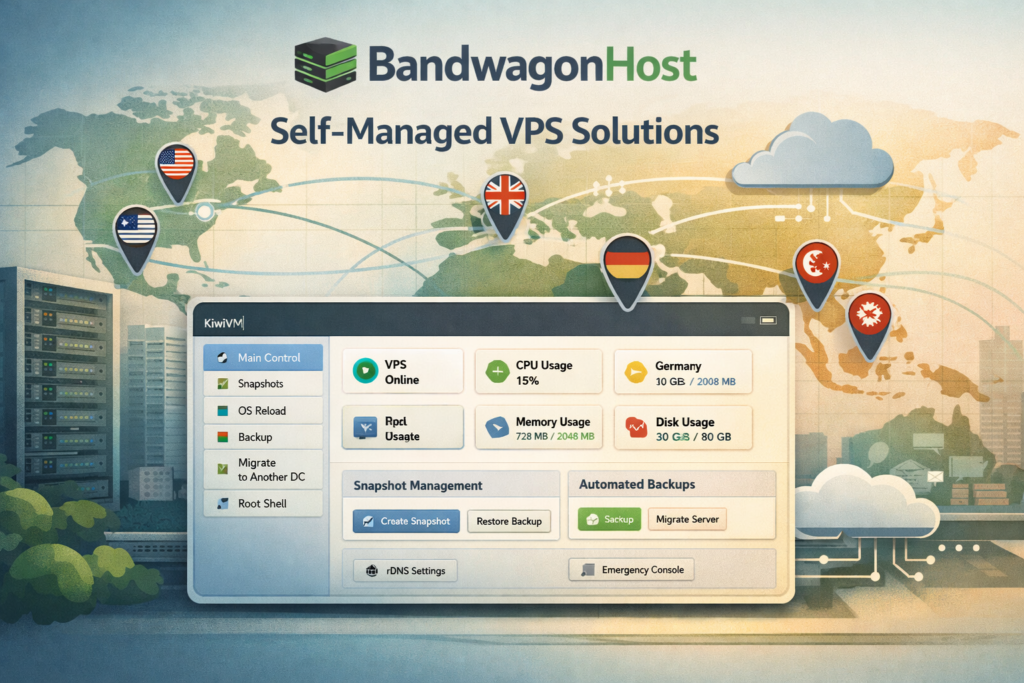
Quick Verdict
| Best for | Developers, sysadmins, technical site owners, China-facing projects, and users who want a self-managed VPS with stronger control over routing and location |
| Not ideal for | Beginners who want managed hosting, server support, or a hands-off setup experience |
| Starting standard plan | 20G KVM Promo VPS from $49.99 per year |
| Control panel | KiwiVM |
| VPS type | Self-managed KVM VPS |
| Strongest selling points | KiwiVM controls, free backups, free snapshots, free migration on supported plans, root access, and specialized CN2 GIA options |
| Main trade-off | You are expected to manage the server yourself |
What Is BandwagonHost?
BandwagonHost is a self-managed VPS provider built around KVM virtualization and the company’s in-house KiwiVM control panel. That immediately tells you what kind of product this is. It is infrastructure, not managed hosting. You get a virtual server, direct controls, and flexibility, but you are also responsible for configuration, updates, security hardening, software installation, and day-to-day server administration.
That makes BandwagonHost appealing to users who are comfortable working with SSH, Linux packages, web stacks, control panels, containers, or custom deployments. It is much less suitable for people who want a host to handle the technical side for them.
The provider is often mentioned in discussions around budget VPS hosting, China-friendly routing, and route-sensitive deployments because it combines standard global plans with more specialized options such as CN2 GIA and regional configurations that are harder to find from generic low-cost VPS brands.
BandwagonHost Pricing
BandwagonHost’s standard KVM Promo lineup covers a wide range of buyers, from very small projects to more demanding self-managed setups. The standard plans are where most people should start if they are comparing BandwagonHost with other budget or mid-range VPS providers.
| Plan | Storage | RAM | CPU | Monthly Transfer | Port Speed | Billing From |
|---|---|---|---|---|---|---|
| 20G KVM Promo VPS | 20 GB RAID-10 | 1 GB | 2x Intel Xeon | 1 TB | 1 Gbps | $49.99/year |
| 40G KVM Promo VPS | 40 GB RAID-10 | 2 GB | 3x Intel Xeon | 2 TB | 1 Gbps | $52.99/semi-annually |
| 80G KVM Promo VPS | 80 GB RAID-10 | 4 GB | 4x Intel Xeon | 3 TB | 1 Gbps | $19.99/month |
| 160G KVM Promo VPS | 160 GB RAID-10 | 8 GB | 5x Intel Xeon | 4 TB | 1 Gbps | $39.99/month |
| 320G KVM Promo VPS | 320 GB RAID-10 | 16 GB | 6x Intel Xeon | 5 TB | 1 Gbps | $79.99/month |
| 480G KVM Promo VPS | 480 GB RAID-10 | 24 GB | 7x Intel Xeon | 6 TB | 1 Gbps | $119.99/month |
From a value perspective, the entry-level annual plan is attractive for light experimentation, but many real-world users will probably get better long-term value from the 80G or 160G tier. Those plans are more practical for running a real website, a small control panel, multiple services, or a moderate WordPress stack without feeling too cramped on memory or storage.
One of the reasons BandwagonHost still stands out is that the standard plans are not stripped down to the point of being annoying. They are not just raw VPS instances with all useful features pushed into add-ons. The official plan pages list several extras that make the service more usable from day one.
What You Get on Standard Plans
| Feature | What It Means for Buyers |
|---|---|
| KiwiVM control panel | In-house VPS control panel for core server management |
| Free automatic migration between datacenters | You can move supported services if a better location becomes more useful later |
| Free automatic backups | Better baseline protection without paying extra first |
| Free snapshots | Useful before updates, migrations, or testing changes |
| Instant OS reload | Fast reinstall if you want a clean start |
| Manual ISO install option | More flexibility than many basic VPS providers offer |
| 1 dedicated IPv4 | Standard dedicated IPv4 setup |
| Routed /64 IPv6 subnet on standard plans | Helpful for buyers who actively use IPv6 |
| Full root access | You control the environment directly |
| Instant rDNS update | Useful for mail and reputation-sensitive setups |
| 99.95% uptime guarantee on many plan pages | Clearer reliability commitment than many ultra-cheap alternatives |
KiwiVM and Why It Still Matters
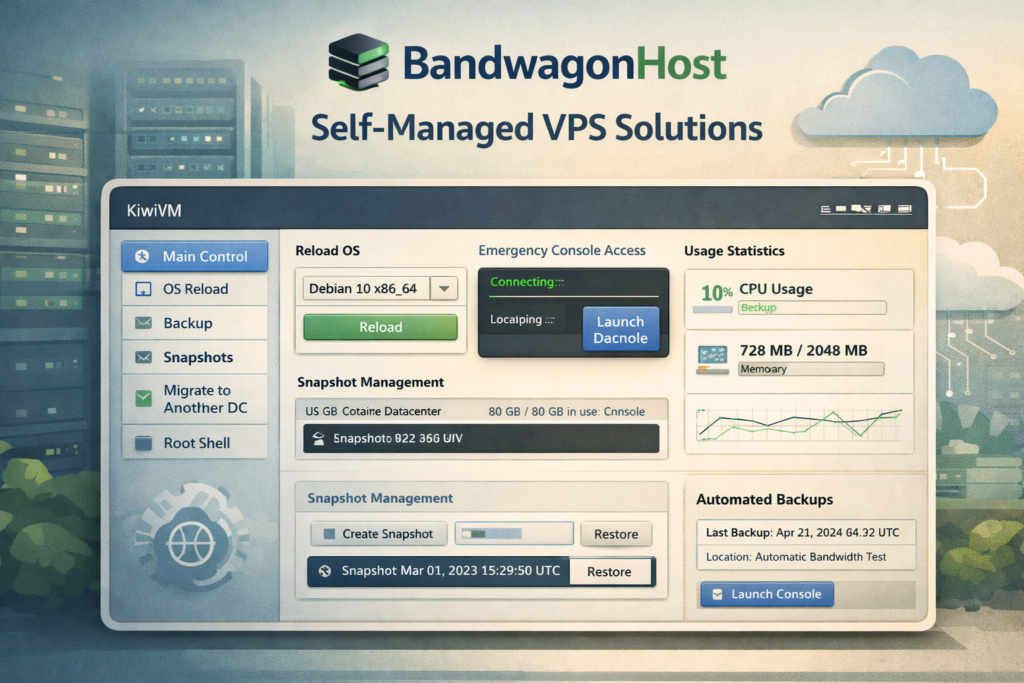
KiwiVM is one of the biggest reasons BandwagonHost remains interesting. A lot of budget VPS providers treat the control panel as an afterthought, but KiwiVM is a genuine part of the product. BandwagonHost says KiwiVM supports start and stop controls, OS reload, emergency console access, rDNS management, datacenter migration, snapshots, usage statistics, and API access.
That matters because those are the features people actually use when they run a self-managed VPS over time. A VPS is more useful when you can quickly reinstall the OS, recover from a lockout using console access, move the instance, manage reverse DNS, and take snapshots before risky changes. Those features reduce friction, and reduced friction often ends up being more valuable than a slightly lower monthly price elsewhere.
BandwagonHost also looks more alive than many small VPS brands because KiwiVM continues to receive updates. For example, the company announced passkey and security key support, which is the kind of platform improvement that suggests the service is still being maintained rather than simply left to age in place.
CN2 GIA and Why Some Buyers Choose BandwagonHost for Routing
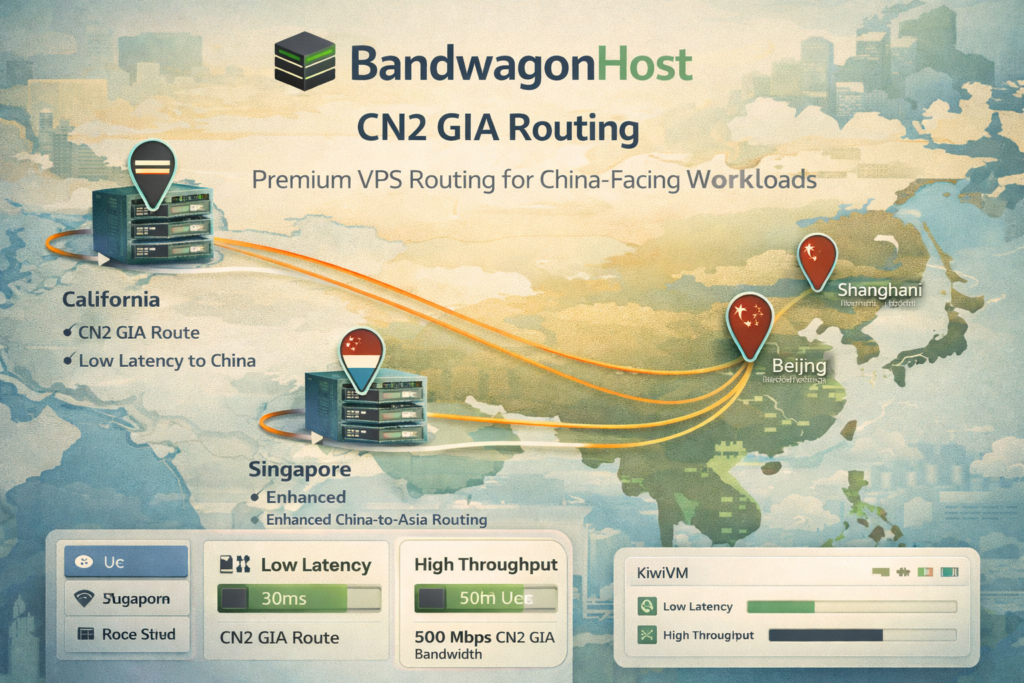
BandwagonHost is not only about low-cost standard VPS plans. Part of its long-term reputation comes from more specialized routing options, especially for users who care about connectivity involving Mainland China. On its official CN2 GIA page, BandwagonHost says it operates multiple 10 Gbe CN2 GIA and CTGNet links in Los Angeles and positions CN2 GIA as a higher-end network option for more demanding workloads.
This is important because the conversation around VPS quality is not only about CPU, RAM, and storage. For many websites and applications, route quality matters just as much. If your users are in China, East Asia, or route-sensitive markets, the cheapest generic VPS can become frustrating very quickly even if the raw specs look fine on paper.
BandwagonHost’s CN2 GIA lineup is also a reminder that the provider serves two different audiences. The first audience wants affordable self-managed VPS hosting. The second audience is willing to pay more for route quality and regional network performance. Those are related markets, but they are not the same budget level.
| Specialized Plan Example | Starting Price | Why It Costs More |
|---|---|---|
| Osaka CN2 GIA 40G | $49.99/month | Premium route-focused network, higher-end regional positioning |
| Tokyo CN2 GIA 40G | $89.99/month | Even more expensive specialized routing and premium location profile |
That price jump tells you something important: BandwagonHost is not “cheap” in every category. Its standard plans are competitively priced, but once you move into premium routing territory, you are paying for a more specialized network product.
Best Use Cases for BandwagonHost
| Use Case | Is BandwagonHost a Good Fit? | Why |
|---|---|---|
| Cheap development VPS | Yes | The starting price is low enough for testing, learning, and lightweight projects |
| Self-managed WordPress hosting | Yes | Good fit for technical users who want control over the stack |
| Docker or app deployment | Yes | KVM, root access, snapshots, and OS reloads are useful here |
| China-facing website or app | Yes | CN2 GIA and route-focused options are part of the value proposition |
| VPN or private tools | Yes | The service advertises tun/tap and full root access |
| Managed hosting replacement | No | This is a self-managed infrastructure product |
| Absolute beginners | Usually no | You are responsible for the technical side |
If you already know how to configure a web stack, firewall, panel, or container-based setup, BandwagonHost can be a strong value. If you do not want to touch Linux administration at all, then even a lower monthly price can become poor value because the time cost shifts to you.
BandwagonHost Pros and Cons
| Pros | Cons |
|---|---|
| Competitive standard plan pricing | Strictly self-managed service |
| KiwiVM is more useful than many basic VPS panels | Not ideal for complete beginners |
| Free backups, snapshots, and migration on supported plans | Premium routing plans become expensive quickly |
| Good flexibility for developers and technical users | You need to handle setup, optimization, and security yourself |
| Strong niche appeal for route-sensitive workloads | Some plan families differ in features such as IPv6 availability |
| Multiple billing ranges and plan sizes | Resource policy limits matter for abusive or sustained heavy usage |
What Buyers Should Watch Out For
The biggest thing to understand before buying is that BandwagonHost is genuinely self-managed. That sounds obvious, but it is the central trade-off. You are getting infrastructure and control, not a managed experience. That is great if you know what you are doing. It is a poor fit if you are hoping the provider will function like a managed web host.
You should also pay attention to plan-specific limitations and resource policies. This is not unusual in the VPS market, but it does matter if your workload is very bursty or continuously heavy on CPU and disk I/O. BandwagonHost’s terms also make it clear that refunds are governed by specific conditions and that services and stored data are terminated when a refund is processed, so buyers should understand the policy before treating the platform like a risk-free sandbox.
Another practical caution is that not every BandwagonHost plan family is identical. Standard plans commonly show routed IPv6 /64, while some specialized location pages differ. Buyers should always compare the exact product page they intend to order instead of assuming every feature is present on every plan category.
Is BandwagonHost Good for Beginners?
Usually not.
BandwagonHost can look attractive to beginners because the pricing is competitive and the control panel is better than many barebones alternatives. But that does not change the basic nature of the product. You still need to install software, secure the server, monitor the environment, and fix problems yourself. If you are completely new to hosting and want the easiest possible path, a managed host will usually be less stressful.
On the other hand, a technical beginner who actively wants to learn Linux server management may still find BandwagonHost worthwhile. In that case, the lower entry price and KiwiVM feature set can make it a good learning environment. It just should not be confused with a beginner-managed product.
Is BandwagonHost Good for WordPress?
Yes, but only if you mean self-managed WordPress hosting.
If you know how to build and maintain your own WordPress stack, BandwagonHost can be a cost-effective option. A mid-tier plan can be enough for many WordPress sites, especially if you use a lean setup with efficient caching, a lightweight theme, and disciplined plugin choices. Free snapshots and backups are useful here because they reduce the risk of major updates and configuration changes.
BandwagonHost is much less suitable if you want managed WordPress features such as application-level support, WordPress-specific troubleshooting, staging as a polished product layer, or hands-off maintenance. It is infrastructure first.
BandwagonHost vs a Typical Budget VPS Provider
BandwagonHost is not automatically better than every budget VPS provider, but it has a few practical advantages that help it stand out.
| Category | BandwagonHost | Typical Cheap VPS Provider |
|---|---|---|
| Control panel quality | KiwiVM is a known part of the product | Often minimal or forgettable |
| Built-in extras | Backups, snapshots, migration on supported plans | Often fewer included tools |
| Route-sensitive options | Strong niche appeal with CN2 GIA and specialized plans | Usually generic global routing only |
| Beginner friendliness | Limited | Usually also limited |
| Value for technical users | Often very strong | Varies widely |
The clearest takeaway is that BandwagonHost tends to make more sense for buyers who know what they are shopping for. If your goal is simply “the cheapest VPS possible,” you can always find something cheaper somewhere. But cheaper alone is not the same as better value, especially if the panel is weak, the routing is poor, or the operational tools are missing.
Is BandwagonHost Worth It in 2026?
For the right buyer, yes.
BandwagonHost is worth considering if you want a self-managed VPS with good operational controls, competitive standard pricing, and the option to move toward more specialized route-focused plans later. The combination of KiwiVM, backups, snapshots, migration, root access, and route-aware offerings gives it a stronger identity than many low-cost VPS providers that only compete on headline pricing.
It is not worth it if you want your host to manage the hard parts for you. In that situation, even a well-priced VPS becomes the wrong product because the support model does not match the user’s needs.
For developers, sysadmins, technical site owners, and route-sensitive buyers, BandwagonHost still earns a serious look in 2026.
Final Verdict
BandwagonHost is still one of the more interesting self-managed VPS providers because it combines affordable entry-level plans with infrastructure features that are genuinely useful over time. KiwiVM adds real value. Free backups and snapshots improve the day-to-day experience. Migration flexibility is a practical advantage. And for buyers who care about route quality, the CN2 GIA lineup gives the brand a stronger niche than many generic VPS competitors.
The main trade-off is simple and non-negotiable: this is a self-managed service. If you are comfortable with that, BandwagonHost can be an excellent fit. If you are not, you should choose a managed hosting product instead.
Overall, this BandwagonHost review points to a provider that still makes sense for technical users who care about control, flexibility, and network-aware VPS buying rather than beginner convenience.
FAQ
Is BandwagonHost managed or self-managed?
BandwagonHost is a self-managed VPS provider. You get the server and control tools, but you handle the technical administration yourself.
Does BandwagonHost include backups and snapshots?
Yes. Standard plans and many specialized plans list free automatic backups and free snapshots.
Does BandwagonHost offer CN2 GIA VPS?
Yes. BandwagonHost has dedicated CN2 GIA and CTGNet options for buyers who want stronger route quality for relevant regions and workloads.
Is BandwagonHost good for WordPress?
It can be very good for self-managed WordPress hosting, but it is not a managed WordPress platform.
Does BandwagonHost have a refund policy?
Yes. The company advertises a 30-day refund policy, but buyers should read the exact policy terms before ordering.
Who should buy BandwagonHost?
BandwagonHost is best for technical users who want a self-managed VPS, especially if they care about KiwiVM tools, datacenter flexibility, or premium routing options such as CN2 GIA.
About the Author
Xu Xun
Contact: xuxun1208@gmail.com
Last Updated: June 2026