
If you are trying to improve your Meta advertising results, better research usually matters more than more guesswork. That is where AdSpy enters the picture. Instead of manually scrolling through ads, screenshots, random spy accounts, and scattered examples, AdSpy is built to help marketers search for Facebook and Instagram ads in a more structured way. For dropshippers, affiliate marketers, ecommerce brands, and media buyers, that can make a real difference because stronger ad research often leads to better hooks, better testing decisions, and fewer wasted campaigns.
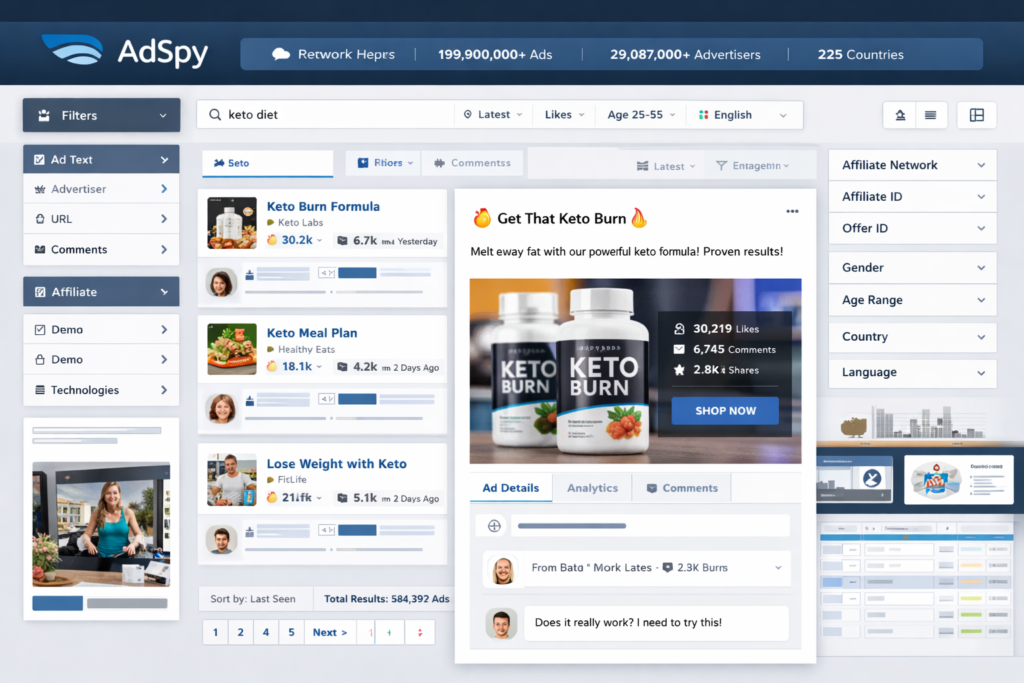
AdSpy positions itself as a large searchable database of Facebook and Instagram ads, with filters that go far beyond basic keyword lookup. The product is designed for people who do not want inspiration alone. It is meant for users who want to search by ad text, page name, URL, comments, affiliate information, demographics, and more, then use that information to validate offers, study competitors, and sharpen campaign strategy.
The big question is whether AdSpy is actually worth paying for in 2026. The short answer is yes for the right type of user, but not for everyone. If your business depends heavily on Facebook and Instagram ad research, the tool can be valuable. If you are a complete beginner who wants an easy shortcut to instant winners, it may feel expensive and overwhelming. In this AdSpy review, I will break down what the platform does well, where it falls short, who it is best for, how much it costs, and whether it deserves a place in your marketing stack.
What Is AdSpy?
AdSpy is an ad intelligence and research platform focused on Facebook and Instagram ads. Its main purpose is to help marketers search through a very large database of social ads and uncover useful patterns faster than manual research would allow. That includes finding active ad angles, analyzing creative trends, spotting long-running campaigns, identifying affiliate promotions, and understanding how advertisers position offers across different markets.
That focus is important because AdSpy is not trying to be an all-in-one marketing platform. It is not a landing page builder, not an email automation platform, and not a creative generation suite. It is first and foremost a research product. That specialization is a strength. People who are serious about paid traffic usually do not need every tool packed into one dashboard. They need reliable information that helps them make better decisions before they spend more money.
In practical terms, AdSpy helps users answer questions like these: What kinds of ads are competitors running right now? Which creative angles keep appearing in a niche? Are certain products being pushed aggressively in multiple markets? How are affiliates promoting specific offers? Which hooks and comments suggest strong audience engagement? These are the kinds of questions that can improve campaign planning before a single new ad is launched.
AdSpy at a Glance
| Category | Summary |
|---|---|
| Product type | Facebook and Instagram ad intelligence tool |
| Main purpose | Search, filter, and analyze social ads for research and competitor intelligence |
| Best for | Dropshippers, affiliate marketers, media buyers, agencies, ecommerce brands |
| Main strength | Deep ad search and filtering for Meta-focused research |
| Public pricing | $149 per month |
| Refund window | 24-hour full refund window on the public refund policy page |
| Platforms highlighted | Facebook and Instagram |
| Recommended use case | Creative research, offer validation, competitor monitoring, market discovery |
Who Should Use AdSpy?
AdSpy makes the most sense for people who already understand the basics of paid traffic and want stronger research. It is especially relevant if Facebook and Instagram are major acquisition channels in your business. The platform is much easier to justify when good research can help you avoid bad tests, spot better creative patterns, or uncover market opportunities earlier than your competitors.
For dropshippers, AdSpy can be used to identify products that appear repeatedly in paid campaigns, study how sellers package their offers, and see how ad messaging changes across different angles. For affiliate marketers, the tool appears even more useful because the platform emphasizes affiliate-friendly search options such as affiliate network and offer-related filtering. That can be valuable if you need to study how offers are promoted rather than just which products are popular.
Agencies and in-house media buying teams can also benefit because AdSpy supports a more systematic competitor research process. Instead of relying on scattered screenshots or occasional manual checks, teams can research campaigns in a repeatable way, compare patterns, and feed those findings into creative testing, messaging development, and strategic reviews.
- Best for: Experienced advertisers, affiliate marketers, dropshippers, agencies, and ecommerce teams
- Good fit: Users who actively run or analyze Meta ads every month
- Less ideal for: Beginners who want a cheap general marketing tool or a passive inspiration library
Key AdSpy Features
The real value of AdSpy comes from how you can search and interpret data, not just from the fact that the database is large. A huge archive alone is not enough. The difference comes from how precisely you can narrow down what you want and how quickly you can turn results into insights you can actually use.
Enhanced basic search
AdSpy allows users to search by things such as ad text, advertiser name, page name, URL, media type, and engagement-related clues. That matters because effective ad research usually starts broad and then narrows. You might begin by searching for a product category, then refine by media format, engagement signals, or how recently the ad was seen. A tool that supports that type of narrowing is much more useful than a database that just lets you type a single keyword and scroll endlessly.
Comment search
Comment search is one of the most interesting parts of the platform. User comments can reveal objections, sentiment, pain points, enthusiasm, confusion, and even buying intent. When you study comments properly, you are not just seeing how advertisers talk. You are seeing how audiences respond. That is useful for creative testing, objection handling, product messaging, and understanding how real people interpret the offer.
Demographic targeting clues
AdSpy also promotes the ability to assess who an ad is trying to target based on factors such as location, gender, and age range. That can help users see how advertisers are segmenting markets and whether certain angles appear tailored to specific audiences. For advertisers planning expansions or testing new audience pools, this can add another useful research layer.
Affiliate-focused research
This is where AdSpy becomes especially interesting for affiliate marketers. The platform highlights search by affiliate network, affiliate ID, and Offer ID, plus the ability to inspect information from landing pages. That gives affiliates a more direct way to research how offers are promoted in the wild. Instead of just finding a creative angle, you can also trace how marketers structure the funnel around a specific offer.
Large global database
A broad database matters because good research often depends on pattern recognition. A tool with strong market coverage gives you more ways to compare angles across niches, regions, languages, and advertiser types. That can be especially useful for brands and agencies looking beyond one country or one narrow product category.
Fast research workflow
The speed of a research tool matters more than many people think. If searching, filtering, and reviewing results feels slow, your workflow breaks down. A good research environment should let you test ideas quickly, compare angles efficiently, and move from one query to another without friction. AdSpy clearly tries to position itself as a tool that can support that kind of speed.
How AdSpy Can Improve Your Ad Research Workflow
The best way to evaluate AdSpy is not by asking whether it contains a lot of ads. It is by asking whether it can help you make better decisions. Strong ad research tools save time, reduce random testing, and make creative development more informed. That is where AdSpy can provide value.
For example, a dropshipper can use the platform to search for products that appear across multiple advertisers and then study the recurring hooks used to sell them. An affiliate marketer can search for a specific offer or network and analyze how different marketers frame the same opportunity. A media buyer can look for long-running ads and compare how the copy, angle, and visual format work together. An agency strategist can research competitor messaging before a new campaign pitch. These are all research-driven actions that become more practical when the search layer is strong.
Another key advantage is that the workflow becomes less dependent on luck. Instead of asking, “What should we test next?” with very little context, you can ask, “What patterns are already showing up in this market, and what can we learn from them?” That change in thinking usually leads to better tests. Research does not remove risk, but it improves the odds that your next campaign starts from a stronger place.
How to Use AdSpy Effectively
Buying an ad spy tool is one thing. Using it well is another. The marketers who get the most value from AdSpy are usually the ones who approach research with a clear objective instead of browsing aimlessly. That means opening the platform with a question in mind. You might want to validate a product category, study how a specific audience is being targeted, find long-running hooks in a niche, or compare how multiple advertisers position the same type of offer.
A practical workflow often starts with broad discovery and then narrows into structured analysis. First, search a niche, product type, competitor brand, or offer-related phrase. Next, filter for the variables that matter most, such as ad format, reactions, comments, recent activity, or affiliate-related details. Then review patterns rather than isolated ads. Look for repeated hooks, common emotional triggers, offer structures, and visual formats that keep showing up. Finally, translate those observations into testing hypotheses instead of copying ads directly.
This matters because the real power of AdSpy is not that it shows you ads. Lots of places can show you ads. The power is that it helps you research more deliberately. Used properly, the platform can support product validation, angle discovery, competitor tracking, objection mining, and campaign planning. Used poorly, it can become an expensive scrolling tool. The difference comes down to whether you use it as a research system or as an inspiration feed.
| Research Goal | How AdSpy Can Help | What To Look For |
|---|---|---|
| Find new angles | Search ad text, comments, and advertiser patterns | Repeated hooks, emotional framing, offer promises |
| Validate a product | Review ad frequency and variation across advertisers | Multiple creatives, recurring pain points, sustained activity |
| Study competitors | Search by page name, brand terms, and comments | Positioning, messaging style, objections, audience sentiment |
| Research affiliate offers | Use affiliate-related filtering and offer-oriented searches | Funnels, claim styles, angle repetition, landing page patterns |
| Plan new tests | Sort through proven market patterns faster | Creative format trends, audience clues, high-interest themes |
What AdSpy Does Not Replace
One of the easiest ways to overestimate any ad research tool is to confuse research with execution. AdSpy can make research faster and more structured, but it does not replace creative judgment, persuasive copywriting, landing page quality, offer strength, or disciplined testing. It can show you patterns in the market, but it cannot guarantee that those patterns will work for your brand in the same way.
This is especially important for newer marketers. When people first hear about ad spy tools, they sometimes imagine a shortcut where the software reveals a winning product, a winning angle, and a winning campaign. In reality, the platform is better viewed as a decision support tool. It helps you begin from a smarter place, but you still need to do the work of positioning, differentiation, budgeting, and optimization.
In other words, AdSpy can improve your odds. It cannot remove the need for skill. That may sound obvious, but it is one of the most useful mindset shifts for getting real value from a subscription like this.
Signs AdSpy Might Be a Good Fit for You
You are much more likely to benefit from AdSpy if several of the following are already true. You actively run Facebook or Instagram ads. You regularly test new offers or creative angles. You want more than random inspiration. You care about competitor intelligence. You can turn research into action quickly. And you have enough advertising or research volume that a better decision process can realistically pay for the software.
On the other hand, if you rarely run ads, do not yet have a clear research process, or mainly want a low-cost tool to browse interesting creatives now and then, AdSpy may not be the best first investment. In that case, the issue is not that the platform is bad. It is that the timing may be wrong for your stage.
| You should seriously consider AdSpy if… | You may want to wait if… |
|---|---|
| You run Meta ads regularly | You only research ads occasionally |
| You need structured competitor intelligence | You mostly want casual inspiration |
| You evaluate offers, products, or creative angles often | You are still learning basic campaign strategy |
| You can justify research software from real campaign spend | You are working with a very limited budget |
| You value affiliate-oriented research depth | You need a broader tool for many non-Meta tasks |
AdSpy Pricing
At the time of writing, the public pricing on the AdSpy homepage is straightforward. The company advertises virtually unlimited usage for $149 per month. It also frames this as an introductory offer, which suggests the price may change in the future. On the public information page, AdSpy states that users are entitled to a full refund within 24 hours of purchase.
| Pricing Detail | What You Should Know |
|---|---|
| Current public price | $149 per month |
| Usage language | Virtually unlimited usage |
| Refund policy | Full refund within 24 hours of purchase |
| Risk level | Moderate if you can evaluate the tool quickly within the refund window |
| Best value for | Active advertisers and researchers who use Meta ad intelligence regularly |
For some users, $149 per month will be completely reasonable. For others, it will feel expensive. The difference comes down to how often you use ad intelligence in decisions that affect real spend. If AdSpy helps you avoid one weak campaign or find one better direction that saves more than the monthly fee, the cost can make sense. If you only browse ads occasionally for inspiration, the value proposition becomes harder to justify.
AdSpy Pros and Cons
| Pros | Cons |
|---|---|
| Focused specifically on Facebook and Instagram ad research | Less attractive if you need a broader all-in-one research suite |
| Advanced search depth beyond simple keyword lookup | Premium pricing for smaller beginners |
| Comment search adds audience-language insight | You still need skill to interpret the data well |
| Useful for affiliate marketers, not just ecommerce sellers | Not the best fit for people who want a beginner shortcut |
| Strong value for competitor monitoring and creative research | Can feel specialized if your workflow extends far beyond Meta ads |
| Refund window lowers short-term purchase risk | You need to evaluate quickly if you want to use the refund policy |
AdSpy for Different Types of Users
AdSpy for dropshipping
Dropshippers often struggle with product validation and creative angle selection. AdSpy can help by making it easier to search for products, advertisers, and related campaign patterns. When a product category is being pushed aggressively, that does not automatically mean you should enter the market, but it does give you evidence worth studying. You can examine how the offer is framed, what claims appear repeatedly, what formats are used, and what audience reactions look like.
AdSpy for affiliate marketers
Affiliate marketers may get some of the clearest value from AdSpy because the product is not limited to generic ad browsing. Search options tied to affiliate networks, affiliate IDs, and Offer IDs suggest that the platform is built with real affiliate workflows in mind. That matters when you need to study how specific offers are being promoted, not just what kinds of creatives are trending in a category.
AdSpy for agencies and media buyers
Agencies and paid social teams can use AdSpy as a structured research layer before launching campaigns or pitching strategy. Instead of guessing what competitors are doing, teams can look for messaging patterns, study creative themes, compare engagement signals, and develop testing ideas backed by real market examples. This does not replace strategy, but it can make strategy less speculative.
AdSpy for brands
For brands, AdSpy can support competitor tracking, positioning analysis, and market expansion research. If you sell into multiple geographies or want to understand how similar products are being presented to different audiences, a searchable global ad database can be helpful. This is particularly useful when you are building a campaign calendar and want stronger evidence before choosing angles.
What AdSpy Does Better Than Basic Manual Research
Many marketers start with manual ad research because it is free. They browse Facebook, check public pages, save screenshots, look through feeds, and collect examples in folders. That can work at a very small scale, but it becomes inefficient quickly. Manual research is slow, inconsistent, difficult to organize, and heavily influenced by what the algorithm happens to show you.
AdSpy solves that by making search intentional. Instead of waiting to encounter ads, you can search for them. Instead of relying on memory, you can structure queries. Instead of seeing isolated examples, you can compare patterns across advertisers and markets. That is the real advantage. The tool changes ad research from passive browsing into active investigation.
That distinction matters because strong paid acquisition teams usually win through systems, not through lucky discoveries. A research tool like AdSpy fits that mindset much better than random scrolling ever will.
AdSpy vs Alternatives: What You Should Keep in Mind
When comparing AdSpy with alternatives, the first thing to remember is specialization. AdSpy is most compelling when your research needs are centered on Facebook and Instagram. That focus gives it clarity. You are not paying for a product that tries to do everything at once. You are paying for deeper search and research in a specific advertising environment.
That said, specialization cuts both ways. If your workflow depends on broader ecommerce intelligence, product sourcing, TikTok-first research, creative generation, landing page building, or other adjacent functions, then you may need to compare AdSpy carefully with broader or cheaper tools. The best choice depends less on which platform looks impressive and more on which one aligns with how you actually make decisions.
In simple terms, AdSpy appears strongest when you want depth in Meta ad research. It becomes less obvious when you want one subscription that covers every marketing research job in your business.
Common Mistakes People Make With AdSpy
The first common mistake is treating every visible ad as proof that something is profitable. An ad existing in the database does not automatically mean it is performing well. Good researchers look for clusters of evidence, not single examples. They compare longevity, angle variation, repeated appearance, engagement clues, and market patterns before drawing conclusions.
The second mistake is copying surface-level creative details without understanding the deeper strategy. A headline, video style, or product promise might look attractive, but without context it is easy to imitate the wrong thing. The strongest use of AdSpy is to extract principles, not to clone assets. That includes learning which pain points are emphasized, which emotional structures recur, and how offers are framed for different audiences.
The third mistake is searching too narrowly too early. If you start with filters that are too specific, you can miss the broader market patterns that matter most. It is often better to begin with a wider view, identify themes, and then narrow the search once you understand what the market is doing.
The fourth mistake is failing to turn insights into documented testing ideas. Research becomes much more valuable when it feeds a repeatable process. That means saving findings, grouping patterns, turning observations into hypotheses, and prioritizing which angles should be tested next. Otherwise, even a powerful tool can produce more browsing than strategy.
Is AdSpy Easy to Use?
From a positioning perspective, AdSpy aims to make a powerful tool feel straightforward. The platform emphasizes a simple interface and fast access to large amounts of data. That is a good sign, but ease of use should be understood in two different ways.
The first kind of ease is interface ease. That means whether the software is fast, organized, and efficient enough for daily use. The second kind is strategic ease. That means whether the findings are easy to interpret and turn into action. AdSpy likely does well on the first one for serious users, but the second still depends on you. The platform can show you data. It cannot replace judgment, testing discipline, or market understanding.
That is why AdSpy tends to be more attractive for marketers who already have some experience. They can see a set of ads, comments, and patterns, then translate that into stronger campaign decisions. Beginners may still learn from the platform, but they are less likely to unlock its full value right away.
Is AdSpy Worth It?
AdSpy is worth it when research quality has a measurable effect on your results. That includes businesses that regularly run paid social campaigns, test new offers, analyze competitors, or manage client accounts where better creative intelligence can improve performance. In those cases, the subscription cost can be viewed as part of the research budget rather than as a generic software expense.
It becomes less worth it when your usage is light or your decision-making process is still immature. If you do not run enough campaigns to benefit from faster ad intelligence, or if you are not yet able to turn research into better creative and testing plans, then the platform may not feel necessary. In that situation, the issue is not that AdSpy lacks value. It is that the value may arrive before your workflow is ready to capture it.
The refund window helps a bit because it gives buyers a short opportunity to evaluate the fit. Still, the best approach is to subscribe only when you already know what you want to research and how you will use the results in your business.
My Final Verdict on AdSpy
AdSpy is a strong niche tool for marketers who need structured Facebook and Instagram ad research. Its biggest advantages are clear: specialized search depth, useful filtering options, a strong research-first focus, and meaningful relevance for affiliates, dropshippers, and media buyers. It looks especially valuable for users who already spend money on Meta ads and need a more efficient way to gather insight before testing.
The biggest downside is not necessarily the platform itself. It is the fact that AdSpy is not built for everyone. If you are looking for a cheap general-purpose marketing tool or a beginner shortcut to instant success, this is probably not the right fit. But if you want a dedicated Meta ad intelligence platform and you know how to use research well, AdSpy is easy to take seriously.
My overall conclusion is simple: AdSpy is most worth it for advertisers who already have a real ad research workflow and want to make it faster, smarter, and more systematic. For that type of user, the platform can be a practical investment rather than just another subscription.
Frequently Asked Questions
What is AdSpy used for?
AdSpy is used for researching Facebook and Instagram ads. Marketers use it to study competitors, validate products and offers, find creative angles, analyze audience reactions, and improve campaign planning.
How much does AdSpy cost?
The public pricing currently shown on the AdSpy homepage is $149 per month.
Does AdSpy offer a refund?
According to the public refund policy page, users are entitled to a full refund within 24 hours of purchase.
Is AdSpy good for dropshipping?
AdSpy can be useful for dropshipping because it helps sellers research products, creative angles, competitors, and market activity on Facebook and Instagram.
Is AdSpy good for affiliate marketers?
Yes, AdSpy appears particularly relevant for affiliate marketers because the platform highlights affiliate-focused search options such as affiliate network, affiliate ID, and Offer ID filtering.
Is AdSpy beginner-friendly?
Beginners can use it, but the tool is more likely to deliver strong value for users who already understand ad testing, competitor research, and creative strategy.
About the Author
Xu Xun
Contact: xuxun1208@gmail.com
Last Updated: June 2026