
If you are building an Amazon affiliate website on WordPress, one of the hardest parts is not writing the article. It is presenting products in a way that looks trustworthy, stays updated, supports buyer decisions, and gives readers a clear reason to click.
That is exactly where AAWP comes in.
In this AAWP review, I will cover what the plugin does, who it is best for, how its core features work, how its API options affect real users, whether the pricing makes sense, and whether it is still one of the best Amazon affiliate WordPress plugins in 2026.
For publishers who create product reviews, buyer guides, comparison posts, and “best” lists, AAWP is still one of the most specialized tools in the WordPress ecosystem. It is not a generic affiliate plugin trying to do everything. It is a focused Amazon affiliate plugin built to improve the way Amazon products appear inside content.
That specialization is exactly why many site owners still consider it worth paying for.
What Is AAWP?
AAWP stands for Amazon Affiliate WordPress Plugin. It is a premium WordPress plugin designed specifically for Amazon Associates who want better product displays, more flexible product data output, and faster ways to build high-converting affiliate content.
Instead of relying on plain text affiliate links or manually built product layouts, AAWP helps you insert Amazon product information into posts and pages through product boxes, comparison tables, bestseller lists, new release lists, text links, widgets, and individual data fields such as price, title, image, or buy button.
That is an important distinction. AAWP is not simply a link management plugin. It is a product presentation plugin built around Amazon affiliate content.
If your website publishes content like “best coffee grinder,” “best office chair under $200,” “air fryer vs toaster oven,” or “top microphones for podcasts,” AAWP is designed for exactly that kind of content structure.
Quick Verdict
| Category | Verdict |
| Best for | WordPress publishers heavily focused on Amazon affiliate content |
| Main strength | Conversion-friendly product displays and comparison tables |
| Main weakness | Premium pricing and some dependency on API access |
| Beginner-friendly | Yes, especially with Gutenberg support and ready-made layouts |
| Advanced-user friendly | Yes, thanks to data fields, templates, and customization options |
| Worth it? | Yes, if Amazon is a serious revenue channel for your WordPress site |
The short version is simple: if Amazon content is a major part of your monetization strategy, AAWP is one of the strongest specialist plugins you can buy. If Amazon is only a small side channel for your site, it may feel more expensive than necessary.
Why AAWP Still Matters for Affiliate SEO
Many affiliate publishers think about plugins only from a design angle. They ask whether a plugin makes their site look nicer. That matters, but it is not the whole story.
A plugin like AAWP can affect how easy it is to build commercial pages at scale, how clearly products are compared, how quickly readers understand the recommendation, and how efficiently you update product information inside older articles.
All of those things connect to SEO performance in indirect but important ways.
If your commercial pages are easier to scan, easier to compare, and easier to trust, readers are more likely to stay engaged and click. If your content is easier to update, it becomes more practical to keep older buyer-intent articles alive. If product presentation is more structured, your site also feels more useful and more editorially intentional.
That does not mean AAWP magically boosts rankings by itself. It does not. But it can make your monetized content stronger, more usable, and more scalable. For serious affiliate publishers, that is a meaningful advantage.
AAWP Features That Actually Matter
AAWP has a long feature list, but not every feature matters equally. The most important question is this: which features truly improve the quality and performance of affiliate content?
1. Product Boxes
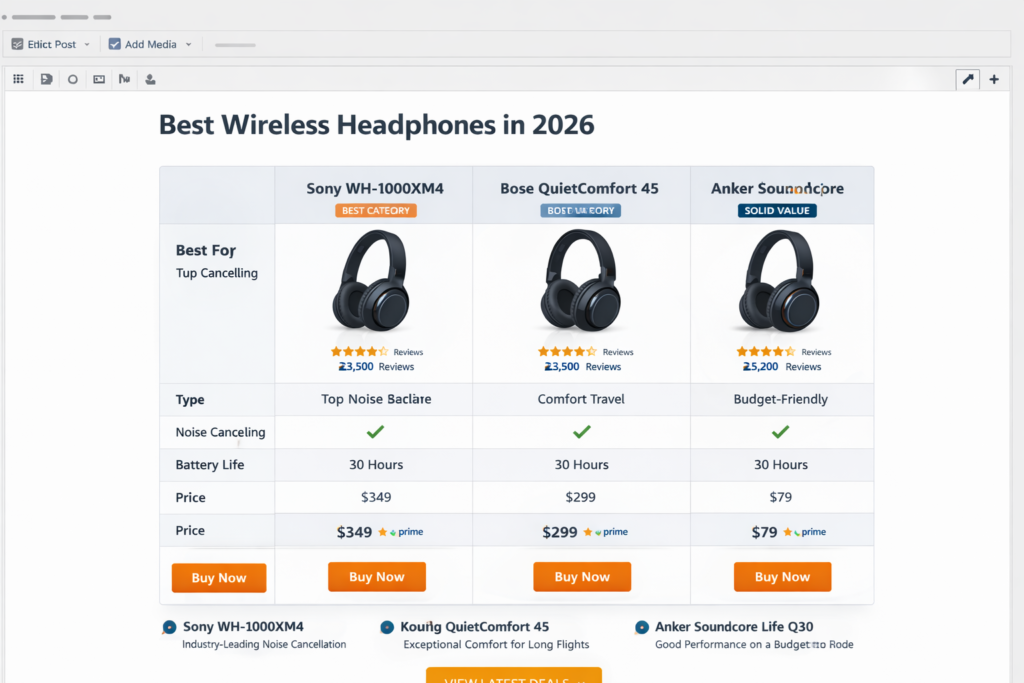
Product boxes are one of the most recognizable AAWP features. They let you place one or more products in a cleaner, more conversion-oriented display than a normal text link.
That matters because many affiliate pages fail at the most basic step: helping the reader instantly identify the recommended product. A product box solves that by giving the recommendation a defined visual block.
When used well, product boxes can improve clarity near the top of a review, after a pros-and-cons section, or inside shortlist content where you want to feature the best overall pick.
2. Comparison Tables
This is one of the biggest reasons many publishers buy AAWP.
Comparison content is one of the most valuable content types in affiliate SEO. People who search for “best,” “top,” “vs,” “alternative,” “under $100,” or “for beginners” usually want quick comparison before deeper reading. If your page does not make comparison easy, you lose attention fast.
AAWP’s comparison tables are designed for exactly this scenario. They let you compare multiple products directly inside WordPress, making it easier to build strong buying-guides and shortlist articles.
This is especially useful for:
- best X product articles
- X vs Y comparison posts
- budget-based recommendations
- beginner vs advanced product recommendations
- roundup articles where readers need fast screening
A good comparison table does not replace the full article. It supports the article by helping readers navigate choices faster.
3. Bestseller Lists and New Release Lists
AAWP also supports bestseller lists and new release lists. These are useful when you want a more automated content element that highlights product trends or category movement.
For example, if you publish content around fast-moving categories, seasonal shopping, or trend-sensitive niches, these list formats can help keep articles more dynamic.
That said, these features are more useful in some niches than others. If you publish evergreen buyer guides with tightly curated recommendations, comparison tables and product boxes usually matter more. If you cover discovery-heavy categories, bestseller and new-release lists become more appealing.
4. Data Fields for Custom Layouts
One of AAWP’s most underrated features is data fields.
Instead of only using prebuilt layouts, you can output individual product information such as title, description, image, price, or button. That gives you more control over how products appear inside your article design.
This matters if you want your site to look more branded and less template-driven. You can mix product data into your own layout logic instead of repeating the same box style everywhere.
For publishers who care about editorial feel, this feature is a major plus.
5. Gutenberg Support
AAWP is not stuck in an old shortcode-only workflow. It supports Gutenberg, which makes it more practical for modern WordPress publishing.
That makes a difference for non-technical users. A plugin can be powerful, but if it slows your publishing workflow, you will use it less. Gutenberg support lowers the friction of inserting tables, text links, and product-related content into your articles.
6. Browser Extension for Faster Publishing
AAWP also offers a browser extension with a shortcode generator. This is one of those quality-of-life features that sounds minor until you start publishing a lot of product content.
If you regularly work from Amazon product pages and want to speed up insertion into WordPress, tools like this reduce friction and save time. For a single article, the benefit may seem small. Across dozens or hundreds of commercial pages, it adds up.
7. Click Tracking
Click tracking is easy to underestimate, but it matters.
It helps you understand which products receive the most clicks and which parts of the box or display attract attention. That kind of data can improve article layout decisions over time.
If one product position consistently wins, or one button style attracts more clicks, that gives you useful feedback for future publishing. It is not a full analytics suite, but it supports optimization.
8. Geo-Targeting
Geo-targeting can help international traffic land on a more relevant Amazon storefront, which may reduce lost commissions from mismatched country traffic.
That sounds excellent in theory, and for some sites it is. But there is an important practical caveat: not every publisher should treat geo-targeting as an automatic win.
If you care deeply about privacy compliance, especially in stricter regions, you need to review the implementation carefully before turning it on. That is not a reason to dismiss the feature, but it is a reason to use it thoughtfully.
AAWP API vs Amazon Creators API: What You Need to Know
This is one of the most important parts of any honest AAWP review.
For many years, Amazon affiliate publishers depended on official API access to pull product data into their sites. That remains important, but it also creates friction because not every site owner has or keeps that access.
AAWP now supports the Amazon Creators API, which is the official path for retrieving Amazon product information. That is the primary route for users who meet Amazon’s requirements.
But AAWP also offers its own paid AAWP API as a fallback. This is one of the plugin’s most practical advantages in the real world. It gives users another route to product data when the official API is not available to them.
That makes AAWP more useful for:
- newer affiliates who do not yet qualify for official access
- publishers who lost official API access
- site owners who need continuity while rebuilding eligibility
- projects where Amazon data is still needed but official access is uncertain
Still, there is a tradeoff. The fallback is not identical to the full official route. In practice, you should view it as a strong backup option rather than a perfect substitute for every feature.
| Option | Best for | Key takeaway |
| Amazon Creators API | Publishers with official Amazon API eligibility | Best choice when you already meet Amazon’s requirements |
| AAWP API | Users who need a fallback product-data option | Very useful backup path, but not identical to the official route |
If you are deciding whether to buy AAWP, this is not a minor technical detail. It is one of the biggest product-level reasons the plugin remains relevant.
Ease of Use and Real Publishing Workflow
AAWP is easier to understand when you think about the daily workflow of an affiliate publisher.
You are usually not publishing a single product mention once a month. You are often building multiple buying guides, product reviews, alternatives posts, and comparison articles. Over time, even small workflow improvements become meaningful.
AAWP helps in several practical ways:
- it reduces the need to manually design product sections from scratch
- it gives structure to product comparisons
- it makes repeated Amazon product insertion faster
- it supports more scalable article templates for buyer-intent content
- it lets you reuse content patterns without every page feeling sloppy
For a small personal blog that adds the occasional Amazon link, this may be more power than you need. For a site built around product-led content, it makes much more sense.
How AAWP Fits Different Content Types
One of the best ways to evaluate AAWP is to map it to the kinds of content you actually publish.
Single-product review articles
AAWP works well here because a product box near the top of the page can immediately show the product, the buying path, and core information. It makes the review feel more structured and more commercial without becoming spammy.
Best-of roundup posts
This is arguably where AAWP shines the most. Comparison tables, ranked boxes, and data-driven product layouts fit buyer-guide pages extremely well.
Versus articles
When someone searches for “Product A vs Product B,” they want fast contrast before reading full detail. AAWP’s comparison capabilities support this search intent naturally.
Budget or use-case pages
Articles like “best monitor under $300” or “best camera for travel” benefit from clear product groupings and easy comparison. AAWP supports that nicely.
Trend or discovery content
If you create content around product discovery or movement within a category, bestseller and new-release lists can add more dynamic content blocks.
AAWP Pricing: Is It Worth the Money?
AAWP is not a bargain-basement plugin. It is a premium Amazon-focused tool, and the pricing reflects that.
For some users, that will be a downside. For others, it will be completely reasonable if the plugin improves publishing speed, product presentation, and click-through performance on commercial pages.
The more Amazon-focused your content business is, the easier the pricing is to justify.
Annual pricing
| Plan | Sites | Price |
| Starter | 1 site | €79/year |
| Advanced User | 3 sites | €129/year |
| Professional User | 10 sites | €299/year |
| Power User | 25 sites | €399/year |
Lifetime pricing
| Plan | Sites | Price |
| Starter | 1 site | €299 one-time |
| Advanced User | 3 sites | €499 one-time |
| Experienced User | 5 sites | €699 one-time |
| Professional User | 10 sites | €999 one-time |
AAWP API pricing
| Monthly product quota | Price |
| 150 products | $5/month |
| 250 products | $9/month |
| 500 products | $19/month |
| 750 products | $29/month |
| 1,000 products | $39/month |
There is also a 30-day money-back guarantee, which reduces the risk for first-time buyers.
The key question is not whether AAWP is cheap. It is whether it helps your site earn more efficiently. For a serious affiliate site, that is the better lens.
If one stronger buyer-guide page or one better-performing money post can offset the plugin cost, the pricing becomes much easier to defend.
AAWP Pros and Cons
| Pros | Cons |
| Built specifically for Amazon affiliate WordPress sites | Premium pricing may feel high for casual users |
| Strong product boxes and comparison tables | Best value depends on Amazon being a serious monetization channel |
| Supports Gutenberg and faster publishing workflows | API access still matters for the full experience |
| Data fields allow more flexible editorial layouts | Fallback API is useful, but not identical to the full official route |
| Click tracking helps optimization | Not the right tool if your site barely uses Amazon links |
| Has both annual and lifetime options | Not a universal multi-network affiliate platform |
Who Should Buy AAWP?
AAWP is a strong fit for several types of users.
Best for niche affiliate sites
If your content model relies on buyer guides, product reviews, and Amazon-heavy commercial posts, AAWP fits naturally. This is the clearest use case.
Best for publishers scaling content
The more product-led content you publish, the more valuable structured displays become. AAWP makes scaling cleaner than manually rebuilding product sections on every page.
Best for WordPress users who want Amazon specialization
Some plugins try to cover every affiliate network and every use case. AAWP goes in the opposite direction. It focuses on Amazon use cases, and that specialization is exactly why it can feel stronger for Amazon-heavy sites.
Best for users who want better buyer-intent page structure
If your goal is to make commercial pages easier to scan and more persuasive without making them look spammy, AAWP helps.
Who Should Probably Skip AAWP?
AAWP is not for everyone.
- If your site rarely uses Amazon affiliate links, AAWP is probably overkill.
- If most of your revenue comes from other affiliate networks, you may prefer a broader affiliate management tool.
- If your budget is extremely tight and your site is still experimental, you may want to validate your niche first.
- If you are not using WordPress, AAWP is irrelevant.
The honest answer is that AAWP becomes easier to justify as soon as Amazon product content becomes central to your publishing model.
What Makes AAWP Better Than Plain Amazon Links?
This question is more important than it sounds.
Many Amazon affiliates technically can publish without AAWP. They can paste links manually, add simple tables, or write basic product sections by hand. The issue is not whether that is possible. The issue is whether that is efficient, scalable, and persuasive enough for serious commercial content.
Plain links usually lose on these points:
- they are less visually clear
- they make comparison harder
- they are less reusable across article templates
- they are harder to scale cleanly
- they often make monetized content look weaker
AAWP improves the presentation layer of Amazon affiliate content. That may sound simple, but on commercial pages the presentation layer matters a lot.
Can AAWP Help You Rank Better?
Not directly in the sense of a ranking hack. AAWP is not an SEO plugin, and it does not replace topical coverage, search intent alignment, internal linking, or strong writing.
But it can support ranking performance indirectly by improving how commercial pages work.
Here is how:
- it makes buyer-intent pages easier to scan
- it improves product comparison clarity
- it creates stronger commercial sections within long-form content
- it helps standardize money-page structure across a site
- it can make content updates more practical over time
That combination can help your page perform better for readers, and that is the part that matters most.
In other words, AAWP is not the reason your page ranks. But it can help make a ranking-worthy page commercially stronger.
Real-World Buying Scenarios
To make the decision easier, here are a few common scenarios.
| Scenario | Should you buy AAWP? | Why |
| You run a serious Amazon niche site on WordPress | Yes | The feature set aligns very well with your revenue model |
| You publish many “best” and “vs” articles | Yes | Comparison tables and product boxes are highly relevant |
| You only add occasional Amazon links to blog posts | Probably not | The plugin may be more than you need |
| You want cleaner product presentation without custom coding everything | Yes | AAWP solves a real design and workflow problem |
| You are still testing whether your niche can make money | Maybe later | Validate the site first if budget is tight |
AAWP Review: The Biggest Strengths and Risks
The biggest strength of AAWP is focus.
It is not trying to be every kind of affiliate plugin for every kind of publisher. It is trying to be a very good Amazon affiliate WordPress plugin. In practice, that focus leads to stronger product presentation tools for Amazon-centric sites.
The biggest risk is that some buyers will overestimate how universal it is. If your site is not deeply tied to Amazon, you may not get enough value from the specialization.
The second key risk is workflow dependency on product-data access. AAWP has handled this better than many people expect by offering its own API path, but you still need to understand how that affects your setup.
The third important consideration is compliance and implementation care around features like geo-targeting. Power is good, but not every feature should be switched on blindly.
Final Verdict: Is AAWP Worth It in 2026?
Yes, AAWP is still worth it in 2026 for the right kind of publisher.
If you are building a WordPress site where Amazon affiliate content is a major revenue channel, AAWP remains one of the most practical premium tools in the category. Its product boxes, comparison tables, data fields, click tracking, Gutenberg support, browser extension, and fallback API path all combine into a plugin that is clearly designed for real affiliate publishing needs.
It is not the cheapest option, and it is not the most universal option. But it does not need to be. Its value comes from being specialized, useful, and aligned with the exact pages that many Amazon affiliates care about most.
If your site publishes serious buyer guides and product comparisons on WordPress, AAWP deserves a place on your shortlist. For many users, it will deserve more than that.
AAWP Review FAQ
Is AAWP worth it for beginners?
AAWP can be worth it for beginners if they are serious about building an Amazon affiliate WordPress site. If you are only experimenting casually, it may be smarter to validate your niche first.
Is AAWP only for WordPress?
Yes. AAWP is specifically built for WordPress users.
Does AAWP require Amazon API access?
AAWP is built around Amazon product data access, but it also offers its own paid AAWP API fallback, which makes it more flexible than many people expect.
What is the best AAWP feature?
For most affiliate publishers, the strongest feature combination is product boxes plus comparison tables. Those two features map especially well to high-intent commercial content.
Can AAWP help with affiliate SEO?
AAWP is not an SEO plugin, but it can support affiliate SEO by making buyer-intent pages clearer, more structured, and easier to monetize effectively.
Is AAWP expensive?
It is a premium plugin, so it is not the cheapest option. But for a site where Amazon content drives real revenue, the pricing can be justified much more easily.
Should you buy AAWP or skip it?
Buy it if Amazon affiliate content is a serious part of your WordPress business. Skip it if Amazon is only a minor side monetization channel and you do not need specialized product presentation tools.
About the Author
Xu Xun
Contact: xuxun1208@gmail.com
Last Updated: June 2026