
Binance Review 2026: Fees, Safety, Features, and Whether It’s Worth It

If you are searching for the best crypto exchange for trading, earning, payments, and long-term ecosystem convenience, Binance is one of the first platforms you will come across. But a strong brand name is not enough. What matters is whether Binance actually delivers on fees, security, usability, and product depth.

In this Binance review, I will break down what the platform does well, where it feels overwhelming, how its fee structure works, what safety tools stand out, and who Binance is best for. Instead of treating Binance like a simple “buy Bitcoin” app, this review looks at Binance as a full crypto ecosystem.

That distinction matters. Many readers searching for a Binance review are not just asking whether the exchange is popular. They are trying to answer bigger questions: Is Binance safe? Are Binance fees still competitive? Is Binance good for beginners? And is Binance worth using if you want more than basic spot trading?

For many users, Binance’s biggest edge is that it combines multiple crypto use cases under one roof. You can trade, earn, explore launch opportunities, use automation tools, send crypto through Binance Pay, and learn through Binance Academy without constantly switching platforms. That convenience is a major strength. It can also be a drawback if you prefer a minimalist experience.
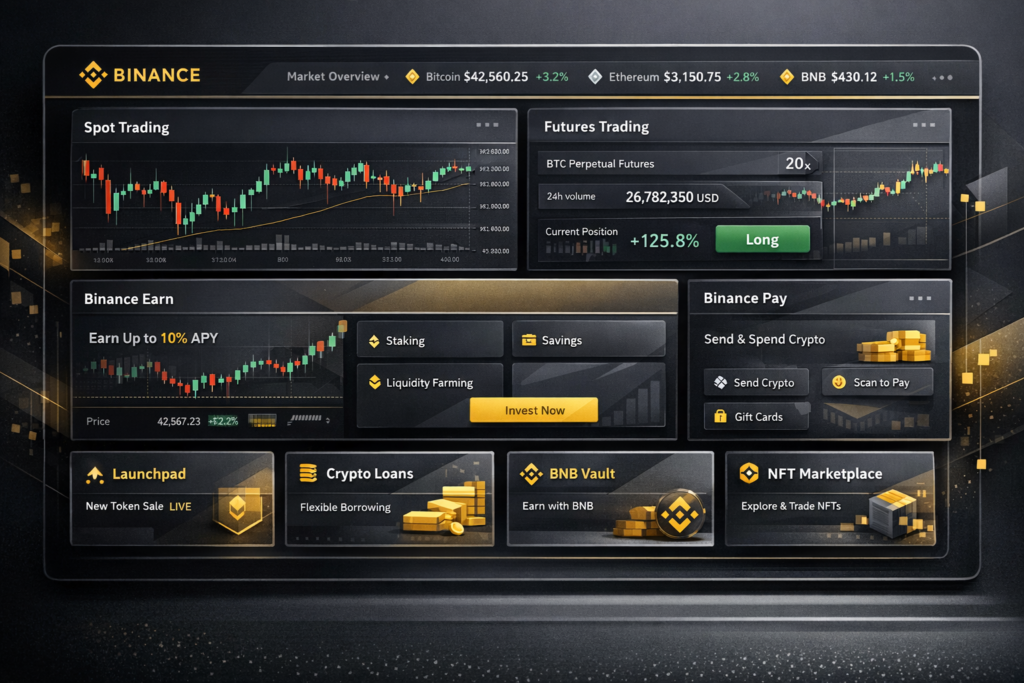
Binance ecosystem dashboard showing spot trading, futures, Earn, and Pay modules in one interface

Quick Verdict

CategoryVerdict
Best forActive traders, multi-feature users, and people who want one ecosystem for trading, earning, and payments
Not ideal forTotal beginners who want the simplest possible crypto app and nothing more
Biggest strengthLarge product ecosystem with competitive fees and multiple utility layers
Biggest drawbackComplexity and region-based feature restrictions
Overall ratingOne of the most complete crypto platforms available, but not the simplest

What Is Binance?

Binance is a global cryptocurrency exchange platform designed for buying, selling, trading, storing, earning, and using digital assets. It started as a trading venue, but today it operates more like a broad crypto infrastructure platform. On Binance, users can access spot trading, margin trading, futures, options, Earn products, P2P transactions, launch tools, trading bots, copy trading, and crypto payments.

That broader identity is important from a search and buyer-intent perspective. Binance is no longer competing only with basic retail exchanges. It is competing with trading-first platforms, yield-focused platforms, and even crypto payment ecosystems. If you are the kind of user who wants one account to handle multiple crypto workflows, Binance becomes much more compelling.

At the same time, that product depth changes how the platform should be evaluated. A useful Binance review should not ask only whether you can buy Bitcoin on it. It should also ask whether Binance gives you enough depth to grow with your needs over time.

Why Binance Still Gets So Much Attention

There are thousands of crypto-related sites, apps, and services on the market. Binance still attracts attention because it solves several problems at once. It offers access, depth, liquidity positioning, extra utility, and a recognizable global brand all in one place.

ReasonWhy It Matters
Broad product rangeYou can move from simple spot buying to advanced tools without leaving the platform
Competitive feesFee efficiency matters more as trading frequency increases
Earn productsUsers can keep idle crypto productive instead of only storing it
Launch and reward ecosystemLaunchpool, Megadrop, and related features create added value for engaged users
Payments and transfersBinance Pay adds real-world utility beyond chart-based trading
EducationBinance Academy helps reduce the learning curve for newer users

Another reason Binance stays relevant is that it appeals to more than one audience. Beginners may come for easy purchases, active traders may come for market access and fees, and long-term users may stay because Earn, Pay, or launch-related features make the ecosystem feel sticky.

Binance Features Explained

1. Spot, Margin, Futures, and Options

Binance is strongest when you look at its market depth from a product perspective. It does not stop at spot trading. Users can trade across spot, margin, futures, and options, which makes Binance much more flexible than a beginner-only exchange. This is one of the clearest reasons Binance remains appealing to users who expect their needs to become more advanced over time.

If you are only buying a small amount of crypto now, that may not seem important. But many users outgrow simple apps. When that happens, having access to a larger product stack without creating new accounts elsewhere becomes a meaningful advantage.

2. Binance Earn

Binance Earn helps turn Binance into more than a trading interface. Instead of leaving assets idle, users can place supported crypto into flexible or locked products. For readers comparing exchanges, this is an important distinction. A platform with real utility after purchase is often more valuable than one that stops at the transaction itself.

Simple Earn is especially appealing for users who want convenience. Flexible products offer easier access and lower commitment, while locked products may offer stronger reward potential in exchange for a time commitment. Binance also presents certain Earn-linked reward pathways that connect to launch-related participation for eligible BNB holdings, which increases the strategic value of staying inside the ecosystem.

3. Launchpool and Token Reward Access

Launchpool is one of Binance’s more distinctive user-retention features. For users already holding eligible assets such as BNB, launch-related participation can feel like an extra layer of upside. Instead of using separate launch platforms or constantly searching for new token opportunities, users can access those opportunities within Binance’s own environment.

This matters because it changes how users think about the platform. Binance is not just a place to execute orders. It becomes a place to discover and interact with new opportunities while already using the rest of the exchange.

4. Binance Pay and P2P Utility

Many exchange reviews focus only on charts, fees, and safety. That misses a major part of Binance’s value proposition. Binance Pay gives users a way to send crypto to family or friends and spend crypto with supported merchants. That makes Binance more useful for people who want practical utility rather than only investment exposure.

P2P also expands usability in regions where peer-to-peer trading plays a bigger role. Together, Binance Pay and P2P help Binance serve users who want movement, transfer, and payment functionality in addition to trading.

5. Trading Bots and Copy Trading

Binance also includes built-in automation and strategy-following tools. Trading bots can help users implement rule-based strategies, while copy trading allows users to review and mirror lead traders. This is attractive to users who do not want every trade to be fully manual.

That said, these tools should not be treated as shortcuts to easy profit. They are still exposed to market risk, strategy risk, and user judgment. From a review standpoint, the right conclusion is not that bots or copy trading are “magic.” It is that Binance gives more optionality than many exchanges.

6. Binance Academy and Learn Resources

Binance Academy strengthens the platform’s beginner support story. New users often struggle not because exchanges are unavailable, but because the terminology is confusing. A platform that offers free education, glossaries, and explainers creates a smoother path from curiosity to actual usage.

That also improves Binance’s brand trust. When education, platform usage, and ongoing engagement live inside one ecosystem, users are less likely to feel lost after signing up.

Binance feature ecosystem overview with Earn, Launchpool, Academy, Pay, and trading tools

Binance Fees: Is Binance Actually Cheap?

Fees are one of the most important reasons Binance remains competitive. For active traders, fee differences are not cosmetic. They compound over time. A platform that looks only slightly cheaper can become significantly cheaper if you trade frequently, use automation, or move larger volume.

For regular users, Binance’s published spot trading fee structure remains one of its strongest selling points. BNB fee deductions and VIP tiers create additional room for savings if you stay active on the platform.

Binance Spot Fee LevelMaker FeeTaker Fee
Regular User0.100%0.100%
Regular User with BNB deduction0.07500%0.07500%
VIP 10.090%0.100%
VIP 1 with BNB deduction0.06750%0.07500%
VIP 20.080%0.100%
VIP 2 with BNB deduction0.06000%0.07500%

For SEO readers and comparison shoppers, this is a strong value signal. Binance is not trying to win only on branding. It is also trying to win on cost efficiency. That matters for spot traders, bot users, copy traders, and anyone who expects to stay active over time.

One practical note: always recheck Binance’s live fee page before publishing or making a decision, because trading fees, discounts, and product-specific promos can change. For an evergreen review article, it is smart to mention that Binance fees are competitive and then point readers to the latest live fee schedule.

Binance fee and value comparison dashboard highlighting spot fees and BNB discount savings

Is Binance Safe?

Safety is one of the most searched parts of any Binance review, and it deserves a balanced answer. Binance does provide multiple safety layers, and those layers are not limited to a single “we take security seriously” statement. The platform highlights Proof of Reserves, SAFU, anti-phishing protection, passkey or 2FA support, withdrawal whitelist controls, and support access.

That does not mean Binance is risk-free. No centralized exchange can remove market risk, custody risk, regulatory risk, or user error. But compared with shallow exchanges that offer little transparency or weak account controls, Binance clearly puts more visible structure around security.

Security AreaWhat It Means for Users
Proof of ReservesBinance provides a transparency framework around asset backing and verification concepts
SAFUA dedicated emergency fund concept designed to help protect users in rare cases
2FA / PasskeyHelps reduce the risk of unauthorized account access
Anti-Phishing CodeMakes it easier to identify legitimate Binance emails and messages
Withdrawal WhitelistRestricts withdrawals to approved addresses and improves account control
24/7 Chat SupportGives users a direct support path when issues arise

From a credibility standpoint, Binance’s security stack is one of the strongest arguments in its favor. The platform’s Proof of Reserves messaging is especially relevant because centralized exchanges are frequently judged on transparency. Binance also gives users practical account-level defenses rather than expecting them to rely only on a password.

The most honest conclusion is this: Binance offers meaningful security tools, but users still need to use them properly. If someone ignores 2FA, skips anti-phishing settings, and treats every incoming message as trustworthy, the problem will not be solved by brand size alone.

Binance security dashboard with Proof of Reserves, SAFU, anti-phishing, and withdrawal whitelist controls

User Experience: Is Binance Easy to Use?

The honest answer is: Binance is easy to start, but not always simple to master. If you only want to buy, hold, or use a few beginner-friendly tools, Binance can feel manageable. If you start exploring futures, bots, launch products, margin features, and platform settings, the experience becomes much more advanced.

This is not necessarily a flaw. In fact, it is partly why Binance is valuable. But it does mean the platform is better suited to users who are comfortable learning gradually. A complete ecosystem naturally has more menus, more modules, and more decisions than a stripped-down crypto app.

For mobile-first users, Binance’s app ecosystem and download availability are positives. For research-first users, Binance Academy and the larger support center help reduce friction. For ultra-casual users, though, the sheer amount of functionality can feel intimidating at first.

What to Know Before You Sign Up

  • Region matters. Some Binance products and services may not be available where you live.
  • Verification matters. Identity verification is part of onboarding and affects what you can do.
  • Crypto remains volatile. Even the best exchange cannot remove market risk.
  • Complexity matters. Binance is more powerful than a beginner-only app, but that also makes it more complex.
  • Security setup matters. You should enable anti-phishing protection, 2FA or passkey, and withdrawal controls early.

Binance Pros and Cons

ProsCons
Large crypto ecosystem with multiple product categoriesCan feel overwhelming for first-time users
Competitive trading fee structureSome products are restricted by region
Strong utility beyond trading through Earn, Pay, and launch featuresAdvanced tools can increase user risk if used carelessly
Visible account security tools and support resourcesNot ideal for people who want the simplest possible interface
Useful for both active and passive crypto usersCrypto volatility still affects every feature layer

Who Should Use Binance?

Binance is a strong choice for users who want a platform that can grow with them. If you expect to move from basic buying to more advanced market activity, Binance gives you room to do that without rebuilding your workflow somewhere else.

User TypeIs Binance a Good Fit?
Beginner who wants to learn graduallyYes, if they use beginner-friendly areas first
Active spot traderYes, especially because fees remain competitive
Futures or advanced traderYes, Binance is much stronger than simple retail exchanges here
Passive user who wants earning optionsYes, Earn products add meaningful utility
User who wants the simplest app possibleProbably not the best fit
User in a restricted jurisdictionNeeds to verify product availability before signing up

👉 Start with Binance here and explore trading, Earn, and crypto payment features in one account.

How to Get Started on Binance

  1. Create your Binance account.
  2. Complete identity verification if your region or funding method requires it.
  3. Secure the account with 2FA or passkey, anti-phishing code, and withdrawal whitelist settings.
  4. Start with Spot or basic buy options if you are new to crypto.
  5. Explore Earn, Pay, or Academy before moving into more advanced products.
  6. Review the latest live fee page and product availability before using advanced tools.

Is Binance Good for Beginners?

Binance can be good for beginners, but only if beginners approach it the right way. The platform offers education, broad access, and a long-term pathway into more advanced products. That is a positive. The problem is that many new users jump into the deepest parts of the platform too quickly.

If you are a beginner, the smarter path is to start with simple buying, basic spot activity, and educational content. Once you understand how Binance works, the wider ecosystem becomes a benefit rather than a source of confusion.

That makes Binance a better fit for curious beginners than for ultra-casual beginners. If you want an exchange that can stay useful as your knowledge grows, Binance is a solid option. If you want almost zero learning curve, another platform may feel easier on day one.

Final Verdict: Is Binance Worth It in 2026?

Yes, Binance is still worth serious consideration in 2026, especially for users who want more than a basic crypto exchange. Its strongest advantage is not just price, and it is not just product count. It is the combination of trading access, earning options, payment utility, learning resources, launch features, and account security tools inside one ecosystem.

That said, Binance is not automatically the best choice for every reader. It is more powerful than simple, and that means more complexity. Some services may also be unavailable depending on where you live. So the most accurate answer is that Binance is excellent for the right type of user, not universally perfect for everyone.

If you want a crypto platform that can handle beginner activity today and more advanced use cases later, Binance remains one of the most complete choices on the market. If you want only the most stripped-down beginner experience, you may prefer something narrower.

👉 Explore Binance now and see the latest fees, features, and region availability before you sign up.


FAQ

Is Binance safe to use?

Binance includes several visible safety layers such as Proof of Reserves messaging, SAFU, anti-phishing tools, 2FA or passkey support, and withdrawal whitelist settings. That said, crypto still involves market risk and personal security responsibility.

What are Binance trading fees?

Binance’s published spot fee structure for regular users starts at 0.100% maker and 0.100% taker, with lower effective rates shown when using BNB fee deduction. Always check the live fee page before making a decision.

Is Binance good for beginners?

Yes, Binance can be good for beginners if they use the platform gradually. Binance Academy, simple buying flows, and broader educational resources help make onboarding easier, but the full platform is still more complex than beginner-only exchanges.

Does Binance offer passive earning options?

Yes. Binance Earn includes flexible and locked products, which can help users earn rewards on supported assets without relying only on active trading.

Can I use Binance everywhere?

No. Binance states that some products and services may not be available in your region. That is why users should verify availability before signing up or relying on a specific feature.

What is Binance best for?

Binance is best for users who want a broad crypto ecosystem that covers trading, earning, payments, launch-related opportunities, and educational support in one account.

Disclosure: This article may contain affiliate links. If you sign up through them, I may earn a commission at no extra cost to you.

Crypto is a high-risk asset class. This article is for informational purposes only and does not constitute financial advice.

Leave a Reply