
If you are searching for a Chatbase review, you are probably not looking for a novelty chatbot. You are looking for a tool that can answer customer questions, reduce repetitive support work, stay on brand, connect with your existing systems, and still give you enough control that the experience does not feel reckless.
That is exactly why Chatbase is worth a closer look. It is no longer best understood as a simple “train a bot on your documents” product. It is much closer to an AI customer support platform that lets businesses build trained agents, connect those agents to actions, deploy them across multiple channels, and then refine them with analytics and human handoff workflows.
This matters because a lot of AI chatbot tools sound similar at first. Many promise instant answers, fast setup, and easy automation. But once you get past the landing page, the real differences show up in training flexibility, deployment options, support workflow depth, security controls, analytics quality, and whether the product can actually fit into a real business operation.
In this Chatbase review, I am going to break down what the platform does well, where it still has limitations, what kind of business should consider it, which plan makes the most sense for most buyers, and whether it deserves a place in a serious customer support stack in 2026.
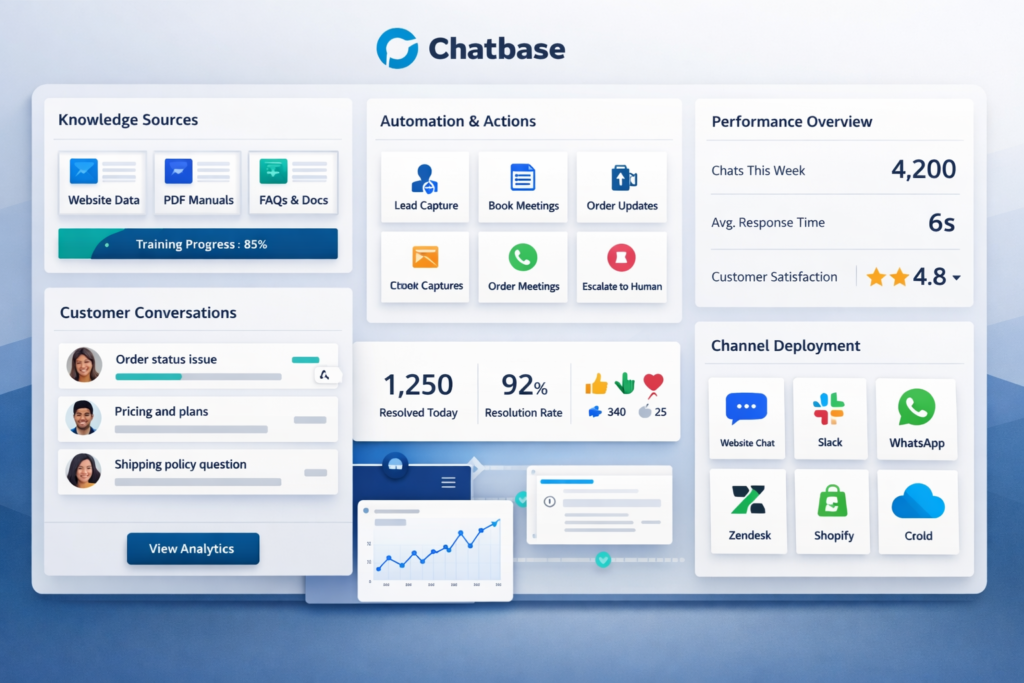
Quick Answer: Is Chatbase Worth It?
Yes, Chatbase looks worth it for businesses that need more than a basic website chatbot. It is strongest when you want an AI support agent trained on your own content, deployed across multiple channels, and connected to actions, analytics, and human escalation paths.
For tiny websites or hobby projects, Chatbase can feel like more platform than you need. But for SaaS companies, ecommerce brands, online service businesses, education companies, and support-heavy teams, the product makes more sense because it is designed around real support operations instead of a shallow FAQ widget.
| Category | Verdict |
|---|---|
| Overall positioning | Best viewed as an AI customer support agent platform, not just a website chatbot |
| Best for | SaaS, ecommerce, service businesses, support-heavy websites, documentation-driven teams |
| Not ideal for | Very small sites, side projects, or buyers who only need a lightweight free chat bubble |
| Biggest strengths | Multi-source training, wide deployment options, AI actions, analytics, and human handoff |
| Biggest weakness | Lower plans are limited for serious production use, so many real businesses will want at least Standard |
| Best plan for most businesses | Standard |
| Overall rating | Strong choice for businesses that treat AI support as infrastructure rather than decoration |
What Is Chatbase?
Chatbase is a platform for building AI agents trained on your own business information. In practical terms, that means you can feed it content from your website, documents, text snippets, structured Q&A, Notion content, and selected support sources, then deploy that trained agent where your customers actually need help.
The important point is that Chatbase is not trying to position itself as “just another bot builder.” Its product direction is much more support-oriented. It is built around helping customers find answers, complete useful actions, reduce ticket load, escalate when needed, and give teams better visibility into how conversations are going.
That shift in positioning is one reason the product has become more interesting. A lot of earlier chatbot tools were mainly about embedding a chat window and hoping for the best. Chatbase is trying to solve a more serious problem: how to deliver faster support without losing control, accountability, or business context.
Why Chatbase Is More Than a Basic AI Chatbot
There are three reasons Chatbase feels more substantial than the average chatbot builder.
First, the platform supports several training inputs. That matters because businesses do not store knowledge in one perfect place. Your help content may live across a website, PDF guides, internal snippets, Notion pages, and support ticket history. A tool that only supports one input method often becomes more work than it saves.
Second, Chatbase is designed for deployment beyond the main website widget. If your customers ask questions through Slack, email, WhatsApp, WordPress, Shopify, Zendesk, Messenger, or Instagram, the product is clearly pushing toward a broader support footprint rather than a one-channel experience.
Third, it includes actions, analytics, and escalation workflows. That is the difference between “the bot answers questions” and “the support agent can actually move work forward.” In a real business, that difference is huge.
| Feature Area | Why It Matters |
|---|---|
| Training sources | Lets you build a more accurate agent from the content your business already owns |
| Multi-channel deployment | Helps you support customers where they already contact you |
| Actions | Allows the agent to do more than answer static questions |
| Analytics | Gives you visibility into what users ask, where the agent fails, and what to improve |
| Escalation | Ensures difficult or sensitive cases do not get trapped in AI-only loops |
| Security controls | Important when AI becomes part of real customer support operations |
Chatbase Features Explained in Plain English
1. Training on your own data
Chatbase lets you train an agent on several types of content, including websites, documents, text snippets, custom Q&A, Notion content, and selected support ticket sources. That gives businesses a more flexible starting point than tools that only scrape a public site.
This is especially useful if your website is not the complete truth about your business. Many companies keep better information in onboarding guides, internal docs, support macros, policy PDFs, or structured Q&A lists. Chatbase makes more sense in those situations than a tool that expects your website alone to carry the entire support experience.
2. Website widget, hosted help page, and channel flexibility
Deployment is one of Chatbase’s stronger selling points. You are not limited to a floating chat bubble on one website. You can turn the agent into a help page, connect it to email, use it inside Slack, deploy it to WordPress, and extend it into messaging and support ecosystems that many businesses already use.
That matters because customer support rarely lives in one clean place. As soon as a business grows, users ask questions through multiple channels. A platform that can follow that complexity is much more useful than one that creates yet another isolated support endpoint.
Suggested alt text: Chatbase workflow showing content training, agent testing, website deployment, and support channel integrations
3. AI actions that move beyond simple answers
One of the clearest signs that Chatbase is aiming higher than a basic chatbot is its actions system. Actions let the agent do useful work during a conversation. Depending on your setup, that can include lead capture, web search, scheduling, custom actions, and connections to other systems.
This is a big deal because many support interactions are not solved by a text answer alone. Sometimes the customer wants to book a call, open a ticket, check something in another system, or get routed correctly. The more you can handle inside the support flow, the more valuable the product becomes.
4. Human handoff when AI should stop
No serious business should run support AI as if it never fails. Customers get frustrated. Billing disputes happen. Sensitive issues come up. Complex edge cases appear. Chatbase is more credible because it includes an escalate-to-human path instead of pretending every conversation should remain AI-only.
That matters for trust. A support agent should not trap users in a loop. It should solve what it can, recognize when the case is too risky or too complex, and pass the conversation to the right human system with enough context to prevent the customer from repeating everything.
5. Analytics that help you improve over time
Chatbase also includes activity and analytics views so you can see what users are asking, which topics keep surfacing, what sentiment patterns show up, and where the agent is getting positive or negative feedback. That is essential if you want to improve performance instead of treating the launch as the end of the job.
Many businesses underestimate this part. A support agent gets better when teams review the gaps, expand the knowledge base, refine instructions, and watch for repeated friction points. If you cannot see those patterns clearly, optimization becomes slow and reactive.
6. Developer path for custom implementation
Chatbase is also more flexible than simple no-code bots because it has a developer path. That makes it attractive to companies that want to start with a plug-and-play deployment and later go deeper with custom integrations, API-based workflows, or more tailored support experiences.
For many businesses, this is the ideal middle ground. Non-technical teams can get something live quickly, while technical teams still have room to turn the product into a more customized support layer when needed.
Chatbase Pricing: Which Plan Makes Sense?
Pricing is one of the biggest decision points in any Chatbase review because the platform looks very different depending on which plan you are evaluating. The free plan is fine for testing. But if you are trying to launch something real, the conversation quickly shifts toward Hobby, Standard, and Pro.
Here is the public annual-billing pricing structure at the time of writing:
| Plan | Price | Message Credits / Month | AI Actions per Agent | Training Size per Agent | Seats | Best For |
|---|---|---|---|---|---|---|
| Free | $0 | 50 | 0 | 400 KB | 1 | Testing only |
| Hobby | $32/month billed annually | 500 | 5 | 10 MB | 2 | Small projects and early experiments |
| Standard | $120/month billed annually | 4,000 | 8 | 20 MB | 3 | Most serious small-to-mid-sized businesses |
| Pro | $400/month billed annually | 15,000 | 12 | 40 MB | 5 | Larger teams with heavier support volume |
| Enterprise | Custom | Higher limits | Higher limits | Higher limits | Custom | Enterprises needing governance, SSO, and tailored support |
On paper, the pricing is not bargain-basement cheap. But that is partly because Chatbase is not trying to sell itself as a toy widget. It is selling a support platform. The right question is not “Is it the cheapest chatbot?” The right question is “Will it reduce enough manual support work, improve enough customer outcomes, or unify enough channels to justify the spend?”
For most businesses, the Standard plan looks like the real starting point. That is where the value begins to feel practical instead of purely experimental. You move beyond a lightweight test environment into something that can support API access, personalization, auto-retraining, and deeper integrations.
Hobby may still work for a solo operator or small site with modest traffic. But if your support volume matters, or if you already know you want actions, integrations, and a more durable setup, Standard is easier to justify than trying to under-buy and then outgrow the platform immediately.
There are also add-ons, including auto-recharge credits and extra agents. That means buyers should think beyond base sticker price and estimate likely usage. If your audience asks frequent support questions, message credits can become a real planning variable.
What You Get on Higher Plans
Moving up the plans is not only about more message credits. It is also about depth.
Hobby adds advanced models, more actions, basic analytics, integrations, and attachments. Standard goes further with API access, personalization, auto-retrain agents, and advanced integrations. Pro adds advanced analytics, source suggestions, and tickets as a source. Enterprise adds higher limits plus more governance and enterprise controls such as custom roles, SSO, white-labeling, audit logs, priority support, a success manager, and SLAs.
That tier progression tells you a lot about Chatbase’s real market. It is not only chasing tiny website owners. It is clearly trying to serve growing teams and enterprise buyers that want an AI support layer with more control, observability, and governance.
Chatbase Pros and Cons
| Pros | Cons |
|---|---|
| Built around AI customer support rather than just generic chatbot creation | Free and lower plans are restrictive for meaningful business deployment |
| Supports multiple training sources including websites, files, Q&A, and more | Serious value often starts at Standard, which may be too expensive for tiny projects |
| Strong deployment flexibility across web, email, WordPress, Slack, WhatsApp, and more | Output quality still depends heavily on the quality of your source content and instructions |
| Actions, analytics, and escalation make it more operationally useful than basic bots | Some advanced enterprise features require custom sales engagement rather than self-serve setup |
| Developer path exists for deeper customization | Buyers who want a full all-in-one support suite may still need other tools around it |
| Security and privacy positioning are stronger than many lightweight alternatives | Usage planning matters because message credits and channel complexity can affect cost |
Who Should Use Chatbase?
The easiest way to decide whether Chatbase is right for you is to ignore the AI hype and look at your support reality.
| Business Type | How Good the Fit Is | Why |
|---|---|---|
| SaaS companies | Excellent fit | Documentation, onboarding questions, billing queries, and product FAQs make AI support especially useful |
| Ecommerce brands | Strong fit | Order questions, shipping policies, product guidance, and support triage are repetitive and high-volume |
| Online service businesses | Strong fit | Lead capture, service explanations, qualification, and support routing can be automated well |
| Education or course businesses | Strong fit | Students often ask recurring questions about access, lessons, pricing, deadlines, and troubleshooting |
| Agencies | Good fit | Useful when clients need AI support deployment without building custom infrastructure from scratch |
| Tiny hobby sites | Weak fit | The platform may be more advanced and more expensive than necessary |
If your company already has a decent help center, product docs, policy pages, or support content, Chatbase becomes easier to justify. You already have the raw material. The platform can turn that content into a faster and more interactive customer support layer.
If your content is thin, outdated, or messy, the result will be weaker. That does not mean Chatbase is bad. It means AI support works best when the business itself has organized knowledge worth training on.
Who Should Probably Skip Chatbase?
Not every buyer needs this much platform.
If you only want a simple chat bubble that answers five common questions, you may not need Chatbase. If your website gets little traffic, your support volume is tiny, and you do not care about multi-channel deployment or analytics, a smaller tool could be enough.
It may also be the wrong fit if your team expects AI to fix disorganized support content automatically. Chatbase can help you scale knowledge delivery. It cannot magically turn weak internal documentation into great customer support.
What Chatbase Still Does Not Solve Perfectly
No review should pretend a product has no friction. Chatbase is strong, but it is not effortless.
The biggest limitation is that response quality still depends on how well you configure the system. You need readable content. You need good instructions. You need to think about when the agent should answer, when it should say it does not know, and when it should escalate. That is normal for serious AI support, but buyers should go in with realistic expectations.
The second limitation is that cost and capability are tied together fairly tightly. The plans make sense if you are using the platform seriously, but buyers on very small budgets may feel pushed toward higher tiers sooner than they expected.
The third limitation is strategic rather than technical. Chatbase is excellent as an AI support layer, but depending on your stack, you may still need other systems for full customer operations, broader CRM workflows, or more complex support team management. In other words, it can be central, but it may not be your only support tool.
How to Get Better Results From Chatbase
If you buy Chatbase and simply dump random content into it, you are leaving a lot of value on the table. The businesses that get the best results usually do a few things well.
- They clean up their support content before training the agent.
- They create structured Q&A for high-priority questions instead of relying only on scraped pages.
- They give the agent clear instructions on tone, boundaries, and what to do when it does not know the answer.
- They review analytics and activity data instead of assuming the first version is good enough.
- They define clear escalation rules for billing, complaints, sensitive issues, or repeated failures.
That last point is especially important. A good support agent is not only judged by how often it answers correctly. It is also judged by how gracefully it fails. If you handle those edge cases well, the entire support experience feels more trustworthy.
Suggested alt text: Chatbase analytics dashboard with chat trends, support topics, sentiment insights, and conversation optimization signals
Chatbase for SaaS Companies
SaaS is one of the clearest fits for Chatbase. Product support tends to be repetitive, documentation-heavy, and spread across onboarding, features, billing, account setup, integrations, and troubleshooting. Those are all areas where a trained AI support agent can create real leverage.
For a SaaS company, Chatbase can reduce time spent answering the same “how do I…” questions, route more complex issues into the right support channels, and keep self-serve users from getting stuck so early in the journey. If the product is well documented, the platform becomes much easier to justify.
Chatbase for Ecommerce Brands
Ecommerce businesses also have a strong use case. Customers constantly ask about shipping, returns, product differences, sizing, order status, delivery windows, and purchase confidence questions. Those conversations are frequent, repetitive, and often time-sensitive.
A good AI support agent can help reduce purchase friction before checkout and support load after purchase. That does not mean it replaces humans completely. It means it can absorb a large volume of predictable interactions so the human team can focus on exceptions and higher-stakes cases.
Chatbase for Agencies and Client Work
Agencies can also benefit, especially if they help clients with support automation, lead qualification, website conversion, or customer experience optimization. Chatbase gives agencies a way to deploy something useful without building an entire agent framework from scratch for every client.
The main question for agencies is not whether Chatbase works. It is whether the client has enough quality content and support volume to make the implementation meaningful. For clients with shallow content and little demand, the result may look more impressive than it actually is. For better-prepared clients, the value can be much more concrete.
Security, Privacy, and Trust
Security is often treated like a footnote in AI software reviews, but it should not be. If an AI support platform is going to sit close to customer data and operational workflows, trust matters.
Chatbase publicly emphasizes GDPR compliance, SOC 2 Type II compliance, encryption at rest and in transit, domain allowlists, rate limiting, user roles, and enterprise controls. It also states that customer data is not used to train AI models and that the platform uses retrieval-based methods to generate responses from your content.
That does not mean buyers should stop doing their own due diligence. But it does mean Chatbase is speaking the language serious businesses expect to hear when evaluating support infrastructure. Compared with lightweight chatbot tools that barely address governance, that is a meaningful advantage.
| Security Area | What Chatbase Highlights |
|---|---|
| Compliance | GDPR and SOC 2 Type II |
| Encryption | Data encrypted at rest and in transit |
| Access control | User roles and permissions |
| Abuse prevention | Rate limiting |
| Embedding control | Domain allowlist |
| Privacy posture | Customer data not used to train AI models |
How Chatbase Compares to Simple Website Chatbots
If you compare Chatbase with a basic website chatbot, the biggest difference is operational depth.
A simple chatbot is usually fine for greeting visitors, collecting leads, or answering a few predictable questions. Chatbase is trying to do more than that. It is trying to become an AI support agent that can work across channels, connect to actions, review analytics, handle escalation, and fit into real support systems.
That makes Chatbase stronger for businesses, but it also means buyers need clearer expectations. You are not buying a decorative plugin. You are buying something closer to a support workflow platform powered by AI.
Should You Choose Chatbase or an Alternative?
The honest answer depends on the job you need done.
If you want a support-focused AI agent with flexible training, strong deployment options, actions, analytics, and escalation, Chatbase is a serious contender. If you want a broader customer messaging suite, a deeply specialized enterprise service stack, or the cheapest possible chatbot widget, your shortlist may look different.
The good news is that Chatbase is easy to understand conceptually: it becomes more attractive the more your business needs structured, scalable, multi-channel support. It becomes less attractive the more your needs are tiny, temporary, or purely cosmetic.
Final Verdict: Is Chatbase a Good Buy?
Chatbase is one of the more compelling AI customer support platforms for businesses that actually want to operationalize AI support instead of just experimenting with a chatbot. Its biggest strengths are the combination of flexible training, wide deployment, action-oriented workflows, human escalation, analytics, and stronger trust positioning than many lighter tools.
It is not the cheapest path, and it is not the best fit for every site. But for companies with real support needs, especially those with good documentation and repeatable customer questions, it has the ingredients of a practical support layer rather than a gimmick.
If you are a serious buyer, the most sensible path is to test it with your real content, not generic demo content. Upload your docs. Crawl your support pages. Define a few important workflows. Review what the agent gets right, where it becomes vague, and whether the human handoff logic feels trustworthy. That will tell you more than any landing page claim.
My verdict is simple: Chatbase is a strong option for businesses that want AI support with real operational depth. For the right company, it is not just another bot. It is infrastructure.
Suggested alt text: Chatbase final verdict image showing AI customer support value, workflow depth, and business decision summary
Frequently Asked Questions
Is Chatbase good for customer support?
Yes, Chatbase looks especially strong for customer support use cases because it is built around trained AI agents, support workflows, channel flexibility, analytics, and escalation instead of only a simple website chat window.
Does Chatbase work with WordPress?
Yes. Chatbase offers a WordPress deployment path, which makes it easier for site owners to add the agent without building a custom integration from scratch.
Can Chatbase answer customer emails?
Yes. Chatbase supports an email channel that can automatically monitor and respond to incoming emails once the domain and authentication requirements are configured correctly.
Is Chatbase secure?
Chatbase publicly highlights GDPR compliance, SOC 2 Type II compliance, encryption in transit and at rest, and privacy protections around customer data. That makes it more reassuring than many lightweight chatbot tools, although serious buyers should still do their own compliance review.
What is the best Chatbase plan for most businesses?
For most businesses, Standard looks like the most practical starting point because it adds more serious capabilities for production use. Smaller sites may still begin with Hobby, but many growing businesses will likely outgrow it fairly quickly.
Can Chatbase replace human support agents?
Not completely, and it should not try to. The smarter role for Chatbase is to handle repetitive and structured support work, while passing complex, emotional, or sensitive issues to human agents when appropriate.
Is Chatbase worth it for small businesses?
It can be, but only if the business has enough support volume, useful content to train on, and a reason to care about better support automation. For very small sites, it may be more platform than necessary.