
UseArticle Review 2026: Is This AI Affiliate Website Builder Worth It for SEO-Focused Marketers?

Most affiliate websites still start the hard way. You buy hosting, install WordPress, pick a theme, configure plugins, connect analytics, add affiliate links, create product boxes, and then finally open an AI writing tool to draft your first article. For many beginners, that stack is not just slow. It is the reason the site never gets launched at all.

That is exactly the problem UseArticle is trying to solve. Instead of treating content, site structure, SEO setup, and publishing as separate jobs, it packages them into one affiliate-focused workflow. In simple terms, UseArticle is an AI affiliate website builder that lets you paste a product URL or choose from its marketplace, then generate a structured affiliate site with long-form content, product pages, SEO-oriented layout, and hosted publishing.

If you are searching for a serious UseArticle review, the main question is not whether the platform can generate words. Plenty of AI tools can do that. The real question is whether UseArticle can help you build affiliate pages that are fast to launch, credible enough to publish, and structured well enough to support search traffic and conversions.

My short answer is this: UseArticle is one of the more interesting tools in this category because it is not trying to be a generic AI writer. It is built specifically for affiliate content and affiliate site creation. That focus gives it a real advantage for review posts, comparison pages, buying guides, and product-led niche sites. At the same time, it is still not a total replacement for a mature WordPress stack if you need advanced customization, extensive plugin flexibility, or a deeply branded long-term content business.

In this article, I will break down what UseArticle does well, where it still falls short, how its pricing looks, whether its SEO angle is convincing, and who should actually use it in 2026.
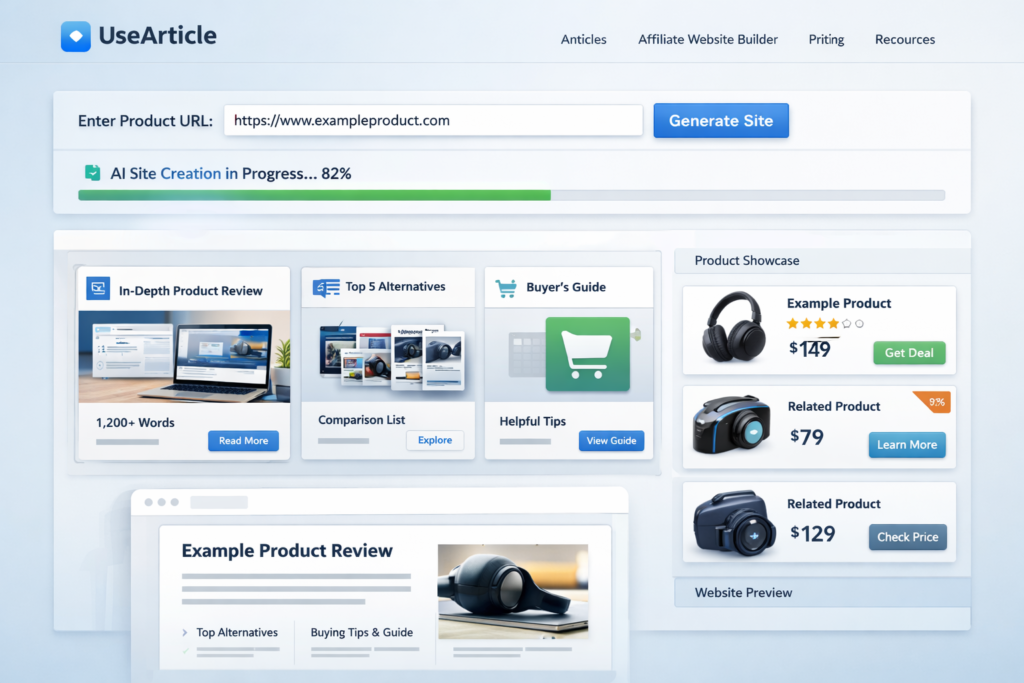
UseArticle AI affiliate website builder dashboard showing product URL import, site generation, affiliate content blocks, and product cards

What Is UseArticle?

UseArticle is an AI-powered affiliate website builder designed to help users launch monetizable affiliate sites faster. Instead of starting from a blank CMS, the platform is built around a simpler promise: pick a product or paste a product URL, then let the platform generate the site structure and affiliate-style content around it.

That distinction matters. UseArticle is not just another AI content generator for random blog posts. It is built around commercial-intent content types such as product reviews, product comparisons, buying guides, best-product lists, roundups, value analysis pages, and budget-focused recommendation content. If your goal is to rank informational lifestyle posts, it may not be your best-fit platform. But if your goal is to create buyer-intent pages around tools, software, products, or affiliate programs, its positioning makes a lot more sense.

The product also includes hosted site infrastructure, product showcase homepages, custom domain support, SSL, global CDN delivery, affiliate link handling, SEO-focused structure, and a curated affiliate marketplace. That combination is what makes UseArticle different from normal AI writing assistants. It is trying to compress a multi-tool workflow into one system.

At a glanceWhat it means
Core categoryAI affiliate website builder
Main jobTurn product URLs or program picks into publishable affiliate content sites
Primary use caseReviews, comparisons, buying guides, roundups, and niche affiliate sites
Built forAffiliate marketers, SEO freelancers, agencies, creators, and niche site builders
Main appealFaster launch speed with less setup friction than a traditional WordPress stack

Why UseArticle Stands Out in a Crowded AI Content Market

The AI content market is full of products that promise faster writing. What makes UseArticle more interesting is that it solves a different problem. Many affiliate site builders do not actually need more blank-page writing tools. They need faster website production, cleaner commercial formatting, better product-page structure, and less technical setup.

That is where UseArticle feels better positioned than a general AI writer. It narrows the workflow around affiliate content instead of pretending to cover every kind of publishing use case. In practice, that focus can save time in at least five ways.

  • You do not need to assemble multiple tools just to launch your first site.
  • You can start from a product URL or affiliate program rather than a blank content idea.
  • The content formats are aligned with buyer-intent SEO instead of generic blog writing.
  • The site has a product-led homepage structure instead of a thin chronological blog archive.
  • The workflow is designed for monetization and publishing speed, not just word generation.

For beginners, this means a lower activation barrier. For experienced affiliates, it means less friction when testing niche ideas or spinning up focused micro-sites. For agencies, it means faster production for templated client workflows. Those three audiences want different things, but they all benefit from a tighter, more specialized workflow.

How UseArticle Works

UseArticle’s workflow is built around speed. You choose a product from the marketplace or paste a product URL, then the platform generates the affiliate site structure and article content around it. That process is much more product-led than traditional blogging, and that is part of the point.

A normal affiliate workflow usually looks like this: research an offer, join the program, build a page structure, write the copy, install the site, add product boxes, configure links, optimize on-page SEO, and then publish. UseArticle tries to compress all of that into one system so the user can move from idea to published site much faster.

On paper, that sounds almost too convenient. But it is actually a smart fit for affiliate SEO because most affiliate websites follow a repeatable content pattern. You need product pages, comparison pages, buying guides, verdict-driven copy, affiliate calls to action, and a reasonably trustworthy site structure. UseArticle is essentially built around that repeatability.

Typical old workflowUseArticle workflow
Buy hostingCreate inside the platform
Install WordPressHosted publishing already included
Set up theme and pluginsAffiliate-ready templates built in
Research products manuallyUse URL input or browse marketplace
Write article from scratchGenerate long-form affiliate content
Create product boxes and affiliate links manuallyProduct homepage and link management handled inside the workflow
Handle domain, SSL, and site speed separatelyCustom domain, SSL, and CDN included

That does not mean it eliminates editorial work. The best way to use a platform like this is still to treat the AI output as a strong structured draft, then improve it with clearer opinions, niche-specific knowledge, better examples, more differentiated headings, and stronger reader trust signals. But the structure and speed are real benefits.

UseArticle workflow showing how a product URL becomes an affiliate website with AI-generated articles and product pages

UseArticle Features: What You Actually Get

Below are the features that matter most if you are evaluating UseArticle for affiliate content and SEO-driven site building.

1. Eight affiliate-focused content templates

This is one of the strongest parts of the product. Many AI tools produce generic writing that still needs to be reshaped into a commercial format. UseArticle starts closer to the final use case by giving users dedicated affiliate-style templates.

TemplateBest use caseWhy it matters for SEO
Honest Product ReviewsSingle product review keywordsMatches bottom-of-funnel buyer intent
Product ComparisonsProduct A vs Product B queriesExcellent for high-converting comparison traffic
Buying GuidesDecision-stage educational searchesSupports informative plus commercial hybrid intent
Best Products ListsBest X for Y keywordsUseful for broader commercial long-tail coverage
Top Category RoundupsBest tools in a categoryStrong for list-style purchase research queries
Value AnalysisIs X worth it?Captures evaluation-stage traffic
Budget Buying GuidesBest affordable or low-cost optionsTargets price-sensitive buyers
Head-to-Head ComparisonsDirect competitive decision pagesSupports conversion-heavy searches

That template coverage is useful because affiliate SEO usually lives or dies on search intent fit. A generic blog post can rank for some keywords, but high-converting affiliate traffic often comes from content that matches a very specific buying stage. UseArticle’s template set is better aligned with that reality than a broad AI blog generator.

2. Auto product extraction

UseArticle highlights auto product extraction as one of its headline features. That is important because affiliate content often becomes weak when the writer has to manually reconstruct the product setup, pricing structure, or key differentiators from scratch. A platform that can pull core product data into the workflow can save serious time.

There is one nuance here. The official feature language specifically mentions Amazon URL extraction, so users should treat broad “paste any product URL” messaging as something to test in their own niche rather than assuming perfectly equal performance across every merchant or software brand. Still, the broader direction is valuable: it reduces manual data assembly and speeds up initial draft creation.

3. Built-in affiliate marketplace

The marketplace is one of UseArticle’s most practical features for beginners and time-constrained publishers. Instead of researching programs separately, users can browse curated options inside the platform, review the commission format, and build around those offers faster.

That is especially useful when niche selection is your bottleneck. Many aspiring affiliates never fail because they cannot write. They fail because they get stuck at the “what should I promote?” stage. A marketplace reduces that friction and encourages faster execution.

Marketplace benefitWhy it helps
Curated programsReduces time spent hunting for monetizable offers
Commission visibilityMakes program selection easier
Category browsingUseful for niche research and portfolio planning
One-click site creation angleShortens the path from idea to publishable site
Useful for beginnersHelps users who do not yet have a monetization map

4. Product showcase homepage

This feature is more important than it first appears. A lot of small affiliate sites look thin because the homepage is little more than a blog roll. UseArticle instead pushes a more product-led homepage model with product cards, category filters, ratings, prices, and affiliate calls to action.

That structure can improve both usability and trust. Readers immediately understand what the site is about. Search engines can also read a clearer topical focus. For a niche affiliate site, that is often more valuable than a pretty but vague homepage design.

5. SEO-oriented content generation

UseArticle does not only advertise article generation. It frames the output around affiliate SEO, buyer-intent keywords, review-focused metadata, product schema, clean URLs, and conversion optimization. In theory, that is exactly what affiliate site owners want to hear, because traffic without purchase intent often does not translate into commissions.

Now, that does not automatically mean the content will rank on its own. No tool can guarantee that. But as a workflow direction, it is the right direction. A product built for affiliate SEO is more useful than one built for generic content volume alone.

6. Hosted publishing with custom domains, SSL, and CDN

These infrastructure features matter because they remove operational friction. If UseArticle required users to move everything elsewhere just to go live, it would lose a lot of its advantage. By including hosted publishing, custom domain support, SSL, and CDN delivery, the platform makes fast deployment much more realistic.

For someone managing multiple micro-sites or testing several offers, that convenience is not a minor bonus. It is part of the product’s core value.

👉 Start with UseArticle free if you want to test how quickly it can turn a single product URL into a structured affiliate site before you commit to a larger content stack.

UseArticle Pricing: Is It Good Value?

Pricing is one of the easiest parts of the platform to understand, and that simplicity is a plus. There is a lower-cost entry plan, a more scalable unlimited plan, and a one-time BYOK option for users who want to control their own AI key costs.

PlanPriceWho it fits bestKey inclusions
Base$15/monthBeginners and small testers3 websites, 100 blog posts per website, unlimited products, all 8 templates, custom domain support, branding removal, priority AI generation, auto product extraction
Unlimited$49/monthActive affiliates, agencies, multi-site buildersUnlimited content, unlimited websites, all 8 templates, custom domain support, branding removal, priority AI generation, auto product extraction, priority support
BYOK Lifetime$250 one timeUsers who prefer no recurring fee and are comfortable using their own OpenAI keyUnlimited AI-generated blogs with your API key, unlimited websites, all 8 templates, custom domain support, branding removal, auto product extraction, priority support, no recurring fees

There is also a yearly option promoted on the pricing page with savings versus monthly billing. For people building multiple small affiliate sites, the Unlimited plan is likely the cleanest value play. For cautious beginners, Base is low enough to test without much risk. For power users who already understand AI usage economics, the BYOK lifetime model is arguably the most interesting option.

Compared with the cost of hosting, themes, link tools, site builders, and premium AI writing subscriptions, UseArticle can look very cost-effective. The biggest question is not whether the subscription is expensive. It is whether the platform’s workflow actually saves you enough time and setup friction to justify consolidating your stack inside it. For many beginners and small publishers, the answer will probably be yes.

UseArticle Pros and Cons

ProsCons
Purpose-built for affiliate websites rather than generic bloggingStill less flexible than a mature WordPress ecosystem
Fast workflow from product URL to site draftTemplate-led output can feel repetitive if not edited
Built-in marketplace makes monetization research easierSome advanced features are still on the roadmap
Hosted publishing removes setup burdenNot ideal for highly customized content businesses
Product-led homepage structure is more useful than a thin blog archiveUsers should test extraction quality in their own niche
Pricing is simple and relatively accessibleStill needs human editorial work for stronger differentiation

Who Should Use UseArticle?

Not every content tool fits every publisher. UseArticle has a clearer ideal user profile than many platforms, and that is actually a good thing.

User typeHow strong the fit isWhy
Affiliate beginnersExcellent fitReduces technical overwhelm and speeds up site launch
Niche site testersExcellent fitSupports fast experiments across multiple offers or sub-niches
SEO freelancersStrong fitUseful for efficient production of structured affiliate pages
Small agenciesStrong fitGood for faster repeatable site and content workflows
Creators building monetized recommendation sitesStrong fitUseful for product-led sites without heavy technical setup
Advanced WordPress developersModerate fitMay appreciate the speed but could find customization limiting
Large editorial brandsLimited fitMay outgrow the template-led workflow and want more control

The people most likely to benefit are the ones who care more about speed to launch and buyer-intent page production than endless design freedom. If that describes you, UseArticle becomes much easier to justify.

Who Should Probably Not Use UseArticle?

There are also users who should be more cautious.

  • If you want total front-end design freedom, WordPress still offers more room.
  • If your content business depends on heavy plugin stacks, custom tools, or unique site architecture, UseArticle may feel constrained.
  • If you publish highly original expert content that must sound deeply personal, you will still need strong manual editing.
  • If you already have a mature site system that works, the migration value may be lower than the “new site launch” value.

In other words, UseArticle is strongest as a launch-and-scale simplifier, not as an infinitely customizable CMS replacement for every publishing business model.

UseArticle and SEO: Can It Really Help You Rank?

This is where most readers of a UseArticle review will be most skeptical, and rightly so. Every AI platform says it is SEO-friendly. That claim matters only if the workflow aligns with how affiliate pages actually rank.

To evaluate that properly, it helps to separate the SEO story into two parts: structural advantages and content-quality risks.

Structural SEO advantages

UseArticle appears to understand some of the fundamentals that matter for affiliate SEO. It emphasizes product schema, review-oriented metadata, buyer-intent keyword targeting, affiliate link optimization, clean URL structure, and fast hosting. Those are all relevant building blocks for commercial pages.

SEO elementWhy it matters
Buyer-intent keyword targetingBetter alignment with traffic that can convert
Review-focused titles and descriptionsImproves SERP appeal for product searches
Product schema markupSupports richer search presentation
SEO-friendly URLsHelps create cleaner information architecture
Fast hosted delivery with CDNSupports technical performance
Affiliate link optimizationUseful for organization and compliance
Product showcase homepageImproves site clarity and internal topical focus

Content-quality risks

This is the side many users ignore. A good structure does not automatically create a good article. AI-generated affiliate content can become bland, repetitive, or too predictable if you publish it with minimal editing. That risk exists with UseArticle just like it exists with other AI tools.

The best-performing affiliate pages usually do more than summarize features. They help readers make a decision. They explain tradeoffs clearly. They frame who the product is for and who it is not for. They speak in a way that reduces buying hesitation. And ideally, they add some original angle, testing insight, use-case nuance, or sharper editorial judgment.

UseArticle can help with the structure, speed, and layout of these pages. But it still benefits heavily from manual improvement. If you want the best results, use the platform to compress the production process, then upgrade the content with better intros, clearer pros and cons, sharper use-case segmentation, cleaner tables, stronger verdict language, and more specific supporting details.

My practical view is simple: UseArticle can absolutely help you publish affiliate SEO content faster, but it should be treated as a leverage tool, not as a substitute for judgment.

UseArticle interface showing affiliate content templates and curated affiliate marketplace programs

UseArticle vs WordPress and Traditional Affiliate Stacks

Most buyers are not comparing UseArticle with nothing. They are comparing it with the traditional method: WordPress plus hosting plus theme plus plugins plus AI writing tools plus manual content structuring.

That comparison is where UseArticle becomes easier to understand. It wins on speed and simplicity. WordPress still wins on flexibility and ecosystem depth.

CategoryUseArticleTraditional WordPress stack
Setup speedVery fastUsually slower
Technical frictionLowHigher
Design freedomModerateVery high
Affiliate-ready structureBuilt inUsually assembled manually
Publishing simplicityHighMedium to low, depending on setup
Customization depthLimited to moderateExtensive
Best fitFast-launch affiliate buildersAdvanced custom site owners

If you like tinkering with plugins, custom themes, performance settings, schema tweaks, and intricate site design, WordPress still offers more freedom. But if your real bottleneck is publishing speed and production consistency, UseArticle becomes much more attractive.

For many new affiliates, the right question is not “Which platform is technically better?” The right question is “Which platform will actually get me publishing high-intent content this month?” On that measure, UseArticle has a strong argument.

Where UseArticle Still Falls Short

No honest UseArticle review should ignore the product’s current limitations. The platform is promising, but it still has some constraints that matter depending on your goals.

1. Some important features are still on the roadmap

UseArticle’s public roadmap shows that several valuable capabilities are still in development rather than fully live. These include easier alternative-post creation, listicle generation, helpful content creator tools, universal templates for broader audiences, WordPress and platform integrations, zero-setup blog creation, smart scheduling, and Google Search Console integration.

That is not a deal-breaker, but it is important context. It means the product still feels like an actively expanding platform rather than a finished mature ecosystem.

2. The best output still requires editorial work

If you want high-quality pages that compete with strong commercial content in search, you still need to edit. That is true for nearly every AI-first content platform, but it is especially important in affiliate SEO because repetitive copy tends to feel untrustworthy and generic.

3. Advanced publishers may hit customization limits

UseArticle is clearly optimizing for ease and speed. That is a strength, but it also means you are not getting the same open-ended site architecture as a custom CMS. If your long-term plan includes elaborate editorial design, dynamic content modules, heavy automation across external tools, or unusual site logic, you may eventually want more control.

4. You should test the workflow in your specific niche

Affiliate categories vary. SaaS, physical products, AI tools, hosting, course platforms, and creator tools all have different buyer expectations. Before scaling aggressively, it is smart to test how well UseArticle’s structure and product extraction fit your exact market.

Is UseArticle Good for Beginners?

Yes, and beginners may actually be its best-fit audience.

Most beginners do not need more options. They need fewer decisions. WordPress gives you a massive ecosystem, but that flexibility often slows inexperienced users down. They spend time choosing themes, reading plugin docs, worrying about hosting, and overthinking their site structure before they publish anything meaningful.

UseArticle removes a large part of that overhead. Instead of forcing you to architect the whole site, it gives you a narrower and more actionable path. For a first affiliate project, that can be exactly what you need.

That said, beginners should still be realistic. The platform may make site creation easier, but affiliate marketing itself is still competitive. You still need good keyword targeting, decent niche selection, useful content, and enough consistency to build search visibility over time.

Is UseArticle Good for Agencies and Freelancers?

Potentially yes, especially for agencies or freelancers offering structured affiliate content services, niche site builds, or lightweight monetized content projects. UseArticle’s multi-site angle and fast production model make it more agency-friendly than a basic AI writer.

The biggest agency benefit is repeatability. If you are building similar product-led sites or affiliate content pages for multiple clients, a more standardized workflow can save time and increase margins. Just keep in mind that client-facing work usually demands more differentiated output, so the editorial pass becomes even more important.

How to Get Better Results from UseArticle

If you decide to use the platform, these practices will help you get stronger outcomes.

  • Choose commercial-intent keywords instead of broad informational ones.
  • Use the generated structure as a draft, then tighten the verdict and use-case positioning.
  • Add clearer pros, cons, and limitations instead of publishing neutral-sounding filler.
  • Improve tables so readers can compare options quickly.
  • Make the introduction answer the reader’s buying question fast.
  • Add stronger internal linking between reviews, comparisons, and buying guides.
  • Update posts when product pricing, features, or competitors change.
  • Keep your niche focused so the site has clearer topical authority.

These improvements matter because SEO success is rarely about the tool alone. It is about how well the tool supports a good content system. UseArticle can reduce your build time, but the publisher still determines whether the final article feels thin or genuinely useful.

Final Verdict: Is UseArticle Worth It?

Yes, UseArticle is worth serious consideration if your main goal is to build affiliate websites faster without managing a full traditional publishing stack.

Its strongest advantage is not that it writes long articles. Plenty of tools can do that. Its real advantage is that it combines site creation, affiliate-oriented templates, product-led homepage design, hosted publishing, SEO-aware structure, and marketplace-driven monetization discovery in one workflow. That makes it especially appealing for affiliate beginners, side-project publishers, niche site testers, and lean operators who want speed more than endless customization.

At the same time, it is important to keep expectations realistic. UseArticle is not magic. It does not remove the need for editorial judgment, search strategy, or differentiation. It also does not fully replace WordPress for users who want total control. But as an AI affiliate website builder, it is focused in the right places and surprisingly practical in ways that many generic AI writing tools are not.

If you want a faster path to review posts, buying guides, comparison pages, and monetized niche sites, UseArticle makes a strong case for itself. If you want a completely custom publishing ecosystem, it is probably not your forever platform. For the right user, though, it can dramatically reduce the friction between idea and execution.

Final score categoryRating
Ease of use9/10
Speed to launch9.5/10
Affiliate-focused usefulness9/10
SEO workflow value8.5/10
Customization flexibility6.5/10
Beginner friendliness9/10
Overall value8.7/10
UseArticle SEO dashboard with affiliate keyword targeting, schema markup, product homepage cards, and conversion-focused content structure

👉 Try UseArticle if you want a faster, simpler way to launch affiliate content sites without juggling hosting, plugins, link tools, and separate AI writing software.

Frequently Asked Questions

What is UseArticle?

UseArticle is an AI affiliate website builder designed to help users create affiliate-focused websites and long-form commercial content faster. It is built around workflows such as reviews, comparisons, buying guides, and product-led niche site publishing.

Is UseArticle an AI writer or a website builder?

It is better described as a hybrid, but its strongest identity is an affiliate website builder with AI content generation built in. That is why it feels different from standard AI blog-writing tools.

How much does UseArticle cost?

The monthly Base plan starts at $15, the Unlimited plan is $49 per month, and there is also a $250 one-time BYOK option for users who want to use their own OpenAI key.

Is UseArticle good for beginners?

Yes. In fact, beginners are one of the best-fit user groups because UseArticle removes much of the usual site setup friction and gives a more direct path to publishable affiliate content.

Can UseArticle replace WordPress?

For some affiliate sites, yes. For highly customized content businesses, not completely. It can replace a large part of the traditional launch stack for users who mainly want fast, structured affiliate publishing.

Does UseArticle include hosting?

Yes. It includes hosted publishing features such as custom domain support, SSL, and CDN-backed delivery, which is part of why the platform can help users launch faster.

What type of content can UseArticle create?

Its current positioning is centered on affiliate content formats such as product reviews, product comparisons, buying guides, best-product lists, roundups, value analysis pages, and budget-focused buying content.

Is UseArticle good for SEO?

It can be helpful for SEO because it is built around buyer-intent content structure, product schema, review-focused metadata, and affiliate-style commercial formatting. But like any AI tool, results still depend heavily on your keyword targeting and editing quality.

What are the biggest weaknesses of UseArticle?

The biggest weaknesses are lower customization than WordPress, some still-in-development features on the public roadmap, and the need for human editing if you want more distinctive and trust-building content.

Who should try UseArticle first?

Affiliate beginners, niche site testers, SEO freelancers, and small agencies are probably the most logical groups to test it first, especially if they value speed and simplicity over deep technical customization.

👉 Get started with UseArticle if you want to move from product idea to publishable affiliate site much faster than a traditional WordPress-plus-tools workflow allows.

发表回复