
If you sell on Amazon, keyword data alone is no longer enough. Search volume can tell you whether a niche has demand. Revenue estimates can help you validate whether a category is worth entering. But neither one fully explains why customers buy, why they complain, why they return products, or what exact frustrations are holding a listing back. That is where VOC AI tries to position itself differently. Instead of focusing only on keyword discovery or revenue estimates, it is built around voice-of-customer intelligence, turning customer reviews, public sentiment, and market signals into product, listing, and operational decisions.
That positioning makes VOC AI especially interesting for Amazon sellers who already understand that review data is not just a reputation metric. Reviews are product research. Reviews are conversion research. Reviews are market research. Reviews are also one of the fastest ways to identify recurring problems, hidden purchase motivations, competitor weaknesses, and gaps that can be turned into better offers. A tool that can turn that information into structured insight has obvious commercial value, especially in competitive categories where basic seller data is no longer enough to create a real edge.
In this VOC AI review, I will break down what the platform does well, where it is strongest, where it may not be the best fit, how its pricing works, which sellers can justify the cost, and how to use it in a practical Amazon workflow. If you are looking for a serious review instead of a shallow product overview, this article is written for that purpose.
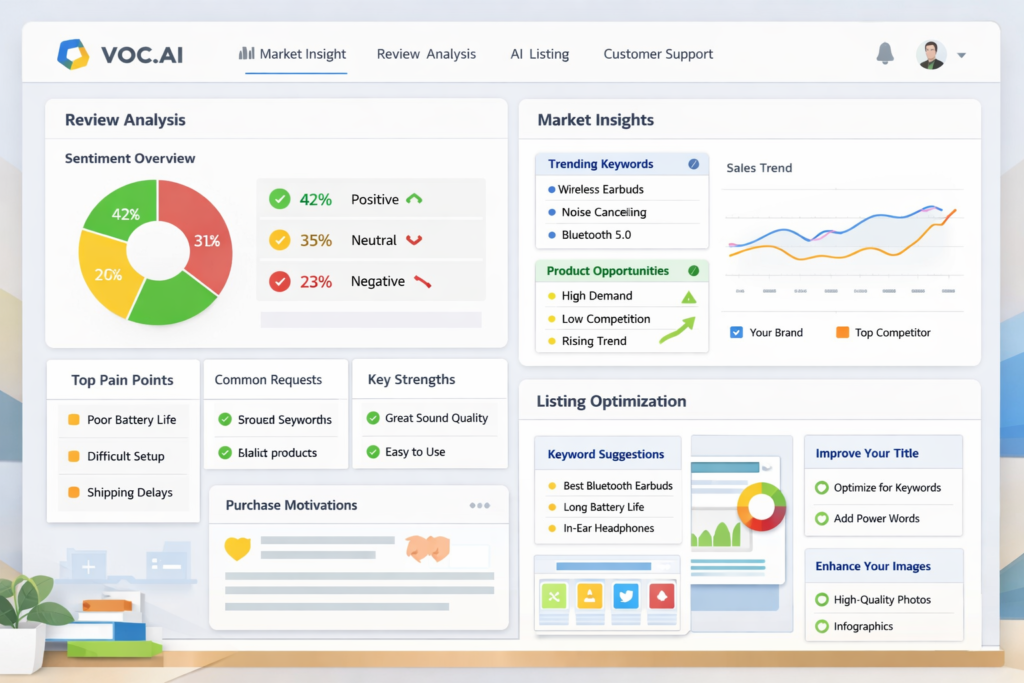
Quick Verdict
| Category | Verdict |
| Best for | Amazon sellers, private-label brands, agencies, and eCommerce teams that want deep customer insight instead of surface-level data only. |
| Standout strength | Review-led product research, listing optimization, competitor gap analysis, and market intelligence. |
| Main weakness | Not the cheapest option for beginners who only need light seller-tool functionality. |
| Best use case | Understanding what customers actually want, fixing product weaknesses, and improving listings based on real buyer language. |
| Less ideal for | Sellers who only want basic keyword research, rank tracking, or a very low-cost starter tool. |
| Starting price | $99/month for the Pro plan. |
The short version is simple: VOC AI is one of the more interesting tools in the Amazon seller space if your goal is to understand the customer behind the numbers. It is not just trying to show you what is happening in a niche. It is trying to explain why customers react the way they do. That makes it more valuable for product improvement, listing optimization, positioning, and brand monitoring than for lightweight seller-tool use.
What Is VOC AI?
VOC AI is a voice-of-customer and eCommerce intelligence platform built around customer feedback analysis. In practical terms, that means the platform is designed to help sellers and brands extract useful insight from Amazon reviews, product feedback, category-level signals, competitor movement, and broader social sentiment. Instead of manually reading hundreds or thousands of reviews, users can turn those reviews into structured insights such as purchase motivations, recurring complaints, preferred features, usage scenarios, unmet needs, and emotional patterns.
That is an important distinction because many Amazon tools are still fundamentally keyword-first. They are excellent for discovering demand, checking search volume, estimating sales, or validating whether a niche is active. But they are not always as strong at explaining what actual customers think after purchase. VOC AI is trying to occupy that gap. It wants to help sellers move from “What should I sell?” to “Why do customers love this product, hate this product, return this product, or choose one competitor over another?”
That voice-of-customer layer can support several different business decisions. It can improve product research by showing real unmet needs in a category. It can improve listings by surfacing the phrases customers naturally use. It can help product teams prioritize fixes. It can help operations teams monitor negative reviews earlier. It can also support broader brand and customer service workflows when the platform is used beyond Amazon-only analysis.
Why VOC AI Stands Out in a Crowded Amazon Tool Market
The Amazon seller tool market is crowded. Most sellers already know the big categories: keyword tools, product research tools, PPC tools, profit trackers, and listing optimization tools. The challenge is that many of those tools overlap. As more sellers gain access to the same revenue estimates, the same keyword databases, and the same rank tracking metrics, it becomes harder to create real differentiation from those numbers alone.
This is where VOC AI becomes more compelling. It is strongest when you care about the human reasons behind performance. Instead of simply telling you which product is growing, it can help explain what customers praise, what they complain about, what features they expected but did not get, what buying language they naturally use, and what patterns repeat across hundreds or thousands of reviews. That is strategic information, not just dashboard information.
Another reason it stands out is that it connects several workflows that are often disconnected in real seller operations. Product research, competitor analysis, listing optimization, review monitoring, social listening, and customer service are usually handled in separate tools or separate teams. VOC AI attempts to connect those areas through one central idea: customer language. When a platform can connect what buyers say, what competitors are doing, and how listings should be written, it becomes more than a single-use tool.
Core VOC AI Features
1. Amazon Review Analysis
This is the core of the platform. VOC AI is designed to take Amazon review data and transform it into usable insight. Instead of manually reading 500, 2,000, or 10,000 reviews, users can see patterns related to product strengths, product weaknesses, buyer motivations, user profiles, usage scenarios, and recurring pain points. That matters because the difference between a weak product and a winning product is often visible in the reviews long before it is obvious in keyword dashboards.
For example, imagine you are evaluating a category where several top competitors have thousands of reviews. Reading those reviews manually would take far too long. Even if you read a sample, you could easily miss recurring patterns. VOC AI’s main value is speeding up that analysis while making the findings easier to act on. That can help sellers identify what to fix, what to emphasize, what to avoid, and what to build into the next product version.
2. Market Insight and Category Analysis
VOC AI is not limited to review summarization. Its Market Insight module is designed to help sellers analyze categories, product attributes, competitor sales movement, review changes, star-rating movement, price changes, and market share patterns. This expands the platform from pure review analysis into a broader product research and monitoring system.
This matters because good product research is not only about finding a niche with demand. It is about understanding what is changing inside that niche. Which product attributes are gaining momentum? Which competitor is losing ratings? Which segment seems overcrowded? Which segment may still have room? Which feature combination is rising? A market insight module can be commercially useful when it helps answer those questions faster than manual research.
3. AI Listing Optimization
VOC AI also includes an AI listing optimization workflow. This is one of its more practical features because it connects review intelligence to listing improvement. Instead of generating copy from a blank prompt alone, the listing tool is positioned around combining review analysis, Amazon search terms, and category selling points. That makes it more useful than generic AI writing tools for Amazon sellers who want copy grounded in actual customer language.
In other words, this is not just about writing prettier bullets. It is about using the words buyers actually use, addressing concerns buyers actually mention, and highlighting strengths buyers actually care about. That can improve both discoverability and conversion if the insight is used well. The best Amazon listings usually do not sound like pure SEO copy or pure copywriting fluff. They sound like a product that clearly understands what the buyer wants. VOC AI is built to move listings closer to that standard.
4. Negative Review Monitoring and Brand Protection
One of the more operationally useful areas of VOC AI is its negative review monitoring. That matters because a sudden wave of poor reviews can damage conversion, ranking, and perceived quality faster than many sellers expect. Monitoring negative reviews early allows teams to react faster, investigate whether the issue is product-related or service-related, and identify whether certain reviews may violate platform rules.
For brands with multiple ASINs, this becomes even more important. Review damage is rarely isolated. One packaging issue, one defect trend, or one recurring complaint can spread across inventory batches or related SKUs. A monitoring layer helps teams move from reactive firefighting to earlier detection. If you care about protecting margin, ratings, and listing health, this part of the product is more valuable than it may look at first glance.
5. Social Listening
VOC AI also expands beyond Amazon reviews into social listening. That broader coverage matters for brands that care about more than marketplace feedback. Buyers talk before they buy, while they buy, and after they buy. Sometimes the signal appears on social platforms before it appears in review volume. A strong social listening layer can help brands detect public sentiment, trend shifts, and emerging product conversations earlier.
This is especially useful for growing consumer brands, agencies, or sellers running multi-channel strategies. If all customer intelligence lives only inside Amazon, you may miss signals from TikTok, YouTube, Facebook, or broader public discussion. Social listening gives VOC AI a wider role than just review analysis and makes the platform more relevant for brands that want a bigger picture of customer perception.
6. AI Customer Service
VOC AI also markets an AI customer service and eCommerce support solution. This puts it into a different category from many Amazon-only research tools. Instead of stopping at insight generation, the platform extends into support automation, faster response handling, omnichannel communication, and knowledge-driven assistance. That means larger sellers or brands can potentially use VOC AI not only to understand customer problems, but also to respond to them more efficiently.
That may not matter to every seller. A solo seller may care far more about product research and listing copy than support automation. But for larger operations, especially global or multi-channel businesses, the customer service layer makes VOC AI more like an operating system for customer intelligence than a single review tool.
7. API Access for Advanced Teams
VOC AI also offers API access for larger teams and advanced use cases. This is particularly useful for agencies, custom internal tools, data teams, and businesses that want to integrate review intelligence into their own workflows. When a platform offers both dashboard-level usability and deeper data access, it becomes much more scalable for serious operators.
That said, API access is usually most relevant for advanced organizations, not beginners. If you are a solo seller, this may not influence your purchase decision much. But if you are running a larger business or service model, it is a meaningful advantage.
👉 Image 2: Insert a review-analysis style image with sentiment clusters, buyer motivations, strengths, weaknesses, and usage scenarios.
Who Should Use VOC AI?
VOC AI is best for sellers and brands that want to compete on insight, not just on data access. If you are developing products, improving existing listings, studying competitors, reducing return rates, or trying to understand why your products are performing a certain way, VOC AI has a strong fit. Its value becomes more obvious when you already have enough review volume or enough category depth to analyze meaningfully.
It is also a strong fit for agencies serving Amazon or eCommerce brands. Agencies often need to move quickly across multiple categories, analyze many competitors, produce insight reports, and create action plans without spending hours reading raw feedback manually. A review-intelligence platform can make that process far more efficient and easier to standardize.
On the other hand, sellers who only need very basic keyword discovery or low-cost seller-tool access may not get maximum value from VOC AI right away. If your store is extremely early, your budget is tight, and your main goal is simply validating whether a niche has demand, you may use a lighter tool first and add VOC AI later when you need deeper customer intelligence.
| User Type | Is VOC AI a Good Fit? | Why |
| Private-label Amazon sellers | Yes | Strong for product research, customer feedback analysis, listing improvement, and competitor gap discovery. |
| Growing brands | Yes | Useful for brand protection, review monitoring, market intelligence, and broader customer insight. |
| Agencies | Yes | Helpful for report generation, competitive analysis, and scalable insight workflows. |
| Solo beginners on a small budget | Maybe | Useful, but the cost may be harder to justify if you only need light seller-tool functionality. |
| Sellers who only want keyword research | No | VOC AI is strongest when you need customer intelligence, not just keyword metrics. |
👉 Try VOC AI here if you want to stop guessing from surface-level seller metrics and start optimizing products and listings around what customers actually say.
VOC AI Pricing
Pricing is one of the most important parts of any software review because it shapes who the tool is really for. VOC AI positions its Amazon seller plans in a mid-to-premium range rather than as an ultra-cheap beginner option. That is consistent with the depth of its feature set. It is trying to sell insight that can influence product, listing, and operational decisions, not just basic access to a dashboard.
| Plan | Price | Best for | Main Highlights |
| Pro | $99/month | Solo sellers or smaller operations | 1 account, 600 review-analysis reports per month, 600 market-insight reports per month, ASIN monitoring, AI Assist, browser extension, AI seller tools, listing optimization access. |
| Team | $299/month | Growing brands and teams | 1 admin plus 5 sub-accounts, 3,000 review-analysis reports per month, 3,000 market-insight reports per month, social listening access, daily monitoring, higher AI Assist allowance, browser extension, AI seller tools. |
| Enterprise | Custom | Large-scale businesses | Unlimited accounts, unlimited reports, unlimited social listening, unlimited social mentions, unlimited listing optimization queries, advanced AI features, API access. |
From a value perspective, the Pro plan can make sense if you are actively researching products, analyzing competitor reviews, refining listings, or monitoring multiple products. If you use the tool to make real decisions, the cost can be reasonable. If you only run a few casual checks per month, the value equation is much weaker. This is a tool that tends to reward active use, not passive ownership.
VOC AI Pros and Cons
| Pros | Cons |
| Strong review-led product and listing intelligence. | Entry pricing is not ideal for casual beginners. |
| Useful for identifying unmet needs, complaints, and buyer motivations at scale. | Beginners may not use enough of the platform to justify the cost immediately. |
| Combines review analysis, market insight, listing optimization, and monitoring in one ecosystem. | The platform is broad enough that new users may need time to understand the best workflow. |
| Social listening expands insight beyond Amazon reviews alone. | Some users may still need a separate keyword-first tool depending on their stack. |
| Advanced plans add API and broader operational value for teams and agencies. | It is more insight-focused than beginner-friendly in its overall positioning. |
The pros here are substantial if you are the kind of seller who acts on feedback. VOC AI is not just about seeing more data. It is about turning feedback into action. That is why it feels more strategic than many basic seller tools. The cons mainly come down to fit. A platform can be good and still not be the right tool for every stage of business.
Best VOC AI Use Cases
| Use Case | Why VOC AI Works Well |
| Product research | Helps identify unmet needs, recurring complaints, and feature opportunities from review patterns. |
| Listing optimization | Connects review intelligence and category language to more customer-aware listing copy. |
| Competitor analysis | Shows what buyers praise or dislike about competing products. |
| Review monitoring | Supports early detection of rating and reputation problems. |
| Brand protection | Useful for spotting repeated issues and protecting listing health. |
| Agency reporting | Makes it easier to turn raw review data into strategic recommendations. |
| Customer service operations | Broader platform capabilities can support response automation and insight-driven support improvements. |
How VOC AI Fits Into a Real Amazon Workflow
A tool review is more useful when you can imagine how the software would fit into actual work. If I were using VOC AI for Amazon operations, I would apply it in a four-step loop.
- Start with market and category analysis. Use market insight to understand category movement, attribute trends, competitor shifts, and where the opportunity may be.
- Analyze reviews across your ASINs and competitor ASINs. Look for repeated strengths, repeated frustrations, emotional triggers, and overlooked demand patterns.
- Turn the findings into listing improvements. Update titles, bullets, descriptions, and positioning using real buyer language instead of assumptions.
- Keep monitoring active. Watch negative reviews, public sentiment, and changing feedback patterns so you can react before a small issue becomes a ranking problem.
This is where VOC AI becomes more than a one-time research tool. Used properly, it can support the entire product cycle: validation, launch, optimization, monitoring, and iteration.
👉 Image 3: Insert a market insight or competitor-tracking style image with sales trends, ratings, reviews, and market-share indicators.
VOC AI vs Traditional Amazon Seller Tools
The easiest way to understand VOC AI is to see where it fits relative to more traditional Amazon seller tools. Traditional tools are often best at demand validation. They help you estimate revenue, research keywords, discover niches, and check search visibility. Those functions are still important. But they do not always tell you what happens after the click or after the purchase.
VOC AI is strongest on the customer-understanding side of the business. It helps answer questions like these: Why do buyers keep mentioning this feature? Why are three-star reviews clustering around the same complaint? Which competitor weakness appears often enough to turn into a product angle? Which customer phrases should appear in the listing because buyers already use them naturally? Which pain points are serious enough to justify product improvement?
That means VOC AI often works best as either the review-intelligence core of your stack or a strategic complement to a keyword-first tool. If your entire workflow only tracks demand, you risk launching products that look viable on paper but are weak in the real world. Customer feedback closes that gap.
Is VOC AI Worth It?
VOC AI is worth it if better customer insight can change your decisions in ways that meaningfully affect revenue, conversion, product quality, or return rates. That sounds obvious, but it is the right way to judge the tool. If reading review patterns helps you avoid launching the wrong product, fix a recurring defect, reposition a listing more effectively, or spot a competitor weakness earlier, the subscription can pay for itself quickly.
On the other hand, if you are extremely early, operating on a tiny budget, and mostly need a basic sense of demand, VOC AI may feel too advanced for your immediate needs. This does not make the product bad. It just means it is built for sellers who are ready to use insight seriously. The more active your decision-making, the easier the cost is to justify.
My Final Verdict on VOC AI
VOC AI is one of the more strategically interesting tools for Amazon sellers because it focuses on a layer many sellers still underuse: the actual voice of the customer. Instead of stopping at keyword visibility or revenue validation, it helps sellers understand the reasons behind satisfaction, dissatisfaction, retention, return behavior, and conversion friction. That is the kind of insight that can improve not only listings, but products themselves.
Its strongest users will be brands, agencies, and sellers who are prepared to do something meaningful with the data. If you are only looking for a cheap starter tool, this may not be your first purchase. But if you want to build better products, write sharper listings, monitor reviews more intelligently, and move from guesswork to evidence-based decisions, VOC AI makes a strong case for itself.
👉 Start using VOC AI here if you want faster review analysis, clearer product insight, and a stronger way to optimize listings based on what customers really care about.
👉 Image 4: Insert a clean customer-service or omnichannel AI support visual if you want to highlight VOC AI’s broader eCommerce platform angle near the conclusion.
Frequently Asked Questions
Is VOC AI only for Amazon sellers?
No. It is heavily positioned around Amazon sellers, but it also has broader eCommerce applications, including Shopify-related use cases, agencies, social listening, and customer service workflows. That said, Amazon seller use cases remain the clearest and strongest fit in its product positioning.
Does VOC AI help with Amazon listing optimization?
Yes. VOC AI includes an AI listing optimization tool built around review analysis, Amazon search terms, and category-level selling points. This makes it more useful than a generic writing tool for sellers who want customer-aware listing copy.
How much does VOC AI cost?
VOC AI’s Amazon seller plans start at $99 per month for Pro, $299 per month for Team, and custom pricing for Enterprise. Pricing can change over time, so it is always smart to check the official pricing page before subscribing.
What is the biggest advantage of VOC AI?
The biggest advantage is its ability to turn customer feedback into practical business insight. It helps sellers move beyond surface-level metrics and understand buyer motivations, frustrations, and expectations in a more structured way.
Is VOC AI worth it for beginners?
It depends on your stage and budget. Beginners who want deep customer insight may still benefit from it, but sellers who only need low-cost keyword research may not use enough of the platform to justify the price immediately.
Can VOC AI help reduce product mistakes?
It can help reduce avoidable mistakes by surfacing repeated complaints, unmet needs, and feature expectations from real customer reviews. That does not guarantee a winning product, but it can make decision-making much more evidence-based.
Conclusion
If your Amazon strategy still relies mostly on search volume, revenue estimates, and competitor snapshots, VOC AI adds a missing layer that can make your decisions smarter. It helps you understand not just whether a market is active, but what customers actually care about inside that market. For sellers who want better product decisions, sharper listing copy, stronger review monitoring, and a more customer-driven growth strategy, VOC AI is absolutely worth a closer look.
👉 Explore VOC AI here if you want to turn customer reviews into clearer next steps for your products, listings, and brand strategy.
About the Author
Xu Xun
Contact: xuxun1208@gmail.com
Last Updated: June 2026