
If you are looking for an honest GetGenie review, the short answer is this: GetGenie is one of the more interesting AI SEO tools for WordPress users because it tries to combine keyword research, competitor analysis, AI writing, content optimization, and post-publishing SEO tracking in one workflow instead of forcing you to use multiple disconnected tools. That positioning matters. Many AI writing tools can generate paragraphs, but far fewer tools are built around the real publishing process of WordPress site owners who need to research keywords, analyze top-ranking pages, draft content, optimize that content, publish it, and then keep improving it over time.
That is why this article does not look at GetGenie as “just another AI writer.” Instead, this review looks at whether GetGenie is actually useful for bloggers, affiliate marketers, niche site builders, agencies, WooCommerce store owners, and content teams that want to publish more efficiently without giving up SEO depth. If your goal is to rank content in Google, improve your WordPress workflow, and build more search-friendly articles at scale, GetGenie is much more relevant than a generic AI chatbot. But that does not automatically mean it is the right choice for everyone.
In this in-depth review, I will cover what GetGenie does well, where it still has limitations, how its SEO features fit into a real publishing workflow, what kind of user should consider it, how its pricing works, and whether it is worth paying for if you are serious about content marketing. I will also explain why GetGenie makes the most sense when you use it as a workflow accelerator and SEO assistant rather than expecting it to replace strategy, experience, editorial judgment, and original value.
Quick Verdict
| Category | Verdict |
|---|---|
| Best for | WordPress bloggers, affiliate marketers, SEO writers, niche site owners, WooCommerce stores, and content teams that want research + writing + optimization in one place |
| Biggest strength | WordPress-native workflow combined with keyword research, SERP analysis, content scoring, and SEO tracking |
| Biggest weakness | It is still most compelling for WordPress-centric users, so non-WordPress teams may not feel the same value |
| Best plan for most users | Writer or Pro, depending on publishing volume and how often you use SEO features |
| Overall verdict | GetGenie is a strong choice if you want an AI SEO assistant inside WordPress, but you will get the most value only if you use its SEO workflow features instead of treating it as a one-click article generator |
If you already publish in WordPress and want a tool that helps with ideation, keyword analysis, outline creation, draft generation, optimization, and follow-up SEO monitoring, GetGenie is easy to take seriously. It has a clearer workflow advantage than many AI writers that are built primarily around a chat box. On the other hand, if your team works mostly in Google Docs, Notion, or a more collaborative editorial stack outside WordPress, GetGenie becomes less unique. Its core value is strongest when you lean into the native WordPress side of the product.
What Is GetGenie?
GetGenie is an AI writing and SEO optimization tool built with a strong WordPress focus. Instead of presenting itself as only a text generator, it positions itself as an all-in-one AI SEO and content assistant. In practical terms, that means it tries to support the full content lifecycle: topic selection, keyword research, SERP analysis, competitor analysis, outlining, long-form generation, content scoring, on-page optimization, and ongoing SEO monitoring.
This is the first reason GetGenie stands out. A lot of AI writing tools start and end with text generation. They can help you draft a post, rewrite a paragraph, or produce social captions, but they do not give you much search context. GetGenie tries to bridge that gap by putting keyword intelligence and content optimization alongside drafting. That matters because ranking content is not just about producing words quickly. It is about aligning the article with search intent, identifying subtopics that deserve coverage, understanding what already ranks, and building something more useful than the current results.
GetGenie is also broader than it first appears. Although its identity is strongly tied to WordPress, it now includes a web-based Playground for non-WordPress users. It also supports page builder workflows such as Elementor, Bricks, and Oxygen, and it includes a WooCommerce product description workflow. So even though it is still clearly a WordPress-first tool, it is no longer limited to the classic blog-post-only use case.
Why GetGenie Is Different From a Generic AI Writer
The easiest mistake people make when comparing tools like this is to assume every AI writer does roughly the same thing. That is not really true. Yes, there is overlap. Most AI writing tools can help with blog ideas, introductions, rewrites, and draft generation. But GetGenie is not really trying to win on “can it write a paragraph?” alone. Its real promise is workflow compression.
With many AI tools, you still need one platform for keyword research, another platform for SERP analysis, another space for writing, and yet another system for tracking content performance after publishing. GetGenie tries to reduce those jumps. You can start from a target keyword, look at search data, generate titles and outlines, compare your content against competitors, improve the article based on NLP and content score recommendations, and then use SEO Insights to track how your pages and keywords are performing. For WordPress publishers, that is a practical advantage, not just a marketing line.
That does not mean GetGenie replaces premium SEO suites or editorial strategy. It does mean the tool is more useful than a basic AI text generator if your objective is actual organic traffic rather than just content production volume. In other words, GetGenie is more about building a smarter publishing system than about showing off flashy AI outputs.
Key GetGenie Features That Matter for SEO
1. Blog Wizard
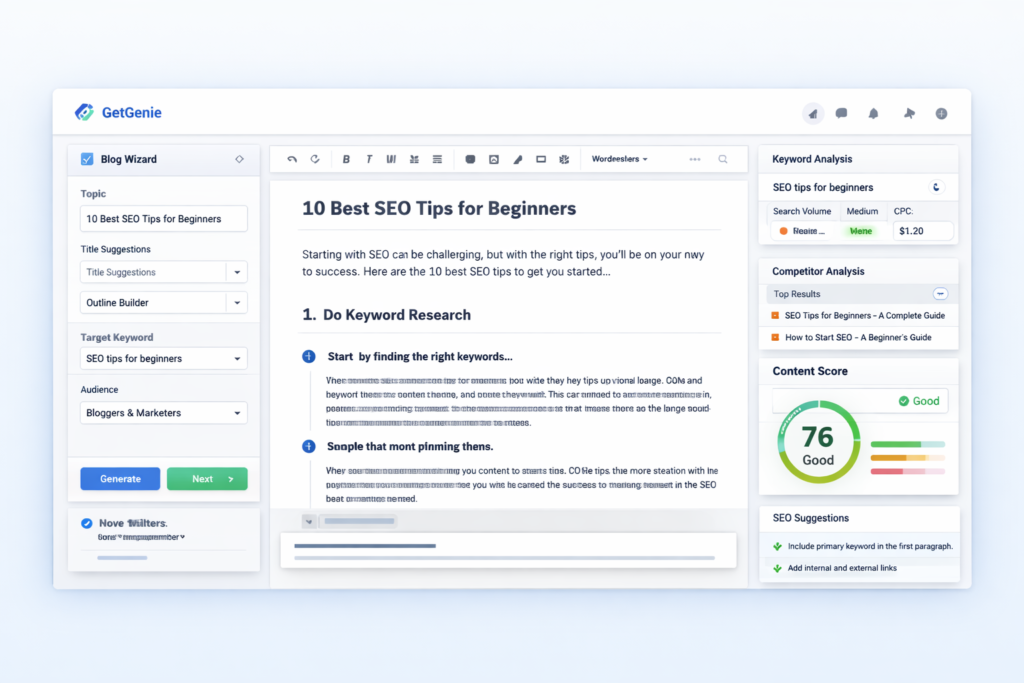
Blog Wizard is probably the feature most people notice first, and for good reason. It gives GetGenie a more structured content creation workflow than many simple prompt-based writers. Instead of forcing you to manually build every section from scratch, Blog Wizard helps turn a target keyword into title ideas, an introduction, an outline, and then a full article draft section by section. There is also a one-click blog generation option for users who want speed, plus a more customizable mode for people who want tighter control over structure and output.
For SEO content, that structure is valuable. The real challenge in long-form publishing is not merely writing a paragraph. It is deciding what the article should cover, how headings should be ordered, how much breadth is needed, and which search intent angle should guide the page. Blog Wizard helps reduce friction in those early steps, which can save a lot of time if you publish consistently.
Still, this is where users need to stay realistic. One-click generation is convenient, but convenience is not the same thing as publish-ready quality. In competitive SERPs, articles that rank well usually include stronger editorial judgment, clearer examples, better product understanding, more original insights, better comparisons, and cleaner intent alignment than a raw AI draft can deliver by itself. The best use of Blog Wizard is to accelerate first-draft production and structural planning, not to remove the need for human review.
2. Keyword Research and SEO Mode
This is one of GetGenie’s biggest strengths. Inside its SEO mode, the tool can surface keyword data such as search volume, competition, CPC, search trends, Google Trends, and related keywords. That immediately gives it more SEO relevance than AI tools that generate text with little or no search intelligence behind it.
Why does that matter? Because ranking content starts before writing begins. If you choose the wrong keyword, target the wrong intent, or miss important supporting subtopics, even a polished draft can underperform. GetGenie’s keyword research features help users understand whether a term is worth targeting and what surrounding keyword ecosystem exists around that topic. That improves both article planning and content depth.
Another benefit is that keyword research inside the writing workflow lowers the chance that you will separate strategy from execution. Many site owners already know the pain of researching in one tab, writing in another, checking headings in a third, and trying to remember which semantic terms should be included. GetGenie makes that workflow more compact, which is especially valuable for solo publishers and small teams who do not want unnecessary tool-switching overhead.
That said, keyword data should guide judgment, not replace it. Search volume and keyword suggestions do not automatically tell you which angle will win. You still need to identify what the reader actually wants, what the top-ranking pages are missing, and where your content can be more useful. GetGenie helps with the data layer, but the strategic layer still needs a human brain.
3. Content Score, SERP Visualizer, and Head-to-Head Comparison
This is where GetGenie becomes more interesting than a typical AI writer. Content score and competitor comparison features push it closer to the kind of optimization workflow SEO-focused publishers actually need. Instead of stopping at draft generation, GetGenie tries to help users understand whether their content structure and topical coverage are strong enough compared with what is already ranking.
The content score layer is useful because it moves the conversation from “Did AI generate enough text?” to “Is this article positioned to compete?” Depending on the context, that can include recommended NLP terms, analysis of words, headings, images, internal links, and more. Head-to-head comparison adds another layer by letting you compare your page more directly with competitor pages, which helps expose content gaps and structural weaknesses.
For serious publishers, this is much more valuable than most people realize. When a page fails to rank, the problem is often not writing quality in a general sense. It is missing intent alignment, missing topical completeness, weak structure, underdeveloped sections, or failure to provide something better than existing results. A content score and competitor comparison framework gives you a more objective way to identify those issues before or after publishing.
Of course, content scores should not become a trap. Chasing a higher score without improving real usefulness can lead to bloated, robotic content. The best use of these features is diagnostic, not mechanical. They should help you spot gaps, strengthen depth, and improve structure, while your editorial judgment decides what readers genuinely need.
4. SEO Insights and Post-Publishing Optimization
One reason many AI writing tools lose value over time is that they help with drafting but not with maintenance. GetGenie tries to solve that with SEO Insights. Instead of being useful only before publication, the platform also gives users a way to monitor tracked keywords, discover new and lost keywords, spot pages that need attention, identify low-hanging-fruit opportunities, and detect competing pages that may be cannibalizing one another.
This is important for SEO because growing sites eventually hit a new kind of problem: content management complexity. Once you have dozens or hundreds of pages, the challenge is no longer only creating new content. You also need to know which pages are slipping, which keywords are worth prioritizing, where internal competition exists, and which pages could move from positions 4–15 into stronger positions with the right improvements. GetGenie’s low-hanging-fruit and competing-pages features are especially useful in this context.
For site owners who regularly update content, this can be one of the most valuable parts of the product. It helps shift your workflow from “publish and forget” to “publish, measure, improve, and consolidate.” That is exactly the kind of discipline many content sites need if they want sustained organic growth rather than random article production.
5. Playground, Elementor, Bricks, Oxygen, and WooCommerce Support
Another reason GetGenie is more flexible than it first appears is that it is no longer limited to the classic blog-editor-only workflow. The Playground gives non-WordPress users access to the SaaS-style version of the product, while builder compatibility extends its usefulness across Elementor, Bricks, and Oxygen. That means the tool can also support page copy, landing pages, and site-building workflows rather than only traditional article creation.
This matters because many WordPress users do not work only in the default editor. Agencies, freelance builders, and marketers often create pages in Elementor or similar builders. GetGenie’s builder support makes it more practical in real projects because users can access writing features while working in those environments instead of copying content back and forth between separate interfaces.
The WooCommerce angle is also worth mentioning. GetGenie includes a WooCommerce Wizard for generating product titles and short or long descriptions. For store owners and affiliate-style sites that publish product-related content, this expands the tool’s use beyond blog posts. It can support product copy, category support content, and commerce-oriented writing tasks inside a familiar WordPress ecosystem.
Playground also makes GetGenie more approachable for users who want to test the tool before committing to a full WordPress-centered workflow. But even with this added flexibility, the strongest overall value proposition still belongs to WordPress users. That is where GetGenie feels most coherent and differentiated.
Who Should Use GetGenie?
GetGenie is best for users who publish inside WordPress and care about search performance enough to want more than simple text generation. That includes affiliate marketers building long-form review and comparison content, bloggers targeting organic traffic, niche site builders publishing topic clusters, agencies managing multiple WordPress client sites, SEO freelancers who want faster drafting and optimization, and WooCommerce store owners who need help with product descriptions and content marketing.
It is especially useful if your workflow includes these recurring tasks:
- Finding a keyword and judging whether it is worth targeting
- Reviewing related and semantic keywords before writing
- Studying what top-ranking pages are doing
- Building a better outline faster
- Drafting long-form content inside WordPress
- Improving content based on score and competitor gaps
- Tracking performance and identifying pages worth updating
If that looks like your real publishing process, GetGenie makes sense. If, however, your team needs more collaboration-first editorial tools, heavily uses external docs, or is only looking for a cheap AI writer that can spin quick drafts without much SEO context, then the product may feel heavier than necessary.
Who Should Probably Skip GetGenie?
Not every user needs what GetGenie is trying to offer. If you do very little publishing inside WordPress, do not care much about keyword research or competitor analysis, or already have a mature workflow built around other SEO tools plus a separate AI writer, then GetGenie may overlap too much with what you already use.
It may also be the wrong fit if you expect one-click AI content to rank by itself in competitive niches. That is not really a GetGenie-specific problem; it is a problem with unrealistic expectations around AI writing in general. Ranking-focused content still benefits from experience, evidence, updated examples, product understanding, stronger comparison logic, and real editorial refinement. If you are unwilling to edit or improve AI-generated drafts, you will probably not get the best results from this tool.
| Use GetGenie if… | Skip GetGenie if… |
|---|---|
| You publish mainly in WordPress | You barely use WordPress in your workflow |
| You want keyword research and AI writing in one workflow | You already have separate best-in-class tools you prefer for each stage |
| You care about content optimization and post-publishing SEO follow-up | You only want a lightweight AI copy generator |
| You create blog posts, landing pages, or WooCommerce content regularly | You rarely publish enough content to justify the workflow advantages |
| You want a more compact SEO content system | You need a deeply collaborative editorial platform first |
GetGenie Pros and Cons
| Pros | Cons |
|---|---|
| WordPress-native workflow | Most compelling for WordPress users, less unique elsewhere |
| Keyword research, competitor analysis, and content scoring in one product | AI output still needs editing for competitive SERPs |
| Useful Blog Wizard for faster planning and first drafts | Can be overkill if you only need a simple AI writer |
| SEO Insights adds value after content is published | Lower plans may feel limited for heavier users |
| Supports builders and WooCommerce | Some users may still prefer separate specialist tools |
| Playground broadens access beyond WordPress | Workflow value depends on how fully you use the platform |
The pros here are practical rather than flashy. GetGenie is not impressive simply because it can generate copy. What makes it attractive is that it can reduce friction across multiple stages of the SEO content process. For users who publish often, that kind of operational efficiency can be more valuable than isolated AI writing quality tests.
The drawbacks are also practical. If you are not the kind of user who will take advantage of keyword analysis, content score, competitor analysis, and SEO Insights, then you may not get enough value to justify paying for the broader platform. GetGenie becomes strongest when you treat it as a system, not just a writing widget.
How to Use GetGenie the Right Way for SEO Content
The best way to use GetGenie is not to press one button and publish whatever appears. The better approach is to build a repeatable ranking workflow around it. A practical process might look like this:
- Choose a target keyword based on business value and realistic competition.
- Use GetGenie’s keyword research to review volume, competition, CPC, trends, and related terms.
- Check the SERP and competitor structure to understand what currently ranks.
- Generate title options and an outline with Blog Wizard.
- Refine the outline manually so it aligns with intent and includes your unique angle.
- Generate sections with AI, but rewrite weak parts and expand thin sections with real specifics.
- Use content score and competitor comparison to find obvious gaps.
- Add better examples, clearer explanations, internal links, and stronger FAQs.
- Publish the article in WordPress.
- Use SEO Insights later to identify whether the page needs updating, consolidation, or stronger optimization.
That workflow is important because it keeps AI in the assistant role rather than the author role. AI is fast at generating starting points, summarizing ideas, and drafting rough sections. Humans are better at judgment, positioning, nuance, evidence, comparison, and usefulness. When you combine those strengths correctly, GetGenie becomes much more valuable.
For example, if you are writing a high-intent review article, do not let the AI decide the full argument. Use it to accelerate repetitive work, surface missing subtopics, and help structure the post. Then step in to improve the parts that affect rankings the most: search intent match, angle, differentiation, examples, pros and cons, purchase guidance, and FAQ quality. This is how you turn an AI-assisted draft into something more competitive.
In other words, GetGenie works best when you use it to reduce friction without reducing standards. The publishers who get the most from tools like this are not the ones trying to avoid thinking. They are the ones trying to spend more of their thinking time on the parts that matter most.
GetGenie Pricing: Is It Affordable?
GetGenie’s pricing structure is broad enough to cover casual users, growing publishers, and high-volume teams. The free plan is useful for testing, while the paid tiers scale mainly through higher AI word limits and broader feature allowances.
| Plan | Regular Monthly Price | Annual Billing From | AI Words / Month | Best for |
|---|---|---|---|---|
| Free | $0 | $0 | 2.5K | Testing the platform and basic experiments |
| Starter | $9.99 | From $6.00/month | 20K | Light users and new bloggers |
| Writer | $19.00 | From $11.40/month | 60K | Solo publishers and smaller content sites |
| Pro | $49.00 | From $29.40/month | 400K | Serious content marketers and growing teams |
| Agency | $99.00 | From $59.40/month | 1M | Agencies and high-volume operations |
For most website owners, the real decision is not whether a paid plan is “cheap” in isolation. The smarter question is whether it saves enough time and improves enough output quality to justify its cost. If GetGenie replaces part of your keyword research workflow, speeds up outlining, shortens drafting time, and helps you find better update opportunities after publishing, then even the mid-tier plans can make sense.
If you only plan to use it occasionally as a basic AI writer, the value proposition becomes weaker. In that case, cheaper or simpler tools might be enough. But if you actually use the research, optimization, and tracking layers, GetGenie becomes easier to justify financially because it is doing more than one job.
One more practical note: the pricing page sometimes shows additional discounts or promotional savings, so it is smart to verify the latest checkout price before publishing a pricing-sensitive article or comparison post.
Is GetGenie Good for AI Search and Modern SEO?
Yes, and this is one of the reasons GetGenie feels more relevant now than it might have a year or two ago. The platform has expanded beyond standard blog drafting with newer templates such as AI Overview Answer Builder and AI FAQ Generator, which are clearly aimed at more answer-first, structured content formats. That matters because search visibility increasingly depends on giving direct, well-structured, well-organized answers that can satisfy both traditional searchers and AI-assisted discovery systems.
For publishers who want content that is easier to cite, easier to summarize, and easier to match with informational intent, this is a helpful direction. A lot of websites are still publishing bloated content that is long but not especially clear. If GetGenie helps users build cleaner answers, stronger supporting FAQs, and more discoverable topic structures, that can be a meaningful advantage.
Still, the same warning applies here as with classic SEO: templates are helpful, but originality still matters. AI-search-friendly formatting is not enough on its own. Pages still need clarity, substance, trust, and differentiation. GetGenie can help you produce more structured content, but it is still your job to make that content worth surfacing.
GetGenie vs Generic AI Writers
When comparing GetGenie with general AI writers, the biggest difference is context. Generic AI writers are usually strong at producing text on demand, but they often rely on the user to bring strategy, keyword direction, SERP understanding, and optimization logic into the process. GetGenie tries to bring more of that context into the same workspace.
That makes it especially useful for SEO-focused WordPress publishing. If you are writing long-form commercial content, informational content, comparisons, alternatives pages, buying guides, or WooCommerce-related copy, then having search research, competitor analysis, and content scoring near the drafting workflow can produce better decisions and faster output.
On the other hand, generic AI writers may still win in some cases. They can feel more flexible for broad brainstorming, more suitable for non-WordPress environments, or simpler for teams that do not want a heavier workflow. So this is not a case of one tool being universally better. It is about which tool better fits the job. For WordPress SEO publishing, GetGenie has a more tailored value proposition than a general-purpose AI writer. That is exactly why it deserves attention.
GetGenie’s Biggest Limitations
No tool like this is perfect, and GetGenie has a few limitations worth taking seriously. The first is that it can still be tempting to over-trust the AI output. Because the workflow is so streamlined, some users may assume faster content creation automatically means strong ranking potential. It does not. AI speed is useful, but speed alone does not create authority, trust, originality, or purchase-driving clarity.
The second limitation is fit. GetGenie is clearly strongest for WordPress-centric users. That is a strength when you are the right audience, but it also means the tool may not feel as special if your workflow is built around other publishing systems. The Playground helps, but the clearest product identity still belongs to WordPress.
The third limitation is that, like any platform with multiple layers, GetGenie only pays off fully when you use more of the system. If you ignore keyword research, skip content scoring, and never look at SEO Insights, you are paying for advantages you are not really using. The users who benefit most are the ones willing to build a repeatable workflow around it.
These limitations do not make GetGenie a weak product. They simply define who should use it and how it should be used. The more your workflow matches its strengths, the better it looks.
Final Verdict: Is GetGenie Worth It?
Yes, for the right type of user. If you publish inside WordPress and want an AI SEO assistant that does more than produce random paragraphs, GetGenie is one of the more useful tools in its category. Its value comes from how it connects research, drafting, optimization, and ongoing SEO follow-up in a single workflow. That gives it a stronger practical advantage than many standalone AI writers.
It is not the right tool for everyone. If you want a universal writing assistant for every possible use case, or if your workflow lives mostly outside WordPress, you may not feel the same benefit. But if you are building a content-driven WordPress site and want to publish smarter rather than just faster, GetGenie is absolutely worth considering.
My overall conclusion is simple: GetGenie is at its best when you use it as a WordPress-native SEO workflow tool, not just as an AI article machine. If that is what you need, it has a strong case. If that is not your workflow, its value becomes easier to question.
FAQ About GetGenie
Is GetGenie only for WordPress users?
No, GetGenie also offers a Playground version for non-WordPress users. However, the product still feels most valuable for WordPress-centric publishers because that is where its workflow advantages are strongest.
Is GetGenie good for SEO beginners?
Yes, especially because it combines multiple SEO-related functions in one place. Beginners can use it to understand keyword data, build better outlines, and improve articles more systematically. That said, beginners should still learn basic search intent, content quality, and on-page SEO principles instead of relying blindly on AI suggestions.
Can GetGenie write a full blog post?
Yes. GetGenie can generate titles, intros, outlines, and full blog drafts through Blog Wizard and one-click generation. The better question, though, is whether you should publish those drafts without editing. In most serious SEO situations, the answer is no. The draft is the starting point, not the final version.
Does GetGenie help with keyword research?
Yes. It includes keyword research functions such as search volume, competition, CPC, trend data, and related keyword suggestions. This makes it much more useful for SEO publishing than tools that only generate copy.
Does GetGenie help optimize existing articles?
Yes. That is one of its biggest advantages. Features like content score, competitor comparison, low-hanging-fruit tracking, and pages requiring attention can help you decide which posts deserve updates and how to improve them.
Is GetGenie useful for WooCommerce?
Yes. It includes a WooCommerce Wizard that can help with product titles and short or long product descriptions. That makes it relevant not only for bloggers but also for ecommerce-focused WordPress users.
Can GetGenie replace human writers?
No, not if your goal is high-quality, high-ranking, differentiated content. It can reduce repetitive work and speed up early drafting, but strong content still depends on human strategy, experience, product understanding, editing, and judgment.
Is GetGenie worth paying for?
It can be, especially if you use the platform as a complete WordPress SEO workflow assistant rather than only as a basic AI writer. The more you use its research, optimization, and tracking features, the easier it is to justify a paid plan.
About the Author
Xu Xun
Contact: xuxun1208@gmail.com
Last Updated: June 2026