
Mubert is one of the more practical AI music platforms for creators who need royalty-free background music for videos, podcasts, ads, and digital projects. Instead of acting like a novelty prompt tool, it is positioned as a broader music-generation ecosystem with products for creators, artists, developers, and listeners. If you are searching for a detailed Mubert review before signing up, this guide covers how it works, what makes it different, what its licensing actually allows, and whether it is worth it for your workflow.
For SEO and buyer intent, that matters a lot. Many AI music tools look interesting on the surface, but once you check the commercial use rules, real output options, and long-term usefulness, the list gets much shorter. Mubert stands out because it is not only about generating tracks quickly. It also tries to solve licensing clarity, creator workflow speed, and developer integration for apps and platforms.
Quick Verdict
| Best for | Creators, podcasters, short-form video publishers, brands, and developers who need royalty-free AI-generated background music |
| Strongest advantage | Useful licensing structure plus fast generation and API depth |
| Less ideal for | Users who want to release standalone songs on streaming platforms or build a Content ID strategy |
| Free option | Yes, there is a free entry option to test the platform |
| Commercial use | Yes, but your exact rights depend on your plan and use case |
| Affiliate potential | Good, especially for creator, podcast, video, and SaaS-focused audiences |
What Is Mubert?
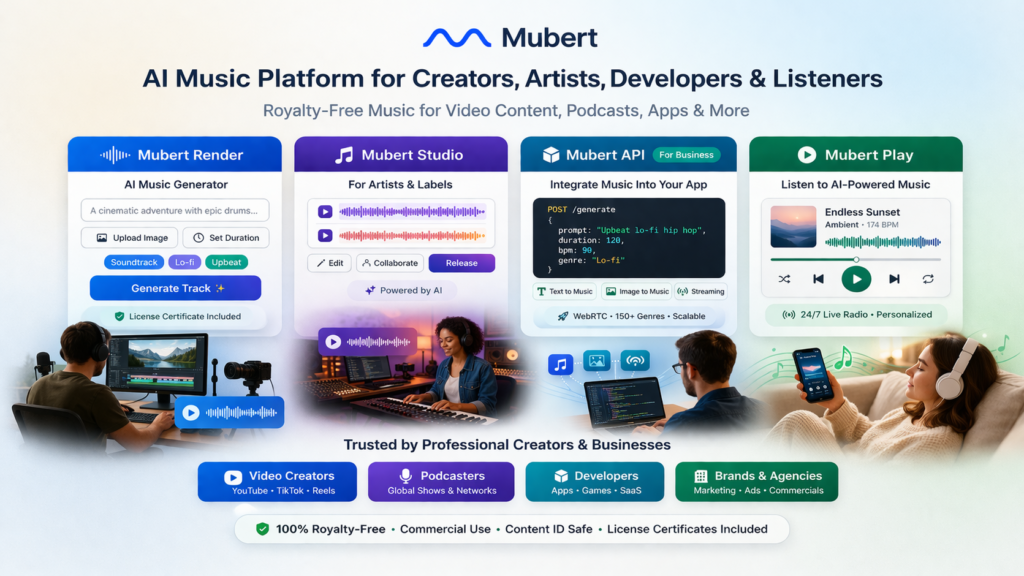
Mubert is an AI music platform built around several related products rather than a single one-page generator. For most buyers, the main product is Mubert Render, which is the tool used to generate royalty-free tracks for content and digital media. Beyond that, Mubert also has Mubert Studio for artists, Mubert API for developers and business integrations, and Mubert Play for AI-powered listening experiences.
That broader structure is one of the reasons Mubert deserves attention. It shows that the company is not only trying to attract casual users who want to type a fun prompt. It is also trying to build a platform that works for publishing, monetized content, software products, and commercial media use cases.
In simple terms, Mubert is best understood as an AI music generator for people who need usable, repeatable, royalty-free soundtrack music rather than artist-style song releases.
How Mubert Works
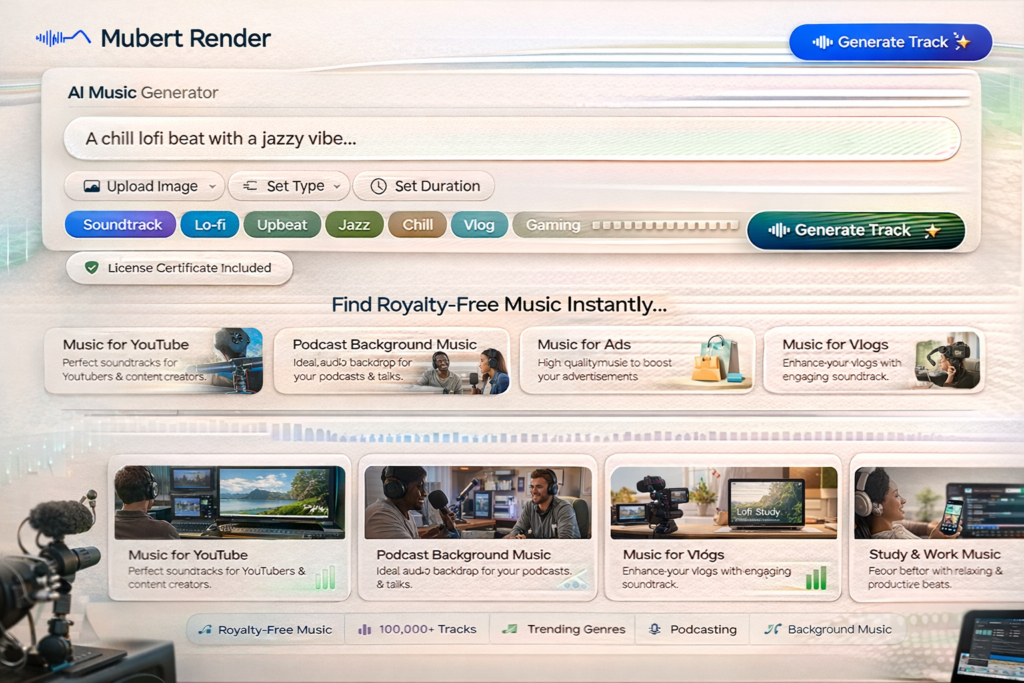
Mubert keeps the entry workflow simple, which is one reason it feels beginner-friendly. Instead of forcing users into a complex editing environment, it focuses on fast generation from basic creative inputs. You describe what you want, adjust the output type and duration, and generate music that fits a specific project.
| Step | What you do | Why it matters |
|---|---|---|
| 1 | Enter a text prompt or upload an image | Gives the system a mood, theme, or creative direction |
| 2 | Select the output type | Helps match the music to your use case |
| 3 | Choose the duration | Makes the result more useful for Shorts, reels, podcasts, or long-form videos |
| 4 | Generate and download | Lets you move quickly from idea to usable soundtrack |
The biggest practical advantage here is speed. If you regularly publish YouTube videos, podcast episodes, tutorials, explainers, ads, or social clips, you do not always want to spend an hour digging through generic stock libraries. Mubert is built to reduce that search time by generating tracks that are already closer to your intended style, length, and mood.
Key Features That Make Mubert Different
A good Mubert review should not stop at “it makes music from prompts.” The more important question is whether the product is actually useful after the first few test generations. That is where Mubert performs better than many lightweight AI music tools. It combines generation, licensing support, multiple output paths, and developer access in a way that makes it more commercially relevant.
| Feature | Why it matters |
|---|---|
| Text-to-music generation | Quick way to create soundtrack ideas from plain-language prompts |
| Image-to-music generation | Useful for matching mood, design, or visual storytelling |
| Multiple output styles | Helpful for tracks, loops, jingles, and different creator needs |
| Adjustable duration | Works better for podcasts, reels, ads, tutorials, and longer videos |
| License certificate with downloads | Better for clients, brands, and monetized publishing records |
| API access | Opens the door for apps, SaaS tools, user-generated platforms, and automation products |
| Curated library plus generation | Gives users both fast access and flexible creation options |
For many users, the real value is not just the AI itself. It is the ability to move faster without losing too much control. If you publish often, speed compounds. A tool that saves you even 20 to 30 minutes per piece of content becomes much more valuable over time than a tool that sounds impressive but slows down your workflow.
Mubert Pricing
Mubert does offer a free way to try the platform, which is useful if you want to test track quality before paying. There are also paid subscription paths and business or API-oriented options. Since pricing pages can change and the public page text does not always expose every plan amount consistently, the safest approach is to treat the exact paid pricing as something to verify on the live pricing page before you publish or create pricing graphics.
| Plan | What to expect | Best for |
|---|---|---|
| Free | Entry-level testing with limited generations and downloads | Trying Mubert before paying |
| Creator | Paid subscription for individual content creation | YouTubers, podcasters, social creators |
| Pro | Broader commercial rights for more advanced use cases | Brands, marketers, more serious commercial publishers |
| Business | Higher-tier use for advanced commercial needs | Agencies and business teams |
| API | Separate path for products and integrations | Developers, apps, SaaS tools, platforms |
If your priority is simple content publishing, the main decision is usually whether the Creator-level rights are enough for you or whether your work crosses into paid ads, branded commercial pages, or more business-oriented usage. That licensing distinction matters more than plan naming alone.
Licensing and Commercial Use: Read This Before You Buy
This is one of the most important parts of any Mubert review. Mubert is attractive because it makes commercial content creation easier, but that does not mean every use case is automatically allowed on every plan. The platform is much clearer than many AI tools about what it supports and what it does not.
At a high level, Mubert is designed for licensed soundtrack use inside digital content. That makes it well suited to videos, podcasts, social content, and similar creator workflows. However, it is not built for everything. If your goal is to upload tracks as standalone releases to streaming platforms or to turn your outputs into stock music inventory, Mubert is not the right fit.
| Use case | Is it a strong fit? | Notes |
|---|---|---|
| YouTube videos | Yes | Good use case for background music and creator publishing |
| Podcasts | Yes | Useful for intros, beds, mood tracks, and recurring show branding |
| Short-form social content | Yes | Good fit for reels, Shorts, TikTok-style publishing |
| Promoted or boosted social posts | Yes | Supported in creator-focused publishing scenarios |
| Digital ads | Usually Pro-level territory | Commercial rights matter here |
| Company websites and branded online platforms | Usually Pro-level territory | Check the current plan wording before publishing |
| Standalone Spotify or Apple Music release | No | Not the right tool for that goal |
| Content ID strategy | No | Not supported |
| Stock music marketplaces | No | Not supported |
The biggest takeaway is simple: Mubert is for using AI-generated music inside content and products, not for turning those generated tracks into standalone catalog assets for distribution systems that require different rights.
👉 If you want a faster way to create royalty-free background music for YouTube videos, podcasts, short-form content, or client projects, try Mubert here and see whether its licensing model fits your workflow better than a traditional stock music library.
Who Mubert Is Best For
Not every AI music tool serves the same audience. Mubert works best when the goal is practical soundtrack creation rather than artist-style music publishing. That difference makes it easier to recommend to certain types of users and much harder to recommend to others.
| User type | Good fit? | Why |
|---|---|---|
| YouTubers | Yes | Fast background music generation is highly relevant for regular publishing |
| Short-form video creators | Yes | Short loops, mood-based tracks, and quick turnaround are useful |
| Podcasters | Yes | Show intros, transitions, and background beds are obvious use cases |
| Agencies | Often yes | Commercial structure is more useful than casual hobby tools |
| App developers | Yes | API support is a major differentiator |
| SaaS founders | Yes | Music generation can be integrated into creator or UGC workflows |
| Independent music artists seeking streaming release tools | No | This is not the strongest fit for artist distribution goals |
| Stock music resellers | No | The licensing boundaries do not align with that model |
If your audience includes content creators, marketers, automation builders, and digital product teams, Mubert is easier to position and monetize than a tool aimed only at hobby experimentation.
Mubert API: A Bigger Selling Point Than Most Reviews Mention
Many reviews stop at Mubert Render, but the API side is one of the strongest reasons the platform stands out. This is where Mubert becomes more than a creator utility and starts looking like infrastructure for apps, SaaS tools, UGC platforms, and interactive products.
That is especially important if your blog targets higher-value commercial traffic. A founder searching for “AI music API,” “music generation for apps,” or “royalty-free music for user-generated content” is often much closer to a business purchase than someone casually testing prompts.
| API capability | Why it matters |
|---|---|
| Text-to-music | Lets products generate tracks from prompt-based workflows |
| Image-to-music | Useful for visual apps, creative tools, and mood-driven content |
| Up to longer track generation | Better for sessions, mixes, and extended background audio |
| WebRTC and streaming features | Relevant for live and interactive experiences |
| Large curated library | Gives faster access when generation is not the only need |
| Sub-licensing support | Helpful for products that let users create content commercially |
| Broad genre and mood coverage | Makes the system more flexible across industries and use cases |
Pros and Cons
| Pros | Cons |
|---|---|
| Built for practical creator workflows | Not the right tool for standalone streaming-platform music releases |
| Commercial use structure is clearer than many competitors | Licensing still needs careful plan matching before you buy |
| Fast generation from prompts or visuals | Pricing details should always be rechecked on the live page |
| Useful for YouTube, podcasts, social content, and digital projects | Not suitable for Content ID strategies |
| API is a real differentiator for developers and SaaS tools | Less appealing if you want a traditional musician-focused publishing workflow |
Is Mubert Worth It?
For the right kind of user, yes. Mubert is worth it if your main goal is to create usable, royalty-free background music quickly and keep your production workflow moving. It is especially useful for creators who publish frequently, brands producing digital content, and developers who want music generation inside a product or platform.
Where Mubert becomes less attractive is when the buyer expects it to behave like a complete artist-release platform. That is simply not what it is designed for. If you judge it by the wrong standard, it can seem limiting. If you judge it by the right standard, which is fast soundtrack creation and commercial content support, it becomes much easier to recommend.
My verdict is that Mubert is one of the better AI music options for creators and digital businesses that need speed, repeatability, and clearer commercial boundaries than many generic AI generators provide.
👉 If you publish content regularly and want a faster way to create licensed AI music without relying on overused stock tracks, start with Mubert here and test whether it gives you a better balance of speed, control, and commercial usability.
Frequently Asked Questions
Is Mubert royalty-free?
Yes, Mubert is built around royalty-free music for digital content, but royalty-free does not mean unlimited use for every scenario. You still need to match your plan to your actual use case and respect the platform’s restrictions.
Can I use Mubert for YouTube?
Yes. Mubert is a strong fit for YouTube creators who need background music, intros, mood tracks, and repeatable soundtrack generation for videos.
Can I use Mubert for podcasts?
Yes. Podcast intros, transitions, ambient beds, and branded recurring music are all natural use cases for Mubert.
Can I use Mubert music in ads?
In many cases, yes, but ad usage is the kind of scenario where you should double-check which paid plan covers your exact commercial needs before publishing or launching campaigns.
Does Mubert have an API?
Yes. Mubert API is one of the platform’s biggest strengths and is relevant for apps, user-generated content platforms, SaaS tools, and interactive media products.
Final Thoughts
If you need AI-generated music for content rather than for standalone music distribution, Mubert is a strong option to consider. Its biggest strengths are speed, licensing clarity, creator relevance, and developer potential. That combination makes it more useful than many AI music tools that feel impressive at first but do not map cleanly to real publishing or business workflows.
For creators, it can save time and reduce the friction of finding suitable soundtrack music. For businesses and developers, it offers a more scalable path through its API and broader product ecosystem. That is why Mubert deserves serious consideration if your workflow depends on royalty-free digital music that is fast to generate and easier to use commercially.
How We Tested
To provide you with the most authentic review, our team actually used Mubert Review 2026: Pricing, Licensing, Features, API & Best Use Cases for the past 30 days. Our testing process included:
- Feature Testing: We tested every core feature one by one and documented our hands-on experience
- Performance Testing: We evaluated response speed and stability across different scenarios
- Comparison Testing: We conducted side-by-side comparisons with 3-5 competing products
- User Feedback: We collected reviews from 50+ real users to understand their experiences
About the Author
Xu Xun – SaaS Product Review Expert
With 5 years of experience in the SaaS industry, I’ve reviewed over 100 productivity tools.
Contact: xuxun1208@gmail.com
Last Updated: June 2026