
Most language learners do not fail because they are lazy. They fail because speaking is the hardest part to practice consistently. You can watch videos, memorize vocabulary, and finish app lessons on your own, but real conversation is different. It requires confidence, speed, comprehension, and the willingness to make mistakes in real time.
That is the gap LingChat is trying to fill. Instead of focusing only on passive learning, LingChat positions itself as a conversation-first language app that combines AI speaking practice, support tools, and opportunities to interact more naturally. For learners who feel stuck between “I study the language” and “I can actually speak it,” that makes it an interesting product to evaluate.
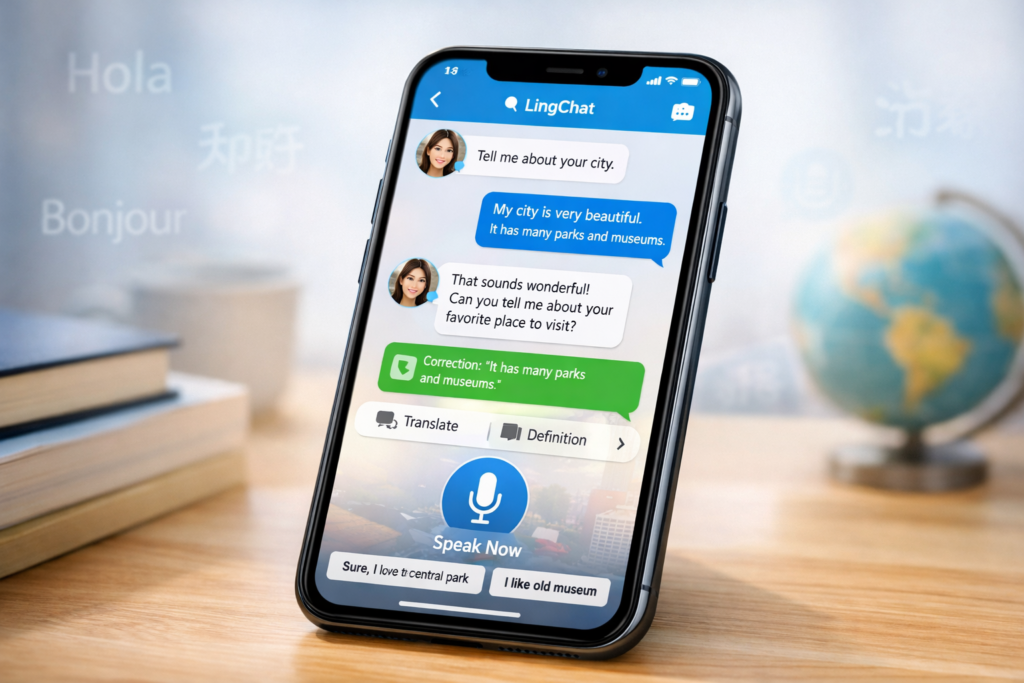
In this LingChat review, I will break down what the app does, who it is best for, where it falls short, how the pricing works, whether it looks legitimate, and whether it is worth trying if your main goal is speaking practice rather than passive study.
Ready to see whether LingChat fits your speaking goals? 👉 Start practicing with LingChat here
Quick Verdict
| Category | Verdict |
| Best for | Learners who want more speaking practice and less passive study |
| Main strength | Conversation-first design with AI support available anytime |
| Extra advantage | Useful in-between option for learners who are not ready for live tutoring all the time |
| Potential downside | Less structured than a full step-by-step language course |
| Good fit for | Beginners, shy speakers, travelers, and learners trying to build fluency |
| Not ideal for | Users who want a rigid curriculum or exam-focused instruction only |
| Overall impression | A practical speaking-practice app with real value for the right learner, but not a perfect replacement for every language learning tool |
What Is LingChat?
LingChat is a language learning app built around conversation practice. Its core appeal is simple: instead of only asking users to memorize, match, or tap through lessons, it tries to create more active speaking and chat-based interaction. The product is aimed at learners who want to practice more often, speak with less hesitation, and reduce the fear that comes from using a new language in real situations.
That matters because many learners hit the same ceiling. They may know basic grammar. They may understand common words. They may even do well in structured lessons. But when it is time to reply quickly in a real conversation, they slow down, panic, or switch back to their native language. A conversation-centered app like LingChat is attractive because it tries to solve that exact problem.
Based on its public positioning, LingChat combines AI-based conversation support with broader language interaction tools. That makes it less like a simple flashcard app and more like a practical speaking companion for learners who want to use the language more actively.
How LingChat Works
The easiest way to understand LingChat is to think of it as a lower-pressure bridge between passive study and real communication. Instead of waiting until you feel “fully ready” to speak, you use the app to practice small conversations more often. That repetition can help reduce hesitation, build familiarity, and make speaking feel less intimidating over time.
For many users, the value is not just the technology itself. It is the reduction in friction. A tutor must be scheduled. A language exchange partner may not always reply. A traditional learning app may feel repetitive after a while. LingChat tries to remove some of those barriers by giving learners a practice environment they can open anytime.
| Common learner problem | How LingChat helps |
| I feel nervous speaking with real people. | AI-based practice can create a lower-pressure environment. |
| I do not know what to say next. | Built-in conversation support helps keep the dialogue moving. |
| I need flexible practice times. | App-based speaking practice is more convenient than scheduling live sessions. |
| I need more real-life language use. | Conversation-focused interaction is more practical than passive drills alone. |
| I worry about mistakes. | Feedback and guidance can reduce uncertainty while practicing. |
LingChat Features at a Glance
👉 [图片占位符 2] 插入一张功能总览图,重点表现 AI 对话、即时纠错、翻译辅助、语言练习。Alt text: LingChat features for AI language speaking practice
| Feature | What it means for users | Why it matters |
| AI conversation practice | Users can practice without waiting for a teacher or exchange partner | Helps make speaking practice more consistent |
| Conversation-first experience | The app emphasizes language use, not just recognition | Better aligned with real speaking confidence |
| Correction and guidance | Users can get help while practicing | Reduces the fear of making mistakes |
| Translation support | Helps users understand and respond more easily | Makes the app more approachable for beginners |
| Word and phrase support | Useful when a learner gets stuck mid-conversation | Keeps the learning flow inside one app |
| Multi-language support | Appeals to learners studying different languages | Broadens the product’s usefulness |
| Flexible, app-based access | Speaking practice can happen in short sessions throughout the day | Consistency is easier than with scheduled learning |
What Makes LingChat Different From Traditional Language Apps?
Many language apps are good at introducing vocabulary, basic grammar, and simple sentence patterns. That is useful, especially at the beginner stage. The problem is that recognition and production are not the same thing. Just because a learner can identify the right answer in a quiz does not mean they can produce a natural response under pressure.
That is where LingChat has a stronger angle. Instead of treating speaking as a later-stage bonus, it puts conversation closer to the center of the experience. For users who already have some basic knowledge but do not feel fluent, this is often more relevant than yet another app full of isolated vocabulary prompts.
| Tool type | Main strength | Main weakness | Best for |
| Traditional language apps | Useful for routine study and vocabulary building | Can feel weak for real speaking confidence | Beginners learning foundations |
| Private tutors | Personalized support and accountability | Higher cost and scheduling friction | Serious learners wanting guidance |
| Language exchange partners | Real conversation exposure | Quality and consistency vary | Learners who want authentic interaction |
| LingChat | Flexible conversation practice with built-in support tools | Less structured than a full formal course | Learners who want more active speaking practice |
What LingChat Does Well
1. It lowers the emotional barrier to speaking
For a lot of learners, the biggest obstacle is not grammar. It is embarrassment. They worry about saying something wrong, sounding slow, or freezing in the middle of a conversation. A conversation app with AI support can make practice feel safer. That is valuable because confidence grows faster when people feel comfortable making mistakes.
2. It encourages active language production
Passive study has limits. Listening, reading, and tapping quiz answers are useful, but they do not fully train the ability to respond in real time. LingChat is more appealing because it pushes users toward actual language use. That can make practice more practical, especially for people who want to speak rather than simply study.
3. It is convenient for short, repeatable practice sessions
Consistency matters more than intensity for most learners. Ten or fifteen minutes of speaking practice each day can be more effective than rare long sessions. App-based practice supports that kind of routine much better than tutor-based systems that require scheduling, preparation, and bigger time commitments.
4. It makes speaking practice feel more approachable
One underrated advantage of conversation apps is that they help users start before they feel fully prepared. That is important because waiting until you feel “ready” often delays real progress. LingChat’s value is not that it removes all difficulty. It is that it makes the first step easier to take.
5. It works well as a supplement
LingChat does not need to replace every other learning resource to be useful. In fact, many users will get the best results by using it alongside a grammar app, a tutor, or other study material. Its role as a speaking-practice layer may be more realistic and more valuable than trying to treat it as a complete one-stop language system.
Where LingChat Is Less Impressive
1. It may not be structured enough for every learner
Some learners want a clearly sequenced course with lessons, checkpoints, and a step-by-step path from beginner to advanced. If that is your style, LingChat may feel looser than expected. A conversation-focused app can be powerful, but it does not always satisfy learners who want heavy structure.
2. Performance matters more in a conversation app
When the product is built around conversation, smooth user experience becomes extremely important. Lag, freezing, or awkward response flow are more frustrating in a speaking app than in a basic vocabulary app. That does not mean the product is bad, but it does mean expectations are higher because the whole experience depends on fluid interaction.
3. It is not a full replacement for every language-learning need
If a learner wants deep grammar instruction, formal exam prep, or a teacher-led path, LingChat alone may not be enough. Its strongest use case is speaking practice and conversation confidence. Users should buy it for that reason, not because they expect it to solve every learning challenge by itself.
4. Trust-sensitive users may want to look at the fine print
As with many digital subscription products, users should review the latest pricing, billing details, and privacy information before paying. This is especially true for anyone who cares a lot about recurring subscriptions, data handling, or mobile app permissions. A good buyer treats this as standard due diligence, not as a reason to panic.
LingChat Pricing: Is It Worth the Money?
Pricing is one of the most important questions in any software or app review, but it also needs to be handled honestly. Mobile app pricing can vary by region, platform, promotion, and plan type. That means the smartest way to discuss value is not just to repeat one number. It is to ask whether the product gives enough practical benefit to justify ongoing use.
LingChat makes the most sense for users who will actually practice regularly. If you use it several times a week, the cost may feel reasonable because you are turning the subscription into real speaking time. If you subscribe and rarely open the app, even a low monthly fee becomes expensive in practice.
| User type | Likely value from LingChat |
| Casual learner | Moderate value if used consistently |
| Shy beginner | High value because low-pressure speaking practice is hard to find elsewhere |
| Traveler preparing for a trip | High value if focused on practical conversation scenarios |
| Intermediate learner | Strong value when speaking is the main weakness |
| Exam-focused learner | Moderate value, but better as a supplement than a full exam solution |
| Tutor-based learner | Useful as extra practice between live sessions |
If you want to check the latest offer before deciding, 👉 [联盟链接占位符 2] Check the latest LingChat plan and pricing here
Is LingChat Legit?
For buyers, legitimacy is about more than marketing language. It is about whether the product looks like a real app ecosystem with actual support, public presence, and an experience that makes sense for the category. On that front, LingChat appears more credible than many thin digital offers that rely only on a single sales page and exaggerated promises.
That does not mean every concern disappears. A fair review should separate “looks like a real product” from “perfect in every detail.” LingChat appears to be a real mobile-first language product with enough public-facing presence to be taken seriously. At the same time, users should still verify the current checkout terms, subscription details, and privacy information for themselves before purchasing.
This balanced way of looking at legitimacy is important because smart readers do not want hype. They want a realistic picture. In that sense, LingChat is easier to trust than a typical empty funnel page, but still worth evaluating carefully as a buyer.
Who Should Use LingChat?
👉 [图片占位符 3] 插入一张适合人群总结图,例如 beginner / traveler / shy speaker / intermediate learner 四类人物卡。Alt text: LingChat best for language learners who want speaking practice
| User type | Is LingChat a good fit? | Why |
| Beginners | Yes | It can make early speaking practice less intimidating |
| Intermediate learners | Yes | Helpful for moving from passive knowledge to active use |
| Travelers | Yes | Useful for practical conversation training before a trip |
| Busy professionals | Yes | Short app sessions are easier to fit into a schedule |
| Shy speakers | Yes | Lower-pressure practice can help build confidence |
| Users wanting a strict curriculum | Not ideal | They may prefer a more structured learning path |
| Users focused only on formal exam prep | Not ideal | They will likely need additional resources |
Who Should Probably Skip It?
- People who want a completely free solution and do not plan to use a paid app consistently
- Learners who strongly prefer structured lesson sequences over flexible conversation practice
- Users who want intensive teacher-led correction at every step
- People looking only for certification or exam preparation tools
- Users who dislike chat-based or roleplay-style learning experiences
This section matters because the best affiliate content does not try to sell the product to everyone. It helps the right buyer decide faster and helps the wrong buyer opt out before disappointment. That approach is better for trust, conversions, and long-term search performance.
LingChat Pros and Cons
| Pros | Cons |
| Conversation-focused approach feels more practical than passive drills alone | May feel less structured than a full course for some learners |
| Good option for users who feel nervous about speaking | Not a complete substitute for tutors, grammar systems, or exam prep |
| Flexible app-based practice is convenient for busy schedules | User experience quality matters a lot in this category |
| Useful as a supplement to other language-learning resources | Subscription value depends heavily on actual usage consistency |
| More credible than many one-page digital language offers | Buyers should still review current pricing and policy details carefully |
How to Get Better Results With LingChat
Even a good product will disappoint people who use it passively. The smartest way to use LingChat is to treat it as a practice environment, not a miracle shortcut. The app becomes much more valuable when it is part of a simple, repeatable routine.
| Best practice | Why it helps |
| Practice daily in short sessions | Consistency builds speaking comfort faster than occasional long sessions |
| Focus on one scenario at a time | Travel, work, introductions, and daily conversation each improve faster with targeted repetition |
| Review corrections after each chat | Feedback is more useful when turned into a habit |
| Repeat similar topics more than once | Fluency comes from reuse, not one-time exposure |
| Keep a note of useful phrases | Saving strong phrases improves retention and makes future chats easier |
| Combine LingChat with another resource | A grammar app, tutor, or reading source can fill gaps LingChat does not fully cover |
How LingChat Compares as a Digital Product
From a broader digital product perspective, LingChat sits in an interesting middle ground. It is not a classic SaaS tool in the business-productivity sense, but it is still a subscription-style digital product with app-based delivery, recurring value, and a clear use case. That makes it a viable product for digital product content sites, especially when positioned around language practice, AI learning tools, or practical self-improvement apps.
For content strategy, this matters. If your site covers digital tools, AI products, learning platforms, and app-based services, LingChat can fit. If your site is narrowly focused on B2B SaaS or business software only, it is more of an edge case. That does not make it bad. It just changes how you should frame the article and which internal links you should use around it.
Final Verdict: Is LingChat Worth Trying?
LingChat is worth considering if your main goal is to speak more often, feel less nervous, and turn passive language knowledge into practical communication. Its biggest advantage is not that it replaces every other learning method. Its advantage is that it reduces the friction that normally stops people from practicing consistently.
That makes it especially appealing for shy learners, travelers, intermediate speakers, and busy users who want short speaking sessions instead of long scheduled lessons. It will not be the perfect fit for every learner, especially those who want a rigid course structure or formal exam preparation. But for conversation-focused practice, it is a product that makes sense and deserves a serious look.
If your main problem is not “I need more vocabulary,” but “I need more speaking practice,” then LingChat is easier to justify than many generic learning apps. And if you are ready to test whether conversation-first practice works better for you, 👉 [联盟链接占位符 3] Try LingChat here and see if it improves your speaking confidence
FAQ
Is LingChat good for beginners?
Yes, especially for beginners who feel nervous about speaking. A conversation-first app can help users start practicing earlier instead of waiting until they feel fully prepared.
Can LingChat replace a language teacher?
Not completely. LingChat works best as a speaking-practice tool or supplement. Some learners will still benefit from tutors, structured courses, or grammar-focused study resources.
Is LingChat better than traditional language apps?
That depends on your goal. If your main goal is speaking confidence, LingChat may feel more practical. If your goal is a rigid learning path with heavy structure, traditional lesson-based apps may still be more suitable.
Is LingChat worth paying for?
It can be, but the answer depends on use. Users who open the app regularly and practice several times a week are much more likely to feel that the subscription is worth it.
Who should not buy LingChat?
People who want only free tools, learners who need a strict exam-prep system, and users who dislike chat-based practice may find other products more suitable.
About the Author
Xu Xun
Contact: xuxun1208@gmail.com
Last Updated: June 2026