
Shockbyte is one of the most recognizable names in game server hosting, especially for Minecraft. For readers comparing hosts, the real question is not simply whether Shockbyte is popular. The better question is whether Shockbyte gives you enough performance, flexibility, ease of use, and value to justify choosing it over other Minecraft server hosting providers or over setting up a VPS yourself.
This review takes a full, decision-focused look at Shockbyte as a hosting platform. Instead of relying on vague marketing language, it breaks the service down into what actually matters for buyers: pricing structure, setup flow, control panel usability, modpack support, server locations, plan flexibility, refund coverage, support experience, and the types of users who are most likely to get good value from it.
For most people, Shockbyte is strongest when you want to launch a Minecraft server quickly, avoid infrastructure complexity, and get a game-hosting-first experience. It is especially appealing for beginners, friend-group servers, community owners, and creators who want to spend more time playing or growing a server and less time configuring Linux, securing ports, or manually assembling a hosting stack.
At the same time, the best Shockbyte review should not stop at the easy positives. A serious buying guide also needs to ask where the platform is less ideal, when a premium plan makes more sense than a budget plan, how much flexibility the control panel really gives you, and whether Shockbyte is the right fit for modded Minecraft, public communities, or multi-game server buyers.
By the end of this article, you should know exactly what Shockbyte is good at, where it has trade-offs, and whether it deserves a place on your shortlist.
Quick Verdict
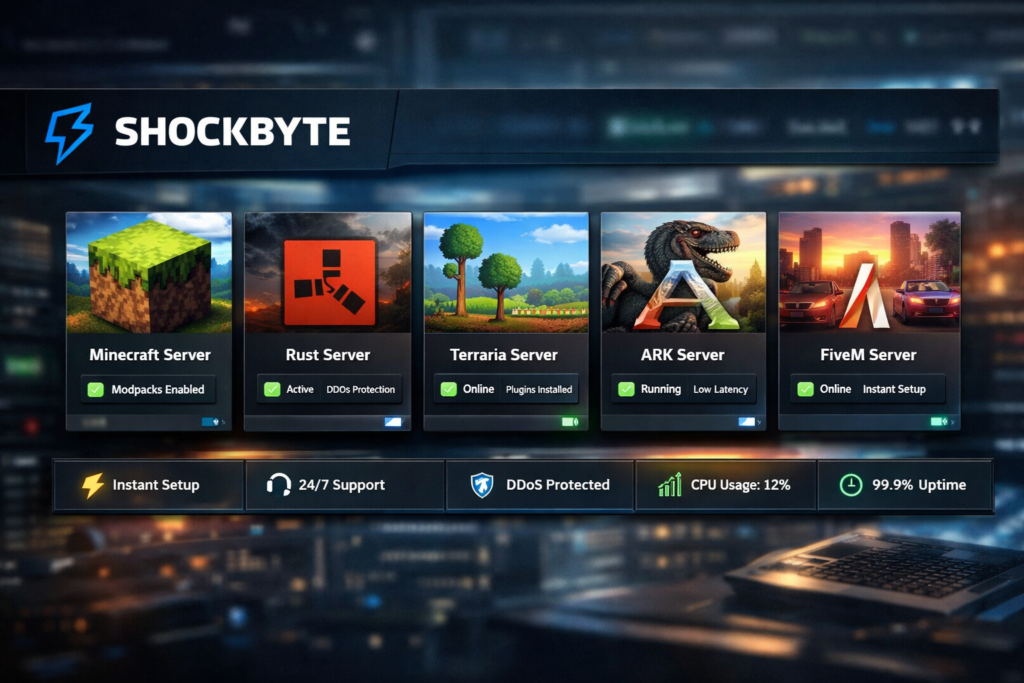
Shockbyte is a strong choice for users who want straightforward game server hosting with a clear focus on Minecraft and other popular multiplayer games. It combines beginner-friendly onboarding, fast deployment, DDoS protection, global regions, modpack support, and a newer custom control panel that is much closer to a purpose-built game management platform than a generic web hosting dashboard.
It is not the best option for every type of buyer. If your main priority is full operating-system control, unusual backend customization, or building a broader self-managed infrastructure stack, then a VPS or dedicated server can make more sense. But for the majority of readers searching for a reliable way to host Minecraft with less friction, Shockbyte is easier to recommend than unmanaged infrastructure.
| Category | Verdict |
|---|---|
| Ease of setup | Excellent |
| Minecraft hosting suitability | Excellent |
| Modded server readiness | Strong |
| Budget entry pricing | Strong |
| Control panel usability | Strong |
| Global regions | Good |
| Support resources | Strong |
| Best for | Beginners, private servers, modded players, small communities, creators |
| Less ideal for | Users who want full root-level infrastructure freedom |
What Is Shockbyte?
Shockbyte is a specialist game server hosting company that began in 2013 and built much of its early reputation around Minecraft hosting. Over time, it expanded into a broader game server platform, supporting dozens of titles rather than focusing on Minecraft alone. That wider game library is important because it makes Shockbyte more than a single-purpose Minecraft host. It also gives the company a stronger brand position for users who may want to host more than one type of game over time.
Still, Minecraft remains the clearest center of gravity in its public positioning. Many of Shockbyte’s strongest features, tutorials, marketing pages, and control panel improvements are framed around Minecraft server owners. That is not a weakness. In fact, for readers looking specifically for Minecraft hosting, it is one of the platform’s biggest strengths. A host that deeply understands the core use case usually converts better than one that spreads itself too thin across unrelated services.
That specialization shows up in several ways: separate budget and premium Minecraft plans, support for both Java and Bedrock server types, one-click installation for common server software, modpack-focused tooling, and a knowledge base built around real server management tasks. When you evaluate a host through the lens of buyer experience rather than only raw specs, that focus matters a lot.
Why Shockbyte Stands Out in the Minecraft Hosting Market
There are many hosts that rent Minecraft servers. Fewer hosts package the experience well enough for beginners while still leaving enough room for growth. That is where Shockbyte has a practical advantage. It does not just sell memory and storage. It sells a more guided, game-specific hosting workflow.
From a conversion perspective, that is what makes the platform easier to market. New buyers often do not know how much RAM they need, what server type they should install, whether they need Java or Bedrock compatibility, or how to upload worlds and manage plugins safely. Shockbyte reduces those barriers by combining guided hosting plans with familiar game-server tools.
| Key Differentiator | Why It Matters |
|---|---|
| Budget and premium Minecraft tiers | Lets users choose between low-cost entry and higher-performance plans without switching providers immediately |
| New custom control panel | Makes ongoing server management easier than relying only on legacy tools |
| Modpack and plugin support | Important for readers who want more than a basic vanilla server |
| Instant setup | Reduces time between purchase and first login |
| Global locations | Helps match server region to player base for better latency |
| 72-hour refund coverage | Lowers the risk of trying the platform |
| Large knowledge base | Useful for troubleshooting and beginner self-service |
That combination is one reason Shockbyte often appeals to first-time server owners. It feels closer to a finished hosting product than a bare rental container that expects the user to figure everything out alone.
Shockbyte Pricing: Budget vs Premium Minecraft Plans
One of the best parts of Shockbyte’s Minecraft offering is that it does not force every user into the same pricing ladder. The company separates Minecraft into budget and premium tracks. That matters because not every buyer has the same needs. A private survival server for a few friends should not be priced like a busier modded or community-oriented server.
The budget line is designed to lower the entry barrier. The premium line is positioned for users who need more performance headroom, larger plan sizes, and a broader path upward. For affiliate content and SEO content alike, this is a strong structure because it lets the article serve both budget-focused readers and more serious server buyers.
Budget Minecraft Plan Snapshot
| Plan | RAM | Public Monthly Price | Best For |
|---|---|---|---|
| Casual | 1GB | $1.99 | Very small private server |
| Survivor | 2GB | $3.99 | Small friend group |
| Explorer | 3GB | $5.99 | Small survival world |
| Warrior | 6GB | $11.99 | More active server or lighter mod usage |
| Mage | 8GB | $15.99 | Larger private groups or more demanding setups |
Premium Minecraft Plan Snapshot
| Plan | RAM | Public Monthly Price Before First-Month Promo | Best For |
|---|---|---|---|
| Dirt | 1GB | $3.99 | Entry-level premium hosting |
| Sand | 2GB | $7.99 | Small always-on server |
| Cobblestone | 3GB | $11.99 | Small plugin or starter modded setups |
| Iron | 4GB | $15.99 | Growing private server |
| Gold | 5GB | $19.98 | Mid-range server needs |
| Redstone | 6GB | $23.99 | Growing communities |
| Diamond | 7GB | $27.99 | Heavier plugin load |
| Emerald | 8GB | $31.99 | More demanding modded play |
| Obsidian | 9GB | $35.99 | Large private servers |
| Spartan | 10GB | $39.99 | Large server owners |
| Zeus | 12GB | $47.99 | High-demand public servers |
| Custom Plan | From 17GB | $67.83 | Advanced scaling needs |
The pricing structure above makes Shockbyte easier to recommend than hosts that offer only a single generic ladder. Readers can start smaller, test the platform, and move upward later. That is especially valuable when buyers are not yet sure how many players will be active, whether they will use mods, or how much performance their specific configuration needs.
It is also worth noting that Shockbyte runs visible promotional discounts on some plan pages. Because discounts can change over time, the safest long-term editorial approach is to present a current snapshot and encourage readers to verify the checkout price before buying.
What You Actually Get With Shockbyte
Pricing only matters if the service behind it is useful. Shockbyte’s value comes from the convenience layer it wraps around game hosting. Instead of asking users to build everything manually, it packages the kinds of tools server owners repeatedly need: quick deployment, file access, modpack installation, backups, real-time console access, analytics, support, and DDoS protection.
| Feature | Why Buyers Care |
|---|---|
| Instant setup | You can begin much faster after purchase |
| DDoS protection | Important for public or visible servers |
| 24/7 support | Useful when setup or plugin issues happen outside your own time zone |
| Free subdomain | Makes sharing your server address easier |
| Backups | Reduces risk when updating worlds, plugins, or configs |
| Real-time console | Helps with monitoring, commands, and troubleshooting |
| Modpack installer | Important for modded Minecraft players |
| Server instances | Useful for switching between different setups |
| Config manager | Makes adjustments less painful for non-technical users |
| Knowledge base | Improves self-service and cuts support dependency |
The biggest practical benefit here is reduced friction. That may sound less exciting than CPU specifications, but for many buyers it matters more. Most people searching for a host are trying to remove operational headaches. Shockbyte performs well on that dimension because it is built around hosting games, not around forcing users to behave like infrastructure engineers.
The Shockbyte Control Panel: One of the Strongest Reasons to Choose It
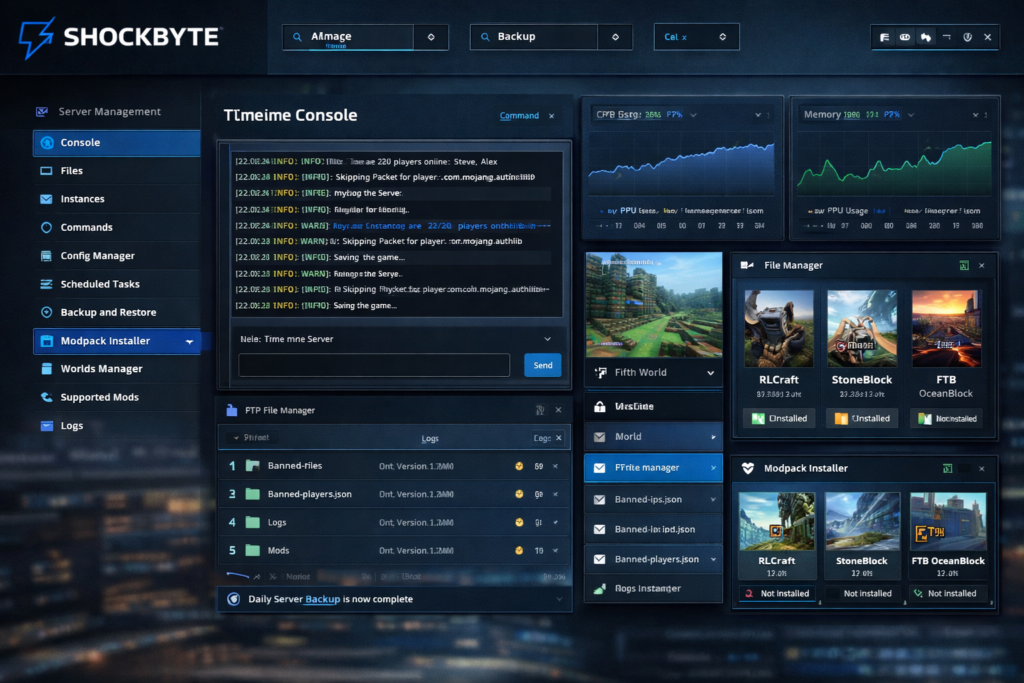
The newer Shockbyte Control Panel is one of the platform’s clearest selling points. Older game-hosting experiences often feel dated, fragmented, or too dependent on external tools for simple tasks. Shockbyte’s newer panel is designed to fix that by bringing more of the day-to-day workflow into one place.
Several features matter especially from a buyer perspective. The real-time console gives server owners a much smoother way to see logs, run commands, and diagnose problems quickly. The modpack installer reduces the friction of launching supported modded setups. The file manager is designed to make file operations more approachable, which is useful for users who would rather not jump into external FTP tools every time they need to edit something. The panel also includes backups, config tools, analytics, and server instances that make it easier to switch between different worlds or server setups.
Server Instances deserve special mention because they can simplify experimentation. A user who wants to test different environments, run separate setups, or swap between a lighter vanilla experience and a modded experience can do so more efficiently than rebuilding from zero every time. That is a meaningful workflow improvement rather than a superficial feature.
For beginners, the biggest win is usability. For more experienced admins, the win is speed. In both cases, a better control panel reduces the amount of energy spent on repetitive maintenance.
Shockbyte for Minecraft Hosting: Is It Actually Good?
Yes, and this is where the platform makes the most sense. Shockbyte’s Minecraft offering is broad enough for several different types of users. It supports Java and Bedrock server types, common server software such as Paper, CraftBukkit, Forge, and Vanilla, and modded ecosystems including CurseForge, Feed The Beast, Technic, and ATLauncher. That support range gives it far more utility than a host that only targets vanilla Minecraft.
For many readers, the appeal comes down to how much work they want to do themselves. Shockbyte is good because it removes setup friction while still leaving room for customization. You can upload worlds, manage plugins, work with configs, and run more advanced setups without needing to rent a blank VPS and build every piece yourself.
This makes Shockbyte a particularly good fit for:
- first-time Minecraft server owners who want an easier start
- friend-group servers that need fast setup and simple management
- modded players who want supported installation paths
- creators building small or mid-sized communities
- server admins who want a smoother panel instead of a bare infrastructure rental
Where it becomes less ideal is when a buyer wants maximum operating-system-level control, non-standard backend tooling, or a highly customized hosting environment beyond the normal scope of game server hosting. For those cases, the convenience layer may feel limiting rather than helpful.
Performance, Hardware, and Server Locations
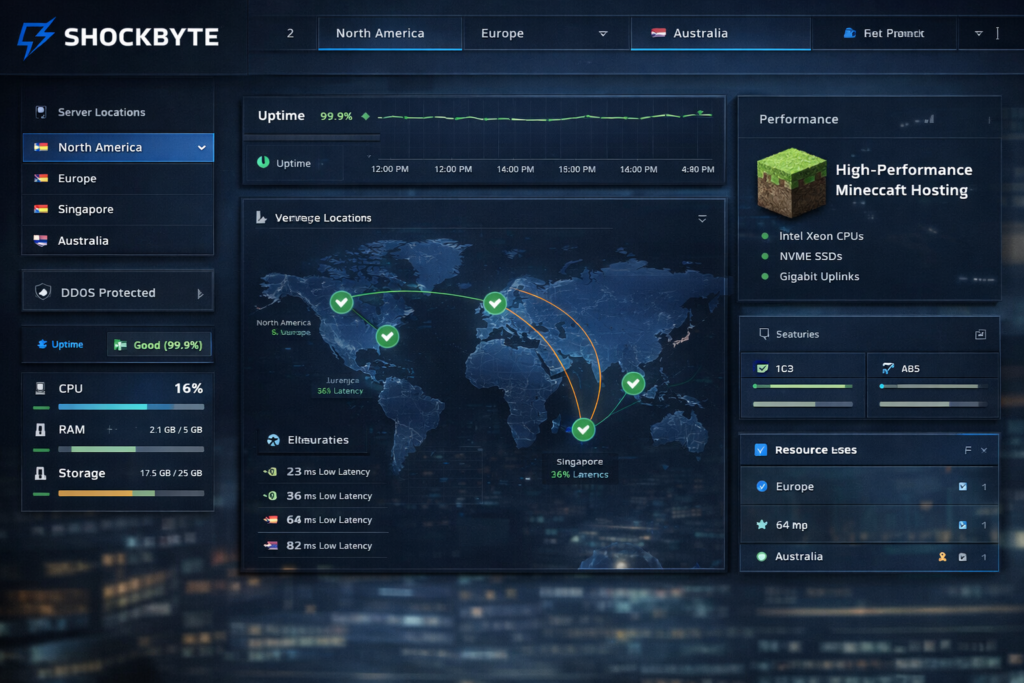
Shockbyte’s public Minecraft pages emphasize performance-oriented hardware, including AMD EPYC CPU specifications on current premium Minecraft pages, NVMe SSD storage, and always-on DDoS protection. For buyers, what matters most is not just the headline hardware language but the practical result: smoother gameplay, fewer resource bottlenecks, and stronger chances of handling plugins or modpacks without the server feeling weak at the worst possible times.
The platform also markets strong uptime on its Minecraft pages and ties service interruptions to an SLA. For most buyers, that combination is enough to create confidence, though the best way to use this in an editorial article is as part of a broader evaluation rather than as the only proof of quality.
On locations, Shockbyte gives users access to regions including North America, Europe, Singapore, and Australia. Region choice matters because low latency is one of the fastest ways to improve real-world server experience. The best location is usually the one geographically closest to the bulk of your player base, not necessarily the one you personally prefer by brand or country.
| Infrastructure Area | What It Means for Buyers |
|---|---|
| AMD EPYC positioning on premium pages | Better appeal for performance-conscious Minecraft users |
| NVMe SSD storage | Better storage responsiveness than older SATA-based expectations |
| DDoS protection | Useful for public-facing servers and community visibility |
| Multiple regions | Helps users match server to player geography |
| Upgradeable plans | Easier to scale than migrating immediately to another provider |
Support, Refunds, and Buyer Risk
Support matters more in game hosting than in many other digital services because problems are time-sensitive. If your server crashes before a planned session, a world upload fails, or a modpack breaks after an update, support quality becomes part of the actual product experience. Shockbyte emphasizes 24/7 support across its main marketing pages and Minecraft pages, which is a strong selling point for buyers in different time zones.
Shockbyte also backs its offering with a 72-hour refund policy for new services, subject to the conditions in its terms. That does not mean every refund scenario is automatic or unconditional, but it does lower the risk for first-time customers who want to test the platform. The existence of a self-serve refund option on recent support pages also signals that Shockbyte wants the trial experience to feel easier and less intimidating.
Buyers should still read the terms carefully. The refund policy has conditions, including time limits, eligibility rules, and cases that can void eligibility. That is normal, but it is still worth understanding before purchase.
Shockbyte Pros and Cons
Pros
- Strong Minecraft specialization
- Separate budget and premium plan paths
- Beginner-friendly onboarding
- Modern control panel features
- Support for Java, Bedrock, plugins, and modpacks
- Global locations including Singapore and Australia
- Instant setup and useful built-in tools
- 72-hour refund policy for new services
- Large support and knowledge base library
Cons
- Less flexible than running your own VPS or dedicated server
- Higher-end needs can push you toward premium pricing faster
- Some advanced users may outgrow a managed game-hosting workflow
- Promotional pricing can make quick comparisons harder if discounts change
- Best experience is tied to Shockbyte’s ecosystem rather than raw infrastructure freedom
Who Should Use Shockbyte?
| User Type | Should You Consider Shockbyte? | Why |
|---|---|---|
| First-time Minecraft server owner | Yes | Easy setup, beginner-friendly tools, support, and refund coverage |
| Friend-group survival server | Yes | Budget plans make it easier to start affordably |
| Modded Minecraft player | Yes | Broad support for server types and modpack tooling |
| Creator or small community owner | Yes | Good balance of usability and growth path |
| Large, performance-sensitive public network | Maybe | Can work, but plan choice becomes more important and custom infrastructure may eventually appeal |
| Advanced sysadmin wanting full control | No, not usually | A VPS or dedicated server will usually fit better |
Shockbyte vs Using a VPS for Minecraft Hosting
Many readers ask whether they should use a specialized host like Shockbyte or simply rent a VPS. The answer depends on what kind of trade-off you want.
| Area | Shockbyte | Typical VPS |
|---|---|---|
| Initial setup | Much easier | More technical |
| Game-focused tools | Built in | Usually manual |
| Modpack workflow | Simpler | Often manual |
| Control panel | Game-oriented | Usually generic or self-installed |
| Infrastructure freedom | Lower | Much higher |
| Beginner suitability | Higher | Lower |
| Time to launch | Faster | Slower |
The reason many buyers still choose Shockbyte is simple: convenience has real value. Even if a VPS can be more flexible, it often costs more time, more attention, and more room for setup mistakes. For readers who care more about launching and managing a server smoothly than about absolute infrastructure control, Shockbyte is often the smarter practical choice.
Is Shockbyte Good Value for Money?
For the right buyer, yes. Shockbyte offers strong value because it does not ask you to pay only for raw hardware. It bundles the kind of management, convenience, and support that many players would otherwise have to recreate through separate tools or manual work. That makes the service especially compelling for users who want a low-friction path into Minecraft or other game server hosting.
The strongest value cases are usually small-to-mid-sized servers where ease of management matters almost as much as technical performance. On the lowest end, budget plans reduce entry cost. On the higher end, premium plans provide a path for users who need more RAM and stronger performance positioning without abandoning the ecosystem right away.
Where the value proposition becomes more nuanced is at larger scale. As resource needs rise, some buyers begin comparing managed game-hosting convenience against custom infrastructure freedom. That is where your priorities matter most. If you still want simplicity, Shockbyte remains attractive. If you want full control over the stack, a VPS or dedicated server becomes more competitive.
Final Verdict: Should You Use Shockbyte?
Shockbyte is easy to recommend for users who want a practical, game-focused hosting experience instead of a do-it-yourself infrastructure project. It is particularly strong for Minecraft, where its product depth, plan structure, modpack support, control panel, and support resources align well with what real server owners usually need.
The platform is not trying to be everything. It is trying to make game server hosting easier, faster, and more approachable. In that role, it performs well. That is why Shockbyte remains one of the more sensible options for readers who want to get online quickly, manage their servers without unnecessary friction, and keep the door open to upgrades later.
If your goal is to run a Minecraft server with less hassle, good region coverage, support for mods and plugins, and a platform that was clearly designed around game hosting rather than generic cloud rental, Shockbyte deserves a serious look.
Frequently Asked Questions
Is Shockbyte good for beginners?
Yes. Shockbyte is one of the more beginner-friendly options in the game server hosting space because it combines instant setup, guided Minecraft plans, a game-focused control panel, and a large support library. That makes it much easier to approach than a self-managed VPS if you are new to server hosting.
Does Shockbyte support modpacks and plugins?
Yes. Shockbyte supports common Minecraft server software, plugins, and multiple modded ecosystems, making it suitable for far more than basic vanilla gameplay.
Can I use Shockbyte for Bedrock and Java?
Yes. Shockbyte markets support for both Java and Bedrock server hosting, which is useful for readers who are not sure which version they want to run or who may want version flexibility later.
Does Shockbyte have a refund policy?
Yes. Shockbyte offers a 72-hour refund policy for new services, subject to the conditions in its terms and refund rules. That gives first-time buyers a lower-risk way to test the platform.
Does Shockbyte have an affiliate program?
When should I choose budget plans instead of premium plans?
Budget plans make the most sense for small private servers, lighter usage, and users who want the lowest-cost starting point. Premium plans are more appropriate when you expect heavier activity, larger groups, or more demanding setups that benefit from stronger performance positioning and a broader upgrade path.
About the Author
Xu Xun
Contact: xuxun1208@gmail.com
Last Updated: June 2026